Introduction
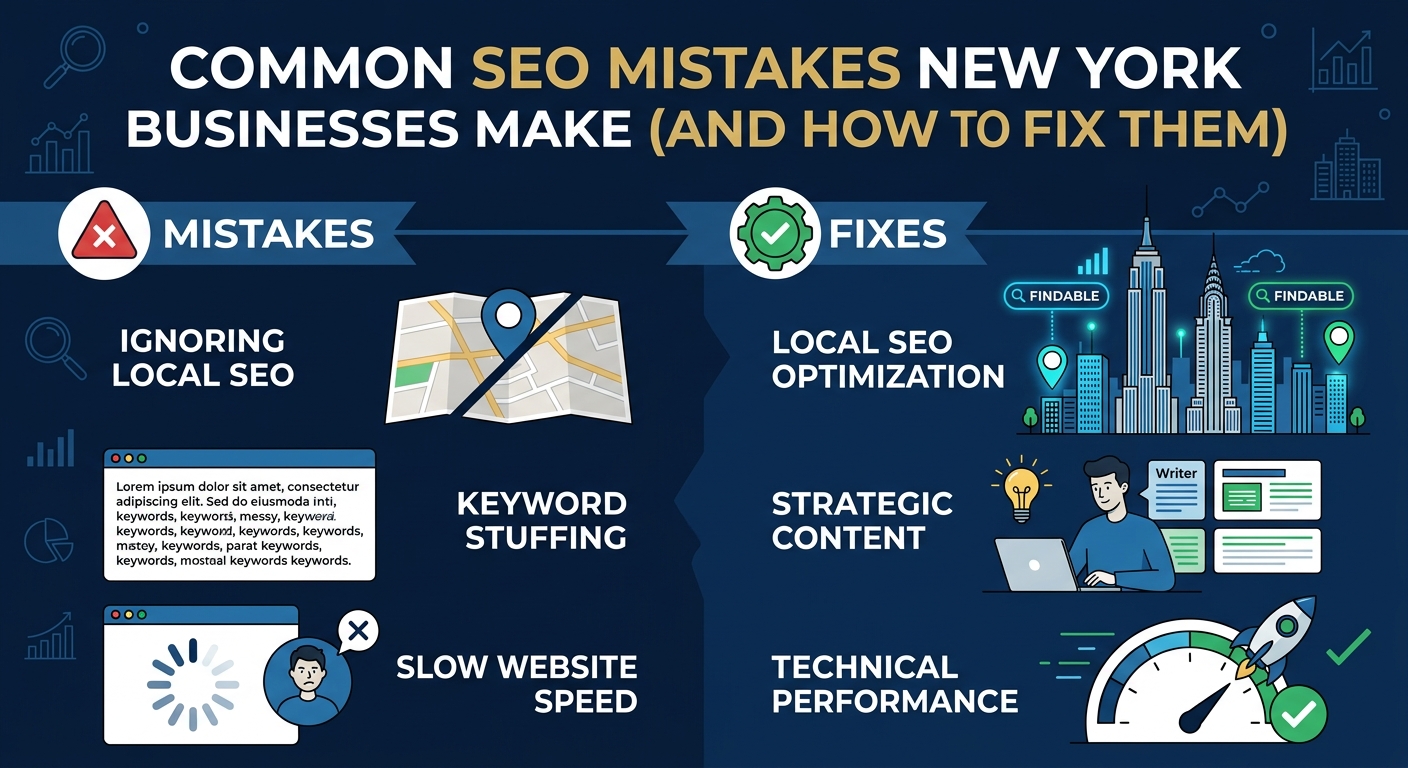
New York is one of the most competitive search markets in the world, and businesses of every size are fighting for the same customers online. A bakery in Queens, a law firm in Manhattan, and a plumber in Brooklyn all depend on search visibility to bring in steady leads. Yet many of them lose ground because of avoidable errors that quietly damage their rankings month after month.
The good news is that most SEO mistakes follow predictable patterns, which means they can be spotted and corrected with the right approach. Owners often assume that poor results come from a lack of budget or luck, when the real cause is usually a handful of overlooked basics. Fixing those basics can unlock traffic that was always within reach.
This guide walks through the most common mistakes seen on New York business websites and explains how to repair each one in practical terms. You will find clear examples, simple checklists, and comparison tables that make the fixes easy to follow. By the end, you will know exactly where your own site may be losing visitors and what to do about it.
Why SEO Mistakes Cost New York Businesses So Much
In a city with millions of residents and thousands of competing companies, the gap between page one and page two of search results is enormous. Most searchers never scroll past the first few listings, so a business that ranks poorly is effectively invisible. Every mistake that pushes a page lower in the results has a direct effect on calls, bookings, and sales.
New York also has a unique search landscape because customers search by borough, by neighborhood, and even by subway line. A person looking for a dentist in Astoria expects different results from someone searching in the Financial District. Businesses that ignore these local details often miss the exact customers who are ready to buy.
Competition adds another layer of pressure. Rivals in this market frequently invest in professional SEO, which raises the standard that every website must meet to be noticed. A site with outdated pages, slow loading, or weak content can fall behind quickly even if it once ranked well.
The table below shows how common mistakes translate into real business costs.
| Common Mistake | What Happens in Search | Business Impact |
|---|---|---|
| Ignoring local signals | Business rarely appears in map results | Fewer calls from nearby customers |
| Wrong keyword targets | Traffic arrives with no buying intent | Low conversion and wasted effort |
| Slow mobile pages | Visitors leave before the page loads | High bounce rate and lost leads |
| Thin or copied content | Pages struggle to rank | Little organic growth |
| No tracking in place | Owners cannot see what works | Poor decisions and wasted budget |
Ignoring Local SEO Fundamentals
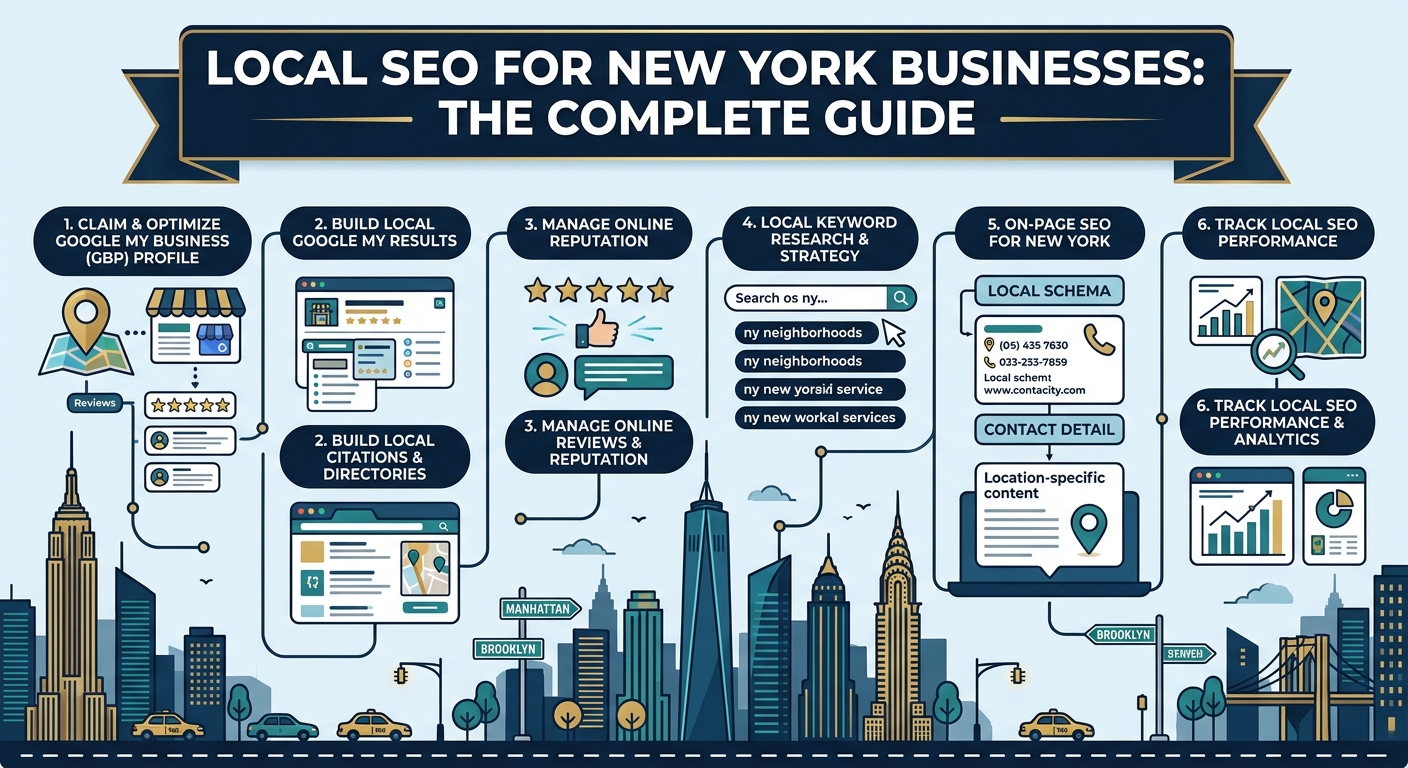
Local search is the lifeblood of most New York businesses, yet it is also the area where mistakes are most common. Many owners build a website and assume that customers will simply find it, without ever claiming or completing their business profile on the main map platform. As a result, their company is missing from the map results that appear at the top of local searches.
Inconsistent business information is another frequent problem. A company might list one phone number on its website, a different one on social media, and an old address on a directory. Search engines compare these details across the web, and mismatches reduce their confidence that the business is real and active.
Common local SEO mistakes include the following:
- Leaving the business profile unclaimed or only partly filled in.
- Using different names, addresses, or phone numbers across listings.
- Choosing the wrong business categories for the main profile.
- Having no dedicated pages for the boroughs or neighborhoods served.
- Never uploading fresh photos or posting updates to the profile.
Fixing these issues starts with a simple audit of every place your business appears online. Make a master record of your exact name, address, and phone number, and then update every listing so that it matches perfectly. Complete every field in your business profile, choose precise categories, and add clear photos of your location, team, and work.
Next, create dedicated pages for each area you serve, and make each one genuinely useful rather than a copy of the others. Include local details such as neighborhood landmarks, building types, or common customer needs in that area. Real stories from nearby clients make these pages far more convincing to both visitors and search engines.
Targeting the Wrong Keywords
Choosing keywords is one of the most important decisions in any SEO project, and it is where many New York businesses go wrong. A common error is aiming for very broad terms such as lawyer or restaurant, which are dominated by large brands and directories. These searches also tend to attract casual browsers who are not ready to hire or buy.
Another mistake is choosing keywords based on personal guesses instead of real search behavior. Owners often use industry language that customers never type into a search box. A contractor may write about fenestration upgrades while homeowners are actually searching for window replacement costs in their neighborhood.
Some businesses also make the opposite error by targeting terms that are too narrow to bring any meaningful traffic. Others place the same keyword on many pages, which causes their own pages to compete against each other. This confusion makes it harder for search engines to decide which page deserves to rank.
The table below compares weak keyword choices with stronger alternatives for a New York service business.
| Weak Keyword Approach | Stronger Alternative | Why It Works Better |
|---|---|---|
| Plumber | Emergency plumber in Brooklyn | Matches location and urgent intent |
| Best dentist | Family dentist accepting new patients in Astoria | Specific and ready to book |
| Accountant | Small business accountant in Midtown Manhattan | Clear audience and area |
| Renovation ideas | Apartment renovation cost in New York | Signals budget research and buying stage |
| Lawyer | Tenant rights attorney in Queens | Focused on a real legal need |
To fix keyword problems, begin by listing the questions your customers ask before they contact you. Look at the exact words they use on the phone, in emails, and in reviews, because those phrases often reveal valuable search terms. Group the keywords by intent, and assign each group to one page so that your pages support rather than compete with each other.
Focus first on terms that combine a service, a location, and a clear need. These searches usually have lower volume than broad terms, but they bring visitors who are far more likely to convert. Review your rankings every month, and adjust your plan when a keyword performs better or worse than expected.
Neglecting Mobile Experience and Page Speed
Most searches in New York happen on phones, often while people are commuting, walking, or comparing options on the go. A website that loads slowly or looks awkward on a small screen loses visitors within seconds. Many business owners still review their site only on a desktop computer, so they never notice how frustrating it feels on mobile.
Speed problems usually come from a few predictable causes. Large uncompressed images, too many scripts, heavy design elements, and cheap hosting can all slow a page down. Search engines also measure how stable and responsive a page feels, so layout jumps and delayed buttons can hurt rankings as well.
Mobile design mistakes go beyond speed. Tiny text, buttons placed too close together, pop ups that cover the content, and phone numbers that cannot be tapped all push potential customers away. A visitor who cannot call you in one tap will often choose a competitor instead.
The most common mobile and speed mistakes include the following:
- Uploading full size photos without compressing them.
- Using pop ups that block the main content on small screens.
- Hiding the phone number or contact button below the fold.
- Loading unnecessary plugins and tracking scripts on every page.
- Choosing a hosting plan that cannot handle regular traffic.
Fixing these problems begins with testing your site on a real phone using a normal mobile connection. Compress every image, remove plugins that you no longer use, and choose a reliable hosting plan with fast response times. Place a tappable call button and a short contact form near the top of every important page.
After the first round of fixes, test your pages again and track the results over time. Faster pages tend to keep visitors longer, which improves both rankings and conversion rates. Treat speed as an ongoing habit rather than a one time task, because every new page or feature can slow your site down again.

Thin and Duplicate Content Problems
Content is the backbone of any SEO strategy, yet many New York business websites are filled with pages that say very little. A service page with only a few short sentences gives search engines almost nothing to evaluate and gives visitors no reason to trust the company. Pages like this rarely rank, and they rarely convince anyone to pick up the phone.
Duplicate content is just as damaging and far more common than most owners realize. Some businesses copy the same description across every location page and simply swap the neighborhood name. Others reuse manufacturer text or paste material from older versions of their own site, which leaves search engines unsure which page deserves to appear.
Thin and duplicate content often appears in these forms:
- Service pages with fewer than 300 words and no real detail.
- Location pages that are identical except for the area name.
- Product or service descriptions copied from suppliers or other websites.
- Several blog posts covering the same topic with slightly different titles.
- Old pages left online with outdated prices, offers, or contact details.
The fix begins with a content audit of every page on your site. Decide whether each page should be improved, merged with a similar page, or removed. Pages that cover the same topic should usually be combined into one stronger resource, with the old address redirected to the new one.
When rewriting service pages, answer the questions that buyers actually ask. Explain what the service includes, how the process works, what it typically costs, and how long it takes. Add real photos, short client quotes, and a clear call to action so the page helps people decide.
For location pages, include details that only apply to that area, such as local building types, common customer needs, nearby landmarks, and real projects completed there. This makes each page genuinely different and far more useful to both visitors and search engines. A smaller number of strong pages will always outperform a large collection of weak ones.
Weak Title Tags and Meta Descriptions
Title tags and meta descriptions are the first things people see in search results, so they act like a shop window for your website. Many New York businesses waste this valuable space with vague titles such as Home or Welcome to Our Website. These titles tell neither searchers nor search engines what the page is about.
Another common error is stuffing titles with repeated keywords in an attempt to rank higher. A title that reads like a list of search terms looks spammy and discourages clicks. Titles that are too long are also cut off in the results, which hides the most important words.
Meta descriptions suffer from similar problems. Some are missing entirely, so search engines choose random text from the page. Others are copied across many pages, which makes every listing look identical and reduces the chance that anyone will click.
The table below compares weak and strong approaches for a typical New York business.
| Page Type | Weak Example | Stronger Example |
|---|---|---|
| Homepage | Home | Trusted Family Dentist in Astoria, Queens, Book Online Today |
| Service Page | Our Services | Emergency Plumbing in Brooklyn, Fast Response and Upfront Pricing |
| Location Page | Manhattan | Accountant in Midtown Manhattan for Small Business Owners |
| Blog Post | New Blog Post | How Much Does an Apartment Renovation Cost in New York |
| Contact Page | Contact | Contact Our Brooklyn Office, Call or Book a Free Consultation |
To fix these issues, write a unique title for every important page, and place the main service and location near the beginning. Keep titles within a length that displays fully in search results, and make sure each one gives a clear reason to click. Avoid repeating the same word several times, and write for people first.
Meta descriptions should summarize the page in a natural and inviting way. Mention a key benefit, include a gentle call to action, and keep the description unique for each page. Although descriptions do not directly raise rankings, a compelling one can increase clicks, and more clicks send positive signals about the page.
Review your titles and descriptions every few months, especially for pages that already rank on the second page. A small improvement in wording can sometimes move a listing into a stronger position. This is one of the fastest and cheapest fixes available to any business.
Poor Site Structure and Internal Linking
A confusing website is hard for both visitors and search engines to navigate. Many New York business sites grow over the years without a clear plan, which leads to pages scattered in random places and menus packed with too many options. Important service pages end up buried several clicks away from the homepage, where they receive little attention.
Internal links are the pathways that connect your pages and pass authority between them. When they are missing, even excellent pages can remain hidden because search engines struggle to discover them. Orphan pages with no links pointing to them are a particularly common problem on older sites.
Frequent structure and linking mistakes include the following:
- Placing key service pages deep within the site.
- Using menus with too many items and unclear labels.
- Leaving valuable pages without any internal links pointing to them.
- Using vague link text such as click here instead of descriptive words.
- Creating long chains of redirects that slow down the experience.
A strong structure starts with a clear hierarchy. The homepage should link to main service categories, each category should link to individual services, and each service should connect to related guides, projects, and location pages. Every important page should be reachable within two or three clicks from the homepage.
Use descriptive link text that tells readers what they will find. A phrase such as kitchen remodeling costs in Brooklyn gives both people and search engines far more information than a generic prompt. Link from your best performing pages to newer pages that need a boost, and add a few related links at the end of every article.
Breadcrumb navigation also helps visitors understand where they are and move easily between sections. Review your structure whenever you add new services or locations so that the site stays organized as it grows. A tidy structure makes every other SEO effort more effective.
Overlooking Technical SEO Basics
Technical problems often hide beneath the surface, so many owners never realize they exist. A site can look attractive and still contain errors that prevent search engines from crawling or understanding its pages. These issues quietly limit rankings no matter how good the content might be.
One frequent mistake is leaving broken pages and dead links on the website. Visitors who land on an error page usually leave immediately, and search engines see these errors as a sign of poor maintenance. Another common problem is blocking important pages from search engines by accident, often during a website redesign.
Other technical oversights are surprisingly common in the New York market. Some sites run on both secure and insecure versions of the same address, which splits their authority. Others lack a sitemap, use confusing address structures, or have no structured data to help search engines understand reviews, services, and business details.
The table below summarizes common technical mistakes and the practical fix for each.
| Technical Mistake | Why It Hurts | How to Fix It |
|---|---|---|
| Broken pages and links | Wastes authority and frustrates visitors | Redirect to the closest relevant page |
| Pages blocked by accident | Search engines cannot index them | Review indexing rules after every redesign |
| Mixed secure and insecure versions | Splits ranking signals | Redirect everything to one secure version |
| Missing sitemap | Slows discovery of new pages | Create and submit a clean sitemap |
| No structured data | Fewer rich results in search | Add markup for business, reviews, and services |
The best way to catch these problems is to run a full technical crawl of your website at least once every month. Fix the most serious errors first, such as blocked pages and broken links on important URLs. Then work through smaller issues such as duplicate titles, missing descriptions, and unnecessary redirects.
Always review technical settings before and after a website redesign or migration. Many businesses lose a large share of their traffic overnight because old addresses were not redirected properly. A careful checklist during any major change protects the rankings you have already earned.
Ignoring Reviews and Reputation Signals
Reviews play a major role in how New York customers choose businesses and how search engines rank them. Shoppers often compare ratings before they even visit a website, so a weak reputation can lose customers before they ever reach you. Businesses with many recent and positive reviews tend to appear more often in local map results.
Many owners make the mistake of never asking for reviews. They assume that happy customers will leave feedback on their own, but most people need a gentle reminder. As a result, businesses with excellent service often have far fewer reviews than competitors who simply ask.
Handling negative reviews poorly is another costly error. Ignoring complaints or replying defensively makes the business look careless to future customers. A calm and helpful response, on the other hand, shows that you take feedback seriously and care about solving problems.
Common reputation mistakes include the following:
- Never asking satisfied customers to leave a review.
- Ignoring negative feedback or replying in an angry tone.
- Spreading reviews across too many platforms with no focus.
- Failing to display reviews on the business website.
- Buying or faking reviews, which can lead to penalties and lost trust.
To fix this, create a simple process for requesting reviews shortly after each completed job or sale. Send a short message with a direct link so that leaving feedback takes only a few seconds. Train your team to mention reviews politely at the end of every successful interaction.
Reply to every review, whether positive or negative, using a warm and professional tone. Thank happy customers by name, and address complaints by acknowledging the issue and offering a clear next step. These replies are visible to everyone and often influence new customers more than the original review.
Finally, display your best reviews on your service pages and homepage so that visitors see proof of your quality right away. Add structured data where possible so that your ratings can appear in search results. A steady flow of authentic reviews builds trust, supports local rankings, and turns more visitors into paying customers.

Building Low Quality Backlinks
Backlinks remain one of the strongest signals of trust, but the quality of a link matters far more than the quantity. Many New York businesses fall into the trap of buying cheap link packages that promise hundreds of links for a small fee. These links usually come from irrelevant or spammy websites, and they can trigger penalties that take months to repair.
Another common mistake is relying only on generic directories with no connection to the business or the local market. A handful of links from respected neighborhood publications, industry associations, and local partners will outperform hundreds of random listings. Search engines look at relevance and reputation, not just the total number of links.
Some businesses also ignore the links they already have. Old partnerships, press mentions, and sponsorships may have produced valuable links that now point to broken pages. Others never check for harmful links that could be dragging their site down.
Common link building mistakes include the following:
- Buying bulk link packages from unknown sellers.
- Exchanging links with unrelated websites on a large scale.
- Using the same exact keyword phrase as the link text again and again.
- Ignoring broken pages that still receive valuable links.
- Never reviewing the overall quality of the backlink profile.
The table below compares risky link tactics with safer and more effective alternatives.
| Risky Tactic | Safer Alternative | Why It Works Better |
|---|---|---|
| Buying link packages | Publishing original local data and guides | Earns links naturally from trusted sources |
| Mass directory submissions | Joining local business associations | Provides relevant and respected links |
| Unrelated link swaps | Partnering with nearby suppliers and professionals | Builds genuine and relevant connections |
| Repeating exact keyword anchors | Using natural and varied link text | Looks organic to search engines |
| Ignoring existing links | Redirecting broken pages that have links | Preserves hard earned authority |
To fix your link profile, start by reviewing every link that points to your site and removing or disavowing clearly harmful ones. Then focus on earning links through useful resources such as local cost guides, neighborhood checklists, and original research. Offer expert comments to local reporters, sponsor community events, and partner with nearby businesses that serve the same customers.
Patience is important because quality links take time to earn. A steady pace of a few strong links each month is far safer and more powerful than a sudden burst of low quality ones. Over time this approach builds authority that competitors cannot easily copy.
Skipping Analytics and Tracking
Many New York business owners invest in SEO without any reliable way to measure the results. They look at overall traffic and assume that more visitors means success, even when those visitors never call or buy. Without proper tracking, it is impossible to know which pages, keywords, and efforts actually produce revenue.
A frequent mistake is failing to track phone calls, which are often the most valuable type of lead for local businesses. Another is leaving form submissions and booking clicks unmeasured, so the real results stay hidden. Some owners also set up analytics once and never check it again, which allows broken tracking to go unnoticed for months.
Decisions made without data tend to be expensive. A business may keep paying for content that attracts the wrong audience, or abandon a strategy that was just beginning to work. Clear measurement removes guesswork and shows exactly where effort should go next.
The most important metrics to track include the following:
- Organic visits, separated by page and by device.
- Keyword positions for your most valuable search terms.
- Phone calls and form submissions from organic search.
- Conversion rate from visitor to inquiry or sale.
- Local map views, direction requests, and profile actions.
To fix this, set up conversion tracking for every action that matters, including calls, forms, bookings, and purchases. Create a simple monthly report that compares current results with the previous month and with the same month last year. Record a baseline before any project begins so that progress can be proven.
Review the data with a clear question in mind, such as which pages bring the most inquiries or which keywords are close to page one. Use those answers to decide what to improve, expand, or remove. A business that measures carefully will always make smarter decisions than one that relies on instinct.
Expecting Instant Results and Quitting Early
SEO is a long term investment, yet many businesses expect dramatic results within a few weeks. When rankings do not jump immediately, they lose patience and stop the work or switch to a new provider. This cycle of starting and stopping prevents any strategy from gaining the momentum it needs.
Search engines need time to discover changes, evaluate new content, and measure how visitors respond. Authority also builds gradually as links, reviews, and engagement accumulate. In a competitive market like New York, meaningful gains usually take several months to appear.
Another related mistake is chasing quick tricks that promise fast rankings. Shortcuts such as keyword stuffing, hidden text, and purchased links may produce a brief bump, but they often end in penalties. Recovering from a penalty can take far longer than building a clean strategy from the start.
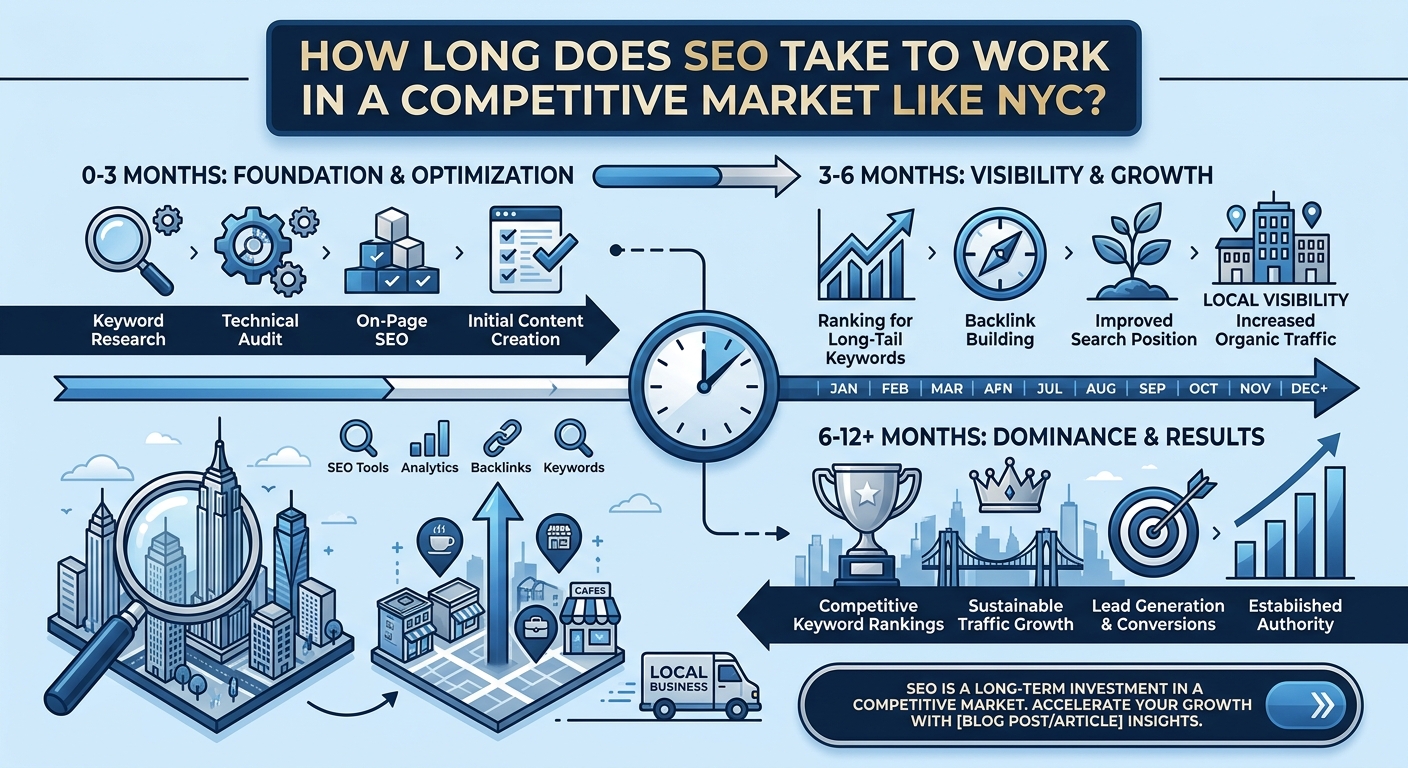
The table below shows a realistic timeline for a typical New York business SEO project.
| Time Period | Typical Focus | What to Expect |
|---|---|---|
| Months one to two | Audit, tracking, and technical repairs | Cleaner site and a reliable baseline |
| Months three to four | On page updates and local cleanup | Early gains in impressions and map visibility |
| Months five to eight | New content and link earning | Steady growth in traffic and inquiries |
| Months nine to twelve | Strengthening top pages and expanding | Stronger rankings and lower reliance on ads |
To avoid this mistake, set realistic expectations from the beginning and agree on milestones that can be reviewed every month. Judge progress by leading indicators such as impressions, keyword movement, and local visibility, not only by final sales. Commit to at least six to twelve months of consistent work before deciding whether a strategy is succeeding.
A Practical Fix It Checklist
Fixing every mistake at once can feel overwhelming, so it helps to work in a clear order. Begin with the issues that block progress, such as technical errors and missing tracking. Then move to the changes that deliver the fastest wins, and finally build the long term assets of content, links, and reviews.
Use this simple checklist to guide your first ninety days:
- Claim and complete your business profile, and make every listing match exactly.
- Set up tracking for calls, forms, and bookings before changing anything else.
- Test your site on a phone, then compress images and remove unused plugins.
- Fix broken pages, redirect old addresses, and submit a clean sitemap.
- Rewrite titles and descriptions for your most important pages.
- Expand thin service pages with real answers, photos, and clear calls to action.
- Build a simple review request process and reply to every review.
- Improve internal links so key pages are reachable within two or three clicks.
- Plan a steady schedule of helpful content based on real customer questions.
- Start earning a few quality local links each month through useful resources.
Review this checklist every quarter, because websites and markets keep changing. A regular habit of small improvements protects your rankings and keeps your business ahead of competitors who only act when problems appear.
Why Choose Dealmate
Dealmate helps New York businesses fix SEO mistakes with a process that is clear, measurable, and built around real customer behavior. The team begins with a detailed audit that finds exactly what is holding your site back, then turns the findings into a prioritized plan you can understand. Reports are written in plain language so you always know what has been done and what results it is producing.
Every strategy is tailored to your market, your budget, and your goals rather than copied from a template. Dealmate combines technical repair, useful content, local visibility, and honest link building, and it avoids shortcuts that risk penalties. If you want a partner who treats your growth with the same care that you do, Dealmate is ready to help you build lasting organic success.
FAQs
1. What is the most common SEO mistake New York businesses make?
The most common mistake is neglecting local SEO, including incomplete business profiles and inconsistent listings. Many owners focus on their website and forget that map results bring a large share of local customers. Fixing names, addresses, phone numbers, and categories is simple and inexpensive. This one step often produces some of the fastest improvements in visibility.
2. How can I tell if my website has SEO problems?
Warning signs include falling traffic, few calls from search, slow loading on phones, and pages that never appear in results. A technical crawl and content review will reveal the exact causes. You can also compare your rankings with those of nearby competitors. A professional audit gives the clearest and most complete picture.
3. How long does it take to fix SEO mistakes and see results?
Technical and local fixes can show early improvements within two to three months. Content and authority improvements usually take six to twelve months to reach their full effect. The timeline depends on competition, the condition of your site, and how consistently the work is done. Steady effort is more important than speed.
4. Do I need to rewrite my entire website to fix SEO issues?
Most businesses do not need a full rewrite and can improve results by upgrading their most important pages first. Focus on service pages, location pages, and pages that already receive some traffic. Merge or remove weak pages that add no value. A targeted approach saves time and delivers better results.
5. Are duplicate location pages really harmful?
Yes, because near identical pages give search engines no reason to rank one above another. They can also make your site look low quality overall. Each location page should include details that are genuinely unique to that area. Real projects, local needs, and customer stories make these pages valuable.
6. How many reviews does a business need to rank well locally?
There is no fixed number, but a steady flow of recent and genuine reviews matters more than a single large batch. Businesses that consistently collect feedback tend to outperform those with a few old reviews. Ratings, review content, and your replies all play a role. Make requesting reviews a regular part of your process.
7. Is mobile speed really that important for rankings?
Yes, because most local searches happen on phones and slow pages cause visitors to leave quickly. Search engines also consider page experience when ranking results. Faster pages typically improve both rankings and conversions. Regular speed testing helps you catch new problems early.
8. Should I buy backlinks to catch up with competitors?
Buying backlinks is risky and often leads to penalties that are expensive to repair. Quality matters far more than quantity, and relevant local links are the most valuable. Earning links through useful guides, partnerships, and community involvement is much safer. This approach builds authority that lasts.
9. What should I track to know if my SEO is working?
Track organic visits, keyword positions, phone calls, form submissions, and local map actions. Compare each month with the previous month and with the same month last year. Record a baseline before starting so you can prove progress. Revenue from organic leads is the clearest measure of success.
10. Can a small business compete with larger companies in New York search?
Yes, because focused local strategies allow small businesses to win searches that big brands overlook. Targeting specific neighborhoods, services, and customer questions reduces direct competition. Strong reviews and accurate listings add further advantages. Consistent effort over time can close even a large gap.
Conclusion
Most SEO problems in the New York market come from a small set of repeated mistakes, from weak local signals and poor keyword choices to slow pages, thin content, and missing tracking. The encouraging truth is that each of these issues has a clear and practical solution. Businesses that fix the basics often see meaningful improvement without needing a huge budget.
Start by auditing your website, claiming your local listings, and setting up reliable tracking so that you can measure progress. Then work through the checklist in a steady order, focusing on quality over shortcuts and patience over quick fixes. With a consistent plan and a dependable partner, your business can turn its website into a lasting source of leads.