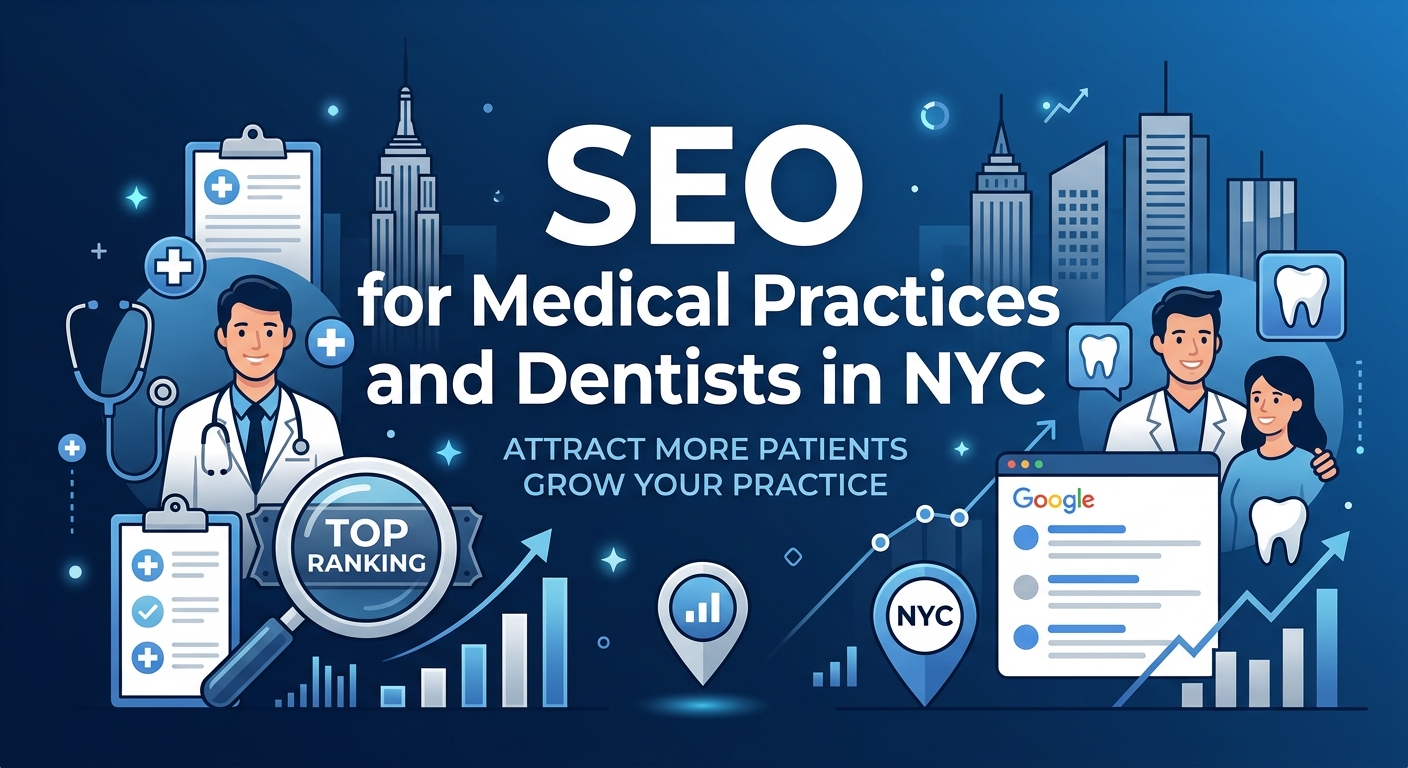
Introduction to Healthcare SEO in New York City
New York City has one of the densest healthcare markets in the world. From busy clinics in Manhattan to family dental offices in Queens, thousands of providers compete for the attention of patients who live, work, and commute across the five boroughs. For a practice that wants to grow, excellent clinical care is essential, but it is no longer enough on its own.
Today, most patients begin their search for a doctor or dentist online. Someone with a toothache, a child who needs a pediatrician, or a family looking for a new primary care provider will usually reach for a phone and type a search before calling anyone. The practices that appear in those results, with clear information and trustworthy reviews, are the ones that earn the first appointment.
Search engine optimization, commonly called SEO, is the practice of making your practice easier to find and easier to trust online. It involves your website, your Google Business Profile, your service pages, your patient reviews, and every place your practice is listed on the internet. When these pieces work together, they help patients discover you at the exact moment they are ready to book care.
This guide explains how New York medical practices and dental offices can use SEO to attract new patients and build lasting relationships in a crowded market. The first part covers why SEO matters, how patients search for providers in the city, and how to build a reliable local foundation. Here is what you will learn throughout the full guide:
- Why online visibility has become essential for modern healthcare practices
- How patients in New York search for doctors and dentists and what they expect to see
- How to set up profiles and listings that build trust and support steady appointments
- How to create a website and content plan that reflects real expertise and care
- How to track results and keep improving over time
Why SEO Matters for NYC Medical Practices and Dentists
Choosing a healthcare provider is a deeply personal decision. Patients want to feel safe, respected, and confident in the person who will care for their health or their smile. A strong online presence helps answer these concerns before the first phone call is ever made.
The New York market is also extremely competitive. A single neighborhood such as the Upper East Side, Flushing, or Downtown Brooklyn can contain dozens of practices offering the same services within a short walk of each other. In such a dense environment, even a small advantage in search visibility can lead to a noticeable increase in new patient inquiries.
SEO also supports steady growth without relying only on insurance directories or paid advertising. Paid campaigns can be costly in competitive healthcare categories, and the traffic stops as soon as the budget ends. A well built SEO foundation continues to bring in visitors month after month, which can lower the cost of each new patient over time.
The table below shows common ways patients find providers and how SEO supports each path.
| Discovery Method | How Patients Use It | SEO Opportunity |
|---|---|---|
| Map and local pack results | Searching for a doctor or dentist near me | Optimize your Google Business Profile and local signals |
| Search engine results | Looking for a specialty, symptom, or treatment | Build helpful, detailed service pages and guides |
| Provider directories | Comparing doctors by specialty, rating, and insurance | Complete and maintain profiles on trusted platforms |
| Review platforms | Reading patient feedback before booking | Collect honest reviews and respond professionally |
| Referrals from friends and other providers | Searching a name after a recommendation | Make sure your name leads to a complete, accurate profile |
| Insurance provider lists | Finding in network practices | Keep insurance details consistent across listings |
Notice that even referrals usually end with an online search. When a friend or another doctor recommends a practice, the next step is almost always to look up the name and check the website and reviews. If your information is missing, outdated, or unclear at that moment, you may lose a patient who was already inclined to choose you.
Trust is another reason SEO matters so much in healthcare. Search engines are especially careful with topics that affect a person’s health and wellbeing, so they favor pages that show real expertise, accuracy, and a good reputation. Practices that publish clear information, display real credentials, and maintain strong reviews tend to perform better because they match what both search engines and patients are looking for.
How Patients Search for Doctors and Dentists in New York
Understanding how patients search is the starting point for any effective healthcare SEO plan. People do not all search in the same way, and each type of search reveals a different need. When you understand these patterns, you can shape your website and profiles to meet patients at the right moment.
Many searches combine a specialty with a location, such as pediatric dentist in Brooklyn, dermatologist in Manhattan, or family doctor in Staten Island. These searches show strong intent because the person already knows what kind of care they need and where they want to receive it. Others begin with a symptom or question, such as what causes tooth sensitivity or when to see a doctor for back pain, and these informational searches give you a chance to introduce your practice early.
Insurance plays a large role in how New Yorkers choose providers. Patients often search for practices that accept a specific plan, or they check whether a provider is in network before they call. Clear and accurate insurance information on your website and listings can remove a major barrier and increase the number of booked appointments.
Here are common search types that matter for medical practices and dentists:
- Specialty and location searches, such as orthodontist in Queens
- Near me searches, which rely heavily on mobile use and map results
- Symptom and question searches, such as how long does a root canal take
- Insurance searches, such as dentist that accepts a certain plan
- Urgent searches, such as emergency dentist open now or walk in clinic nearby
- Branded searches, where the patient already knows your practice and wants details
Mobile behavior is especially important in this city. Many New Yorkers search from their phones while commuting, waiting in an office, or walking between appointments, and they expect answers within seconds. If your website is slow, hard to read on a small screen, or makes it difficult to call or book, the visitor will quickly move on to another practice.
Same day and urgent care searches deserve special attention. A person with severe tooth pain or a sudden illness wants help immediately and will often call the first practice that looks credible and available. Clear phone numbers, visible hours, and accurate information about walk in or same day options make a major difference in these moments.
Language and community also shape how patients search. New York is one of the most diverse cities in the world, and many patients prefer a provider who speaks their language or understands their culture. Sharing the languages your team speaks and the communities you serve can help you reach patients that other practices may overlook.
Building a Strong Local SEO Foundation
Before investing in new content or advanced strategies, make sure your basic local information is complete, accurate, and consistent. This foundation tells search engines exactly who you are, where you practice, and what you offer. It also gives patients a dependable first impression no matter where they find you.
Your Google Business Profile is one of the most important assets for a medical or dental practice. It appears in map results and local searches and often shows your address, phone number, hours, reviews, and website in one place. Claim and verify your profile, then complete every section with care and accuracy.
Choose a primary category that best describes your main specialty, such as dentist, pediatrician, or dermatologist, and add secondary categories only when they truly apply. Write a clear description that explains your services, your approach to care, and the communities you serve in natural language. Add professional photos of your office, waiting area, treatment rooms, and team so that patients know what to expect when they visit.
Consistency across the web is the next priority. Your practice name, address, and phone number should appear in exactly the same format on every directory, social profile, and healthcare listing. Even small differences, such as a missing suite number or a different phone number, can confuse search engines and weaken your visibility.
Practices with several providers or locations need extra care. Create a separate profile and a separate website page for each office, each with its own address, local phone number, hours, and unique description. Individual providers can also have their own profiles on professional platforms, as long as the details match the main practice information.
Use this checklist to build your foundation:
- Claim and verify your Google Business Profile and complete every available field
- Set up profiles on Apple Maps, Bing, and other major map platforms
- Use one standard version of your practice name, address, and phone number everywhere
- List your specialties, accepted insurance plans, and languages spoken accurately
- Add accessibility details, such as wheelchair access and transit directions
- Upload professional photos of your office, your providers, and your equipment
Healthcare marketing also comes with strict professional and privacy rules that you should respect. Never share patient information without proper permission, avoid promising specific medical outcomes, and follow the advertising guidelines that apply to your profession in New York. Honest and careful wording protects your patients, your reputation, and your license.
Finally, remember that your local foundation needs regular attention. Providers join or leave, offices move, and accepted insurance plans change, so a quick monthly review helps keep everything accurate. With a clean and complete base in place, you are ready to build a website and content strategy that turns more of those searches into booked appointments.

Medical and Dental Website Essentials
Your website is the center of your online presence, and it is often where a curious visitor becomes a booked patient. When someone finds you through a map result, a provider directory, or a referral, the next step is usually a visit to your site. A clear, fast, and welcoming website can turn that visit into an appointment within minutes.
Speed and mobile design come first. Most healthcare searches in New York happen on phones, often in moments when people want answers quickly. Compress your images, keep your layout simple, and make sure buttons, phone numbers, and booking tools are easy to tap on a small screen.
Online booking can make a major difference for busy patients. Many people prefer to schedule an appointment at night or during a break at work rather than waiting on hold during office hours. A simple booking form or scheduling tool, paired with a visible phone number for those who prefer to call, gives every patient a comfortable way to reach you.
Trust signals deserve a visible place on every important page. Patients want to know who their provider is, where they trained, and whether other people have had a good experience. Provider biographies, licenses, board certifications, professional memberships, and genuine patient feedback all help build confidence before the first visit.
The table below outlines the essential website elements and why each one matters.
| Website Element | Purpose | Why It Helps SEO and Patient Growth |
|---|---|---|
| Fast mobile friendly design | Smooth browsing on phones | Improves user experience and reduces early exits |
| Online booking and visible phone number | Quick path to schedule care | Turns visits into appointments |
| Provider profile pages | Shows training, experience, and approach | Builds trust and supports expertise signals |
| Service and treatment pages | Explains each type of care in detail | Helps the practice appear for specific searches |
| Insurance and payment information | Answers common cost questions | Removes barriers and reduces unnecessary calls |
| Patient reviews and testimonials | Provides social proof | Strengthens credibility and conversion rates |
| Office location, map, and transit details | Helps patients find and visit the practice | Supports local relevance and convenience |
| Secure connection and clean structure | Protects visitors and helps search engines explore the site | Supports technical health and rankings |
Accessibility and privacy are especially important for healthcare websites. Use readable fonts, strong color contrast, and clear headings so that patients with different needs can use your site comfortably. Any form that collects personal or health related details should use a secure connection and clearly explain how the information will be used and protected.
Keep your core details identical to what appears on your Google Business Profile and other listings. If your website shows one phone number and a directory shows another, patients lose trust and search engines receive mixed signals. Treat your website as the main source of truth and update it first whenever something changes.
Keyword Strategy for Healthcare Providers
Keywords are the words and phrases that patients type into search engines when they need care. A smart keyword strategy helps you understand what people are looking for and then match your pages to those needs. For healthcare providers, the best keywords usually combine a specialty or treatment, a location, and a clear intent.
Start by listing every service your practice provides and the types of patients you want to welcome. A dental office focused on cosmetic dentistry in Manhattan will use very different language from a pediatric practice serving families in the Bronx. Think about the exact problems your patients face and the everyday words they use to describe them.
Location keywords are especially powerful in New York. People often search by borough or neighborhood, such as dentist in Forest Hills, urgent care near Williamsburg, or cardiologist in the Financial District. Mentioning the areas you serve naturally across your site helps you appear for these local searches, but avoid listing dozens of unrelated places in a single block of text.
Here are the main keyword groups to consider:
- Specialty keywords, such as family medicine, orthodontics, dermatology, or pediatrics
- Treatment keywords, such as teeth whitening, dental implants, annual physicals, or vaccinations
- Location keywords, such as boroughs, neighborhoods, and nearby transit stops
- Intent keywords, such as book an appointment, new patient exam, or emergency care
- Question keywords, such as how often should I get a dental cleaning
- Audience keywords, such as children, seniors, or patients who speak a particular language
Match each keyword group to a specific page whenever possible. Your homepage can focus on your practice and your main services, each treatment page can target one topic, and each location page can target one office area. This structure gives search engines a clear picture of what every page offers and helps patients land on the most relevant information.
Think about intent as well as wording. A person asking a general question is usually early in the process and wants to learn, while a person searching for a provider near them is ready to book. Writing each page to satisfy its main purpose leads to stronger engagement than simply repeating keywords.
The table below shows how different search intentions connect to page types.
| Search Intent | Example Search | Best Page to Show | Key Feature to Include |
|---|---|---|---|
| Find a provider | Pediatrician in Astoria | Service or provider page | Clear services, credentials, and booking options |
| Learn about a treatment | What to expect during a dental implant procedure | Treatment guide | Plain explanation and a gentle invitation to book a consultation |
| Check insurance | Dentist that accepts my plan in Brooklyn | Insurance page | Accepted plans and a contact option for questions |
| Get immediate care | Emergency dentist open now | Contact or urgent care page | Phone number, hours, and same day options |
| Compare providers | Best dermatologist in Manhattan | Provider profile and reviews | Credentials, experience, and patient feedback |
Finally, write for people first. Search engines have become very good at understanding meaning, so there is no need to repeat the same phrase many times. Clear and helpful writing that answers real patient questions will always outperform pages filled with awkward or forced keywords.
Service and Location Pages
Service pages are among the most valuable assets on a healthcare website. Each one should focus on a single treatment or type of care and explain it in enough depth to help a visitor understand what to expect and why your practice is a good choice. Thin pages with only a few sentences rarely perform well, especially in a market as competitive as New York.
A strong service page begins with a clear heading that states the service and the location. It then explains who the treatment is for, how the process works, what recovery or follow up may involve, and what questions patients commonly ask. Plain language is important, since many visitors are not familiar with medical terms and want information they can understand and use.
Include helpful sections that answer real concerns. Describe what a first visit looks like, explain general timelines, mention comfort options where relevant, and outline what patients should bring or prepare. Avoid promising specific results, and make clear that every patient is different and that only a qualified provider can recommend the right plan after an examination.
Use this short checklist when building each service page:
- Write a unique title and short description for every page
- Use one clear main heading that states the service and location
- Explain the process in simple and accurate language
- Add a short frequently asked questions section based on real patient concerns
- Display provider credentials and relevant patient feedback where appropriate
- Place a visible booking or contact option near the top and the bottom of the page
Location pages matter for practices with more than one office or those serving several boroughs. Create a separate page for each office with its own address, phone number, hours, directions, parking or transit details, and a short description of the neighborhood. Avoid copying the same text across locations, since unique pages help each office rank for its own area.
Titles and descriptions play a big role in how your pages appear in search results. A good page title includes the service, the location, and your practice name in a natural and readable way. The short description under the title should invite action, such as booking a visit or learning more about a treatment.
Consider adding structured details that help search engines understand your practice. Information such as your practice name, address, phone number, specialties, accepted insurance, and provider profiles can be presented in a format that search tools read easily. This can improve how your listing appears and may help your practice show richer information in results.
Internal links also help both visitors and search engines. Connect related pages, such as a general dentistry page linking to cleanings, fillings, and preventive care pages, so that readers can explore the topics they need. A logical link structure shows that your site covers each subject thoroughly and makes navigation easier for everyone.
Content That Builds Patient Trust
Healthcare decisions rest on trust, and trust grows through content that shows real knowledge and care. Search engines look for pages that demonstrate experience, expertise, and reliability, especially on topics that affect a person’s health. Publishing accurate and helpful content is one of the best ways to show these qualities.
A blog or resource center gives you space to answer the questions patients ask every day. You can explain common conditions, describe what to expect during routine procedures, share preventive care tips, and offer seasonal advice such as flu season guidance or back to school checkups. Each helpful article gives you another chance to appear in search results and to introduce your practice to someone who may need you later.
Frequently asked questions pages are especially useful. Patients often search with a direct question, and a clear and honest answer can build trust right away. Organize questions by service so that visitors can quickly find what applies to them.
Here are practical content ideas for medical practices and dentists:
- Step by step guides that explain common procedures and visits in plain language
- Answers to frequently asked questions for each service
- Preventive care tips, such as oral hygiene habits or healthy lifestyle advice
- Provider profiles that share background, education, and approach to patient care
- Guides to insurance, payment options, and what to bring to a first visit
- Community focused articles that address health topics relevant to specific neighborhoods or groups
Accuracy and ethics must guide everything you publish. Have a qualified provider review medical and dental content, update it when guidelines change, and include a clear note that information is general in nature and does not replace personal medical advice. Avoid exaggerated claims, protect patient privacy at all times, and follow the advertising rules that apply to your profession.
Provider profile pages deserve special care because they connect real people to your practice. Include education, board certifications, special interests, languages spoken, and a professional photo, and write in a warm and approachable tone. Patients often choose a provider because they feel comfortable with the person, and a thoughtful profile helps create that connection before the first appointment.
Photos and video can also strengthen your content. Images of a clean and welcoming office, short introductions from your providers, and simple explainer videos can help nervous patients feel at ease. Add clear descriptions to each image and keep file sizes small so that pages stay fast on mobile.
Do not forget to keep your content fresh. Outdated articles, expired information, and broken pages can weaken trust and make your site look neglected. A quick quarterly review to refresh or remove old material keeps your website accurate and signals that your practice is active and reliable.
With a well built website, a smart keyword plan, detailed service pages, and trustworthy content, you have created the tools needed to attract more of the right patients. The next step is strengthening your reputation, earning authority through listings and mentions, and tracking results so that your growth continues over time.