Introduction 🌐
Search engine optimization has become an essential part of growing a business online, especially in California, where companies compete across diverse industries, from technology and e-commerce to healthcare, real estate, professional services, and hospitality. Businesses that want to attract qualified visitors, generate leads, and increase online sales need a clear SEO strategy that helps potential customers discover their products and services through search engines.
However, achieving sustainable search visibility requires more than adding keywords to website pages or publishing occasional blog posts. Companies need technical optimization, useful content, keyword research, competitor analysis, local search strategies, and continuous performance monitoring to remain competitive as search behavior evolves.
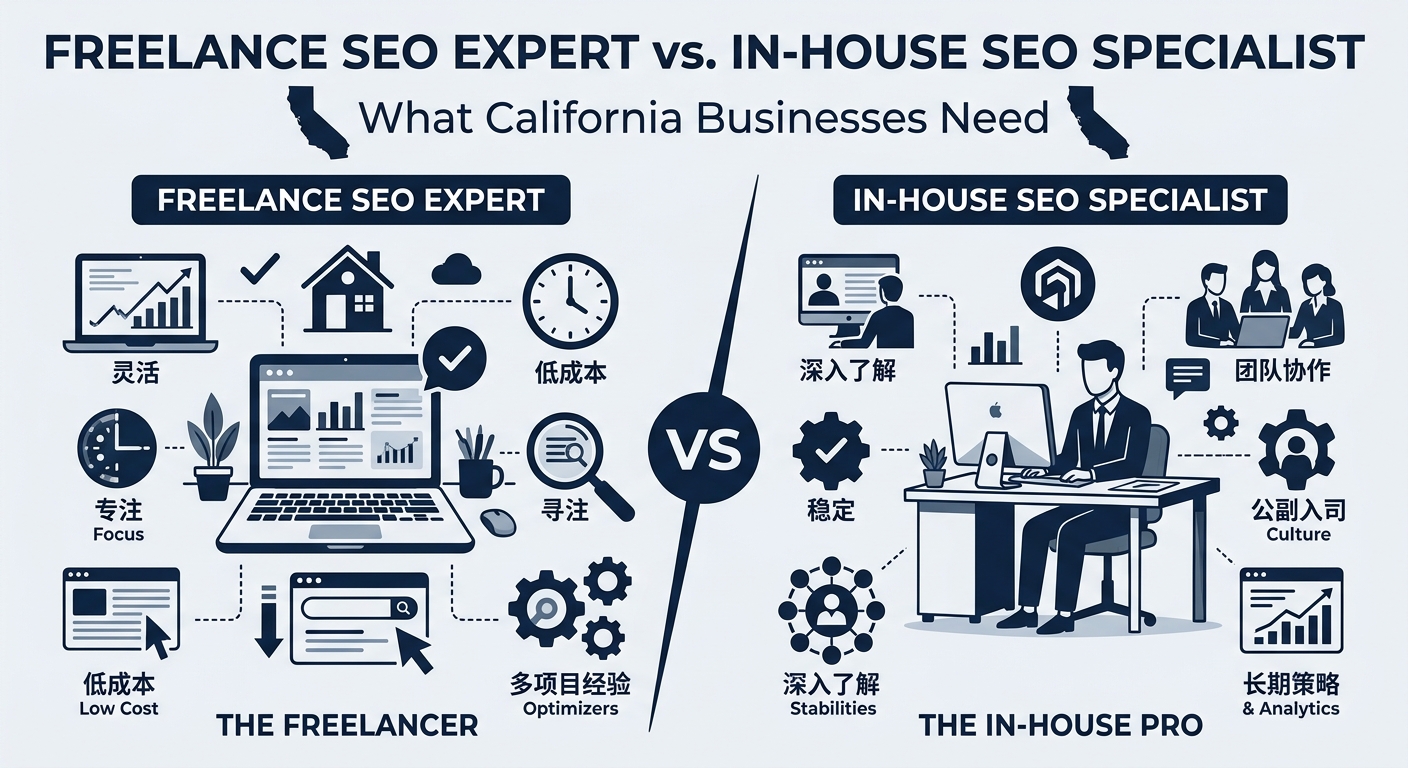
One important decision businesses must make is whether to hire a freelance SEO expert or employ an in-house SEO specialist. Both options can support organic growth, but they differ in cost structure, availability, expertise, collaboration, and long-term responsibilities.
For a small business in Los Angeles, a growing e-commerce company in San Diego, or a technology startup in San Francisco, the right choice depends on its website, marketing budget, business objectives, and internal resources. Understanding these differences can help California businesses invest in SEO services that match their current needs without creating unnecessary expenses.
This guide explores the strengths and limitations of freelance SEO experts and in-house SEO specialists, explains when each option makes sense, and shows how businesses can evaluate their choices before committing to an SEO hiring model.
Understanding a Freelance SEO Expert 🔍
A freelance SEO expert is an independent professional who helps businesses improve their visibility in organic search results. Rather than working exclusively as a permanent employee for one company, a freelancer typically provides services to multiple clients through project-based agreements, monthly retainers, or hourly arrangements.
Freelancers may work remotely, visit client offices when necessary, or collaborate with distributed marketing teams. This arrangement allows businesses to access SEO knowledge without necessarily creating a full-time position, making it attractive to startups, small businesses, and companies exploring organic marketing for the first time.
What Does a Freelance SEO Expert Do?
A freelance SEO expert develops and implements strategies designed to improve a website’s search performance and attract relevant visitors. Their responsibilities depend on their specialization, experience, the agreed scope of work, and the goals established by the client.
Some freelancers focus on technical SEO, while others specialize in content optimization, local SEO, keyword research, or broader organic growth strategies. Businesses should clarify these areas before hiring because the term SEO expert does not automatically mean that one professional provides every service at an advanced level.
Common responsibilities include:
- 🔎 Keyword research to identify relevant search terms, customer questions, and commercial opportunities.
- 🛠️ Technical SEO audits to identify crawling, indexing, website structure, and performance issues.
- ✍️ On-page optimization, including title tags, meta descriptions, headings, internal links, and content improvements.
- 📍 Local SEO to improve visibility for relevant geographic searches and strengthen business profile optimization.
- 📊 Competitor analysis to understand competing websites, content gaps, and potential opportunities.
- 📝 Content planning to develop useful landing pages, service pages, and informative blog articles.
- 📈 Performance reporting to monitor organic traffic, keyword visibility, conversions, and other agreed metrics.
The most suitable freelancer is not necessarily the person offering the longest list of services. Instead, businesses should look for someone whose skills match their most important challenges and who can explain how their work will contribute to measurable business outcomes.
How Freelancers Work With California Businesses
Freelance SEO experts commonly use a flexible working arrangement that allows businesses to purchase the support they need. A company may hire a freelancer for a one-time technical audit, a three-month content optimization project, or an ongoing engagement covering keyword research, implementation guidance, and performance reporting.
For example, a local plumbing company in Sacramento may need help appearing in relevant local searches, while an online retailer serving customers throughout California may require product page optimization and improvements to its website architecture. Both businesses can work with freelancers, but the scope, technical requirements, and expected deliverables will differ considerably.
Communication typically takes place through email, video meetings, project management platforms, and shared reporting documents. This can work well for companies that already have employees capable of implementing recommendations, although businesses should establish clear deadlines and responsibilities to prevent important SEO tasks from being delayed.
Freelancers may also bring experience from working across several industries and website types. That broader exposure can help businesses discover optimization opportunities they might not have identified internally, provided the freelancer understands the client’s market and avoids applying generic strategies without proper research.
Advantages of Hiring a Freelance SEO Expert ✅
One of the biggest advantages of hiring a freelancer is flexibility. Businesses can select the services they need, adjust the scope as priorities change, and avoid committing immediately to a permanent employee when their SEO workload is still developing.
Freelancers can also provide access to specialist knowledge. A company facing indexing problems, declining organic traffic, or weak local search visibility may benefit from a professional who has dealt with similar challenges and can recommend a focused approach.
Another advantage is the ability to begin with a clearly defined project. A business can commission an SEO audit, review the findings, and decide which improvements should be prioritized before committing to a longer engagement. This approach can be particularly useful for organizations with limited budgets or uncertain SEO requirements.
Freelance arrangements may also reduce some employment-related expenses because the business pays for contracted services rather than maintaining a permanent SEO position. However, the actual savings depend on the freelancer’s fees, project complexity, required tools, and the amount of ongoing support the company needs.
For businesses that already have content writers, web developers, or marketing coordinators, a freelancer can complement existing capabilities instead of duplicating work. This makes freelance support a practical option when the company needs strategic direction or specialist input rather than another full-time team member.
Potential Challenges of Freelance SEO Support ⚠️
Despite its advantages, freelance SEO support also comes with limitations that businesses should evaluate before making a hiring decision. Because freelancers often manage several clients, their availability may vary according to existing commitments, project deadlines, and the terms of their agreements.
A freelancer may provide excellent recommendations but have limited capacity to implement every change personally. For example, resolving complex website development problems may require cooperation with the client’s developer, while producing a large volume of content may require additional writers or editors.
Continuity can also become a concern if a freelancer becomes unavailable or ends the engagement unexpectedly. Businesses can reduce this risk by maintaining access to their analytics accounts, documenting SEO changes, retaining copies of reports, and ensuring that important strategy decisions are recorded.
Another challenge is finding a professional with the right combination of skills, communication habits, and commercial understanding. Some freelancers specialize in a narrow area, and others may offer services that do not match the business’s actual needs. Reviewing relevant case studies, discussing deliverables, and agreeing on realistic performance expectations can help companies make a more informed choice.
Understanding an In-House SEO Specialist 🏢
An in-house SEO specialist is an employee who works directly for a company and focuses on improving its organic search visibility. Unlike a freelancer who generally divides time among several clients, an in-house specialist can concentrate on the organization’s website, products, services, audience, and long-term marketing objectives.
This arrangement is often useful for businesses with continuous SEO requirements, large websites, frequent content updates, or complex coordination between marketing and technical departments. Having an SEO professional inside the organization can also improve access to internal information, subject-matter experts, and decision-makers.
However, employing an in-house specialist requires more than paying a salary. Businesses must consider recruitment, onboarding, employee benefits, professional development, equipment, SEO software, and the management support necessary to help the employee succeed.
What Does an In-House SEO Specialist Do?
The responsibilities of an in-house SEO specialist depend on the organization’s size, website complexity, and marketing structure. In a small company, one employee may manage keyword research, content optimization, reporting, and local SEO, whereas a larger organization may divide these responsibilities among several specialists.
An in-house specialist generally works closely with other departments to ensure that SEO considerations are included in website updates, content production, product launches, and marketing campaigns. This involvement can make it easier to identify problems early and maintain consistent optimization across the website.
Typical responsibilities include:
- 🔍 Developing and maintaining an SEO strategy aligned with business objectives.
- 🧭 Conducting keyword research and mapping search intent to website pages.
- 🛠️ Coordinating technical SEO improvements with developers and website administrators.
- ✍️ Optimizing existing content and guiding the creation of new search-focused material.
- 📍 Managing local search optimization when the company serves specific geographic markets.
- 📊 Monitoring organic performance, identifying trends, and communicating findings to management.
- 🤝 Working with marketing, sales, product, and content teams to improve organic acquisition.
- 📅 Maintaining an ongoing SEO roadmap with priorities, deadlines, and measurable outcomes.
The role may also include monitoring search algorithm changes, reviewing competitors, improving internal linking, and supporting website migrations. Since the specialist works within the organization, they can often develop a deeper understanding of the company’s customers, products, internal processes, and commercial priorities over time.
Daily Responsibilities and Long-Term SEO Management
SEO is an ongoing process rather than a single task that can be completed permanently. Websites change, competitors publish new content, customer expectations evolve, and search engines continually refine how they discover and present information.
An in-house specialist can dedicate regular working hours to monitoring these changes and coordinating appropriate responses. For example, when a company introduces new services across several California cities, the specialist can work with the content team to plan relevant landing pages, review existing pages for overlap, and establish internal links that support the new sections.
Daily work may include reviewing search performance, checking technical issues, updating content briefs, meeting developers, and assessing the impact of previous changes. Longer-term responsibilities can involve developing content clusters, improving category structures, supporting international or statewide expansion, and establishing consistent measurement practices.
The advantage is continuity. An employee who remains with the company can retain knowledge about past SEO decisions, previous website changes, customer behavior, and unsuccessful experiments, reducing the need to rebuild that understanding at the start of every new project.
Nevertheless, continuity alone does not guarantee strong results. An in-house specialist still needs appropriate training, sufficient resources, clear priorities, and support from decision-makers to turn SEO recommendations into implemented improvements.
Collaboration With Internal Teams 🤝
SEO frequently depends on the cooperation of people outside the SEO function. Technical recommendations may require developer support, content improvements may need subject-matter experts, and conversion optimization may involve designers or sales teams.
An in-house specialist can build working relationships with these colleagues and incorporate SEO considerations into existing processes. This can be particularly valuable when a website publishes new pages frequently or when changes to products, pricing, services, and website navigation affect organic search performance.
For instance, a California e-commerce company may update hundreds of product pages during a seasonal campaign. An in-house SEO specialist can coordinate with merchandising, development, and content teams to review product information, page templates, internal links, and indexing requirements before the changes go live.
Internal collaboration can also help SEO recommendations move through approval processes more efficiently. Rather than repeatedly explaining the business context to an external provider, the specialist can participate directly in planning meetings and help colleagues understand why certain improvements deserve priority.
However, the benefits depend on the organization’s culture and structure. If developers are overloaded, content approvals take months, or management does not prioritize organic growth, even a knowledgeable in-house specialist may struggle to deliver meaningful improvements.
Advantages of Hiring an In-House SEO Specialist ✅
An important benefit of employing an in-house specialist is the ability to dedicate consistent attention to the business. The employee can become familiar with the organization’s audience, competitive position, products, and internal goals, allowing SEO decisions to reflect company-specific knowledge rather than generic recommendations.
Another advantage is direct communication with colleagues and managers. When SEO is integrated into website planning, product development, and content production, the company may identify opportunities earlier and avoid expensive corrections after changes have already been published.
An in-house specialist can also maintain a consistent optimization process. Regular monitoring, documented workflows, planned content updates, and ongoing technical coordination help the business develop SEO as a lasting capability instead of relying exclusively on occasional external projects.
For larger organizations, internal ownership can improve accountability because SEO priorities, reporting responsibilities, and implementation schedules are managed within the company. Management can establish expectations around deliverables, collaboration, and business performance while ensuring that SEO activities support broader marketing objectives.
Over time, the organization may develop valuable internal knowledge that supports future campaigns and website improvements. This can be particularly beneficial for companies with complex websites, multiple product categories, several business locations, or a steady stream of new content.
Potential Challenges of Hiring an In-House SEO Specialist ⚠️
The main challenge is the total cost of employment. In addition to salary, businesses may need to budget for recruitment, payroll-related expenses, benefits, equipment, training, and subscriptions to professional SEO tools. These costs continue even when the company has fewer SEO projects or temporarily shifts its marketing priorities.
Another limitation is the range of expertise available from one employee. SEO includes technical analysis, content strategy, local search, analytics, website architecture, and conversion optimization, and one person may not have advanced skills across every discipline. Companies with complex needs may still require freelancers, agencies, developers, or other external specialists.
Recruitment can also take time, particularly when a business needs someone with strong technical knowledge and practical experience in its industry. A poor hiring decision may result in additional recruitment costs, delays, and a strategy that does not address the organization’s most important problems.
There is also a risk of relying too heavily on one employee. If the specialist leaves, takes extended leave, or becomes responsible for too many unrelated marketing tasks, important SEO activities may be delayed. Businesses can reduce this risk through documented processes, shared account access, regular reporting, and cross-functional collaboration.
Finally, hiring an in-house SEO specialist does not automatically produce faster rankings or higher revenue. Search performance depends on competition, website quality, content usefulness, technical implementation, customer demand, and many other factors. The employee needs sufficient authority and resources to implement improvements, while management must understand that SEO results typically develop over time rather than appearing immediately.
Freelance SEO Expert vs. In-House SEO Specialist: Key Differences ⚖️
Choosing between a freelancer and an in-house specialist requires businesses to consider more than the initial price. Both options can deliver value, but their effectiveness depends on the amount of work involved, the skills required, the company’s internal capabilities, and the importance of continuous SEO management.
A freelancer may be a better fit when the company needs specialist advice, a defined project, or flexible support without creating a permanent role. An in-house specialist may be more suitable when SEO activities occur throughout the week and require close coordination with several internal departments.
Cost and Budget Flexibility 💰
Freelancers typically charge through hourly rates, fixed project fees, or monthly retainers. This allows businesses to define a scope of work and match spending to their immediate requirements, although extensive or highly specialized projects can still be expensive.
An in-house specialist generally receives a regular salary, and the employer must account for additional employment and operating expenses. Although this creates a more predictable staffing arrangement, the company pays for the employee’s capacity even when the volume of SEO work changes.
Skills, Experience, and Specialist Knowledge
Freelancers may bring experience gained from working with different clients, website platforms, industries, and competitive environments. Depending on their expertise, they can provide focused assistance with technical audits, content strategy, local SEO, or other specialized needs.
An in-house specialist develops deeper knowledge of one company’s products, processes, customers, and internal systems. However, a single employee may need external training or specialist assistance when the organization faces problems outside their strongest areas of expertise.
Availability, Communication, and Accountability
An in-house employee is generally available according to the company’s working schedule and can participate in internal meetings, planning sessions, and day-to-day collaboration. This can be useful when website changes require frequent discussion or when SEO priorities must be coordinated with other departments.
A freelancer’s availability depends on the service agreement and existing commitments. Businesses should establish communication expectations, reporting frequency, response times, and project deadlines before work begins to ensure that external support fits their operational requirements.
Scalability and Workload Management
Freelancers allow companies to adjust the scope of SEO work as their needs change, although a freelancer’s individual capacity remains limited. When a project grows substantially, the business may need to hire additional specialists or work with a broader service provider.
An in-house specialist offers consistent internal ownership, but one employee cannot manage an unlimited workload. Expanding the internal team may require additional recruitment, while using external professionals for specific projects can provide extra capacity without immediately increasing permanent staffing.
Comparison Table: Freelance SEO Expert vs. In-House SEO Specialist
| Comparison factor | Freelance SEO expert | In-house SEO specialist |
|---|---|---|
| Employment arrangement | Independent contractor | Permanent or fixed-term employee |
| Payment structure | Hourly, project-based, or retainer | Regular salary and employment costs |
| Budget flexibility | Often higher for defined projects | Lower flexibility due to ongoing costs |
| Business knowledge | Develops through client collaboration | Builds deeper internal knowledge over time |
| Specialist expertise | Depends on the freelancer’s skill set | Depends on the employee’s skill set |
| Daily availability | Defined by the agreement | Usually aligned with company working hours |
| Team collaboration | External coordination required | Direct internal collaboration |
| Workload changes | Scope can be adjusted by agreement | Capacity may require additional staffing |
| Ongoing SEO ownership | Depends on contract continuity | Can remain with the internal employee |
| Best suited for | Projects, specialist needs, flexible support | Continuous SEO work and internal coordination |
The table provides a general comparison rather than a guarantee of cost or performance. A highly experienced freelancer may cost more than an entry-level employee for certain projects, while an in-house specialist may deliver greater operational value when SEO requires continuous involvement across several departments.
California businesses should therefore compare the total cost of each arrangement against the actual work required. The most effective hiring model is the one that provides the necessary expertise, implementation capacity, and accountability without creating avoidable financial or operational pressure.
SEO Needs of California Businesses 🌴
California is one of the most competitive business environments in the United States, with companies operating across technology, entertainment, retail, healthcare, real estate, professional services, and many other industries. Businesses must understand their audiences, geographic markets, and competitors before deciding whether a freelance SEO expert or an in-house SEO specialist is the better investment.
A company serving customers in Los Angeles may face different search challenges from a business operating in Sacramento or San Diego. Some organizations need to attract customers within a small service area, while others must compete for statewide or national visibility through large websites and extensive content libraries.
The right SEO hiring model depends on these differences. A local business with a handful of service pages may benefit from targeted freelance support, whereas an established company publishing content regularly and managing thousands of website pages may need dedicated internal SEO ownership.
Local SEO for Service-Based Businesses 📍
Local SEO helps businesses improve their visibility when potential customers search for services in a particular geographic area. It is especially important for plumbers, electricians, dentists, restaurants, law firms, home improvement companies, and other businesses that depend on customers within specific locations.
A freelance SEO expert can help these businesses identify location-specific keywords, optimize service pages, improve Google Business Profile information, and strengthen local search relevance. This can be a practical option for a small company that needs focused assistance without hiring a full-time employee.
An in-house SEO specialist may be more suitable when the business operates multiple branches, regularly expands into new service areas, or needs continuous coordination between marketing, customer service, and location managers. The specialist can maintain consistent business information, monitor local performance, and help each location follow an organized optimization strategy.
Regardless of the hiring model, local SEO should focus on accurate business information, useful location pages, authentic customer reviews, and a strong website experience. Creating many nearly identical city pages without meaningful local information is unlikely to provide sustainable value and may weaken the overall quality of the website.
E-commerce SEO and Statewide Competition 🛒
California e-commerce businesses often compete with national retailers, specialist online stores, and marketplaces that invest heavily in product visibility. Their SEO requirements can include product page optimization, category page architecture, internal linking, structured data, index management, and the prevention of duplicate or low-value URLs.
A freelancer with relevant e-commerce experience can perform technical audits, identify keyword opportunities, and recommend improvements to product and category pages. This is useful for smaller stores that need specialist assistance with particular problems or want to establish a stronger organic search foundation.
Larger e-commerce companies may benefit from an in-house SEO specialist because website changes happen frequently and can affect hundreds or thousands of pages. Close collaboration with developers, merchandising teams, content managers, and product owners can help the organization identify issues before they affect important search landing pages.
However, employing one specialist does not eliminate the need for additional expertise. A large online store may still require external technical consultants, content specialists, or developers when it faces complex migrations, international expansion, or significant website architecture challenges.
SEO Requirements for Startups and Growing Companies 🚀
Startups often need to validate their market, build brand awareness, and generate leads without spending excessively on marketing. At this stage, hiring a freelance SEO expert can provide access to keyword research, website audits, content planning, and strategic guidance without the long-term commitment of a permanent position.
A startup might begin by identifying its most valuable customer searches, optimizing essential landing pages, and publishing useful content around a small number of business priorities. Once organic acquisition becomes a consistent source of leads or sales, the company can evaluate whether it needs more regular internal SEO management.
Growing businesses may eventually reach a point where SEO work requires daily attention. Frequent product launches, expanding content libraries, multiple target markets, and increasing technical complexity can justify hiring an in-house specialist or building a broader internal marketing team.
The decision should be based on actual workload and business needs rather than company size alone. A small technology company with a complex website may need specialist support earlier than a larger business with a simple website and limited organic search requirements.
Cost Comparison and Budget Planning 💰
Budget is one of the most important factors when choosing between freelance SEO services and an in-house SEO specialist. However, businesses should compare the total cost of delivering the required SEO work instead of focusing exclusively on hourly rates or advertised salaries.
A freelancer may charge a project fee that appears higher than an employee’s hourly equivalent, but the business may only need that expertise for a limited period. An employee may appear more expensive because of salary and employment expenses, yet provide better value when the workload requires consistent daily attention.
Freelance SEO Pricing Structures
Freelance SEO experts may charge hourly rates, fixed fees for specific deliverables, or monthly retainers covering ongoing services. Pricing varies according to experience, location, specialization, website complexity, project scope, and the level of responsibility involved.
An hourly arrangement can work well for consultations, troubleshooting, or occasional support. A fixed-price project can suit a technical audit or a defined website optimization task, while a monthly retainer may be more appropriate for ongoing content planning, implementation guidance, and performance monitoring.
Businesses should request a clear explanation of what each fee includes. An inexpensive package may cover only recommendations, while a more comprehensive engagement may include implementation, meetings, reporting, and continued optimization.
It is also important to distinguish between SEO strategy and execution. A freelancer may identify important technical problems but charge separately for working with developers or producing content, so the company should understand the full expected cost before signing an agreement.
In-House SEO Salary and Employment Costs
Hiring an in-house SEO specialist involves recurring expenses that extend beyond the employee’s base salary. Depending on the employment arrangement, businesses may also need to cover payroll taxes, benefits, recruitment, equipment, training, software subscriptions, and management time.
California employers should account for applicable state and local employment requirements when preparing a staffing budget. Actual costs depend on the employee’s compensation, benefits package, work location, and the organization’s internal policies.
A full-time employee can be a worthwhile investment when the company has enough ongoing work to keep the role productive. For example, a business that regularly publishes content, maintains a large website, and coordinates frequent development changes may gain more value from dedicated internal SEO ownership than from purchasing disconnected projects.
However, if the business needs only occasional audits or a few optimization projects each year, maintaining a permanent position may be difficult to justify financially. In that situation, freelance support can provide access to expertise while preserving more flexibility in the marketing budget.
Example Budget Comparison
The following figures are illustrative planning estimates in US dollars, not verified market averages or quotations. Actual freelance fees and employment costs can vary significantly across California, so businesses should obtain current proposals and salary information before making financial decisions.
| Expense category | Freelance SEO expert | In-house SEO specialist |
|---|---|---|
| Professional services or base pay | Example: $1,000 to $3,000 monthly retainer | Example: $5,000 to $8,000 monthly base salary |
| Employment-related expenses | Usually not paid as employee benefits for a genuine independent contractor | Additional payroll, benefits, and related employment expenses may apply |
| SEO tools and software | May be included in the fee or billed separately | May require company-funded subscriptions |
| Recruitment and onboarding | Usually limited to vendor selection and onboarding | Can include recruiting fees, interviews, and employee onboarding |
| Workload flexibility | Scope may be adjusted by agreement | Staffing capacity is more fixed |
| Best budget fit | Defined projects or flexible ongoing support | Continuous workload requiring internal ownership |
These examples are intended to demonstrate how the two models differ, not to predict what a specific business will pay. The freelancer’s fee may exclude implementation, content writing, or additional tools, while an employee’s full cost will depend on the actual compensation package and operating requirements.
How to Choose the Most Cost-Effective Option
Businesses should begin by listing the SEO activities they need each month, estimating the hours required, and identifying which tasks demand specialist knowledge. They should then compare the full cost of completing that work through a freelancer, an employee, or a combination of both.
It is equally important to consider the cost of delayed implementation. If a company has serious indexing problems or a large backlog of technical fixes, paying for recommendations without allocating resources to implement them may waste part of the SEO budget regardless of who provides the advice.
A useful approach is to identify the expected deliverables before discussing pricing. For example, a company may need a technical audit, a prioritized implementation plan, eight optimized service pages, and a monthly performance report, allowing different providers to quote against a comparable scope.
Measuring SEO Return on Investment 📈
SEO value should be assessed through meaningful business outcomes rather than keyword rankings alone. Rankings and organic traffic can provide useful information, but businesses also need to understand whether search visitors become qualified leads, customers, bookings, or sales.
For a service business, relevant measures may include organic lead volume, calls from qualified prospects, consultation bookings, and the conversion rate of organic landing pages. An e-commerce company may prioritize organic revenue, transactions, product page performance, and the contribution of organic search to customer acquisition.
Businesses should establish a baseline before implementing major changes and track results over a reasonable period. Search demand, seasonality, competition, conversion rates, and other marketing activities can affect performance, so changes in revenue should not automatically be attributed to one SEO task.
A freelancer and an in-house specialist should both be evaluated against realistic objectives, transparent reporting, and the quality of their work. Neither arrangement can guarantee specific rankings or a fixed return because SEO outcomes depend on several factors beyond an individual professional’s control.
When to Hire a Freelance SEO Expert 🎯
Hiring a freelance SEO expert is often a sensible choice when a business needs specialist skills, flexible support, or a clearly defined set of deliverables. This model allows companies to access professional guidance without immediately committing to the recurring costs associated with a permanent employee.
The most important consideration is whether the freelancer can deliver the work the business actually needs. Companies should review experience, communication, project management, and implementation capacity rather than choosing solely on the basis of the lowest quotation.
Small Businesses With Limited Budgets
Small businesses may not have enough ongoing SEO work to justify employing a dedicated specialist. They may need occasional keyword research, help improving important service pages, technical troubleshooting, or advice about local search visibility.
A freelancer can provide focused support around these priorities while allowing the owner or existing marketing employee to manage other activities. This arrangement can be particularly effective when the business has a clear objective and enough internal capacity to implement recommendations.
For example, a family-owned cleaning company in Long Beach may want to improve visibility for its main services and attract customers from nearby communities. A freelancer can review its website, identify relevant local searches, optimize key pages, and recommend improvements to its business profile without requiring the company to create a full-time SEO position.
The business should still budget for ongoing maintenance and performance reviews. Even a well-optimized website needs periodic attention as services, customer demand, and competitors change.
Companies Needing a Specific SEO Project
A freelancer is often a good fit for businesses with a defined project and a clear completion point. Examples include conducting a technical audit, reviewing a website migration plan, improving title tags across key pages, or developing an SEO content strategy.
A project-based engagement allows the business to agree on deliverables, deadlines, responsibilities, and reporting before work starts. This can make it easier to evaluate the quality of the work and decide whether additional support is necessary.
For example, a California professional services company planning a website redesign may hire an SEO expert to review the existing URL structure, identify important landing pages, and recommend redirect and migration procedures. Once the project is complete, the company may only need occasional follow-up assistance.
However, project completion should not be confused with permanent SEO success. The company needs a plan for implementing recommendations, monitoring the redesigned website, and addressing any issues that emerge after launch.
Businesses Seeking Specialist Support
Sometimes, a company already has an in-house marketing team but lacks advanced knowledge in one particular area. A freelance specialist can fill that gap without requiring the organization to recruit another permanent employee.
For instance, a company may need assistance with structured data, large-scale crawling and indexing issues, JavaScript SEO, or diagnosing a sudden decline in organic traffic. A freelancer with relevant experience can investigate the issue and work alongside internal developers or marketers to implement appropriate solutions.
Specialist support can also provide an independent perspective on an existing SEO strategy. Reviewing the website and current processes may reveal overlooked technical problems, gaps in keyword targeting, or opportunities to improve content usefulness and internal linking.
Before hiring, the business should confirm that the professional has direct experience with the problem in question. A general SEO background may be helpful, but complex technical challenges often require deeper expertise than routine page optimization.
Startups Testing SEO Opportunities
Startups may benefit from using a freelancer while determining whether organic search can become a reliable acquisition channel. Early work can focus on understanding search intent, validating target keywords, optimizing core pages, and developing a manageable content plan.
This approach helps the company learn which topics attract relevant visitors and which pages contribute to business goals before expanding its SEO investment. It also allows founders to evaluate the effectiveness of organic search alongside other acquisition channels.
Once the company establishes a consistent workload and identifies opportunities for growth, it can consider hiring an in-house specialist. Until then, flexible external support can reduce the risk of creating a permanent role before the business understands its long-term requirements.
The startup should avoid expecting immediate results from a small initial budget. SEO typically requires time for implementation, indexing, content development, and performance evaluation, particularly in competitive California markets.
Companies Needing Flexible SEO Assistance
Some businesses experience significant changes in SEO workload throughout the year. Seasonal retailers, event businesses, growing service providers, and companies preparing for major launches may need more assistance during certain periods than others.
A freelancer can help manage these fluctuations by supporting specific campaigns, optimizing seasonal landing pages, or addressing technical tasks during busy periods. This flexibility can help the business obtain additional expertise without immediately expanding its permanent workforce.
For this arrangement to work well, companies should agree on availability, response times, project priorities, and access to necessary information. Freelancers may have other client commitments, so businesses should not assume that unlimited availability is included in a standard agreement.
Flexible support is most effective when the company retains ownership of its strategy, accounts, documentation, and business data. This allows work to continue smoothly if the engagement changes or the business later decides to bring SEO management in-house.
When to Hire an In-House SEO Specialist 🏆
An in-house SEO specialist is often the stronger choice when organic search is a core part of the company’s marketing strategy and requires consistent attention throughout the year. This model can provide ongoing ownership, closer team integration, and deeper familiarity with business operations.
However, the role should have enough meaningful work to justify its cost. Businesses should evaluate the website’s complexity, the frequency of updates, the number of teams involved, and the expected value of maintaining dedicated SEO capabilities.
Businesses With Ongoing SEO Workloads
Companies that regularly publish content, update products, expand services, or improve website functionality may benefit from having an internal specialist. Continuous ownership helps ensure that SEO is considered during planning rather than being addressed only after problems appear.
An in-house employee can monitor performance, prioritize tasks, coordinate implementation, and document the impact of optimization changes. This can be particularly useful when the website needs frequent updates and several departments must contribute to the SEO process.
For example, a growing California software company may publish educational articles, create new product pages, and launch features throughout the year. An internal specialist can coordinate keyword targeting, content optimization, internal linking, and technical reviews as part of the company’s regular marketing workflow.
The organization should still establish clear priorities to prevent the specialist from becoming responsible for unrelated tasks that reduce time available for SEO. Consistent ownership delivers value only when the employee has sufficient resources and authority to perform the role effectively.
Companies With Large Websites or E-commerce Stores
Large websites often require continuous monitoring because even small changes can affect many URLs, internal links, page templates, or indexing signals. E-commerce stores, online marketplaces, publishers, and software companies may have particularly complex requirements.
An in-house specialist can work closely with developers and product teams to review changes, monitor technical health, and ensure that important search landing pages remain accessible and useful. Internal involvement may also help the company respond more quickly when new categories, products, or website features are introduced.
For example, an online retailer operating throughout California may need regular reviews of product availability pages, category structures, filter URLs, and structured data. An internal SEO specialist can help maintain a consistent process for these activities and identify recurring issues before they become widespread.
Even large websites may require external expertise for specialized audits or migrations. An in-house role should provide strategic ownership, but the business does not need to assume that every advanced task must be completed by one employee.
Organizations Requiring Daily Coordination
Some SEO tasks depend on frequent communication with writers, designers, developers, sales teams, and product managers. In these organizations, having a specialist inside the company can make collaboration more practical.
An in-house employee can participate in planning meetings, review content before publication, advise developers about technical changes, and help colleagues understand the potential impact of their decisions. This can reduce communication delays and make SEO considerations part of everyday operations.
The benefit is especially relevant when multiple departments influence the website. If product launches, promotions, service changes, and content publishing happen regularly, an internal specialist can help coordinate these activities under a consistent strategy.
However, businesses should ensure that internal processes support collaboration. Hiring a specialist without giving them access to relevant teams, website systems, and decision-makers can limit their effectiveness and delay important improvements.
Businesses Investing in Long-Term Organic Growth
Companies that view SEO as a strategic source of leads, sales, or customer acquisition may benefit from developing internal expertise. An in-house specialist can maintain a long-term roadmap, document lessons from previous work, and coordinate improvements across multiple campaigns.
Over time, the employee can build a detailed understanding of the company’s customers, competitive environment, product priorities, and conversion patterns. This knowledge may support better decisions about which content to create, which technical issues to prioritize, and which organic opportunities deserve investment.
An internal role can also make reporting more consistent because the same person tracks progress, communicates challenges, and helps management understand how SEO supports business objectives. The organization can use this information to refine its strategy as customer behavior and market conditions change.
Long-term investment still requires realistic expectations. Strong organic performance depends on consistent implementation, quality content, technical health, competition, and customer demand, so the company should evaluate progress over time rather than expecting guaranteed rankings or immediate revenue growth.
Companies With Established Marketing Teams
Businesses that already employ content writers, developers, designers, and digital marketing professionals may be well positioned to support an in-house SEO specialist. The specialist can coordinate these existing resources and ensure that organic search considerations are incorporated into campaigns and website updates.
For example, a company with an established content team can use its SEO specialist to develop keyword maps, content briefs, internal linking recommendations, and optimization guidelines. Writers can then produce content with a clearer understanding of the audience’s needs and the search intent each page should address.
An established marketing team can also help distribute responsibilities more effectively. Instead of expecting one person to perform keyword research, write every article, fix all technical issues, and manage every report, the organization can allocate tasks according to each employee’s skills.
Nevertheless, businesses should consider their current gaps before recruiting. If the main challenge is a complex technical issue that occurs only occasionally, hiring a full-time specialist may be less efficient than obtaining targeted external support.
When a Hybrid SEO Model Makes Sense 🤝
California businesses do not always need to choose exclusively between a freelance SEO expert and an in-house SEO specialist. A hybrid model combines internal ownership with external expertise, allowing companies to maintain consistent SEO management while bringing in additional skills when specific challenges arise.
This approach can work particularly well for growing businesses that have regular SEO responsibilities but cannot justify employing a large team of specialists. An internal marketer or SEO specialist can manage priorities, reporting, and implementation, while freelancers provide support for technical audits, content projects, website migrations, or specialized optimization tasks.
Combining In-House Ownership With Freelance Expertise
In a hybrid arrangement, the in-house specialist typically manages the overall SEO roadmap and coordinates activities with other departments. Freelancers contribute additional capacity or expertise when the business needs assistance beyond its internal team’s capabilities.
For example, a California e-commerce company may have an in-house SEO specialist responsible for product optimization, keyword research, and performance reporting. When the company plans a major website migration, it can hire an experienced technical SEO consultant to review the migration plan, identify potential risks, and support the internal development team.
This structure allows the company to maintain continuity without expecting one employee to possess every specialist skill. It also creates opportunities for knowledge sharing because external professionals can explain their recommendations and help internal employees strengthen their capabilities.
Outsourcing Technical Audits and Specialist Tasks
Some SEO activities require advanced expertise but do not necessarily justify a permanent position. Technical audits, structured data reviews, large-scale website migrations, and complex indexation investigations are examples of projects that may benefit from specialist support.
A business can hire a freelancer to investigate the problem, document findings, and provide a prioritized action plan. Its internal team can then implement the recommendations and monitor their impact, maintaining responsibility for the website and its long-term performance.
The arrangement should clearly define responsibilities, deliverables, timelines, and access permissions. Businesses should also ensure that any external recommendations are reviewed in the context of their website, because an optimization technique that works for one platform or industry may not be appropriate for another.
Building an Efficient SEO Workflow
A hybrid SEO model works best when the internal team and external professionals follow a shared process. The company should establish a central task list, agree on priorities, maintain accessible documentation, and schedule regular reviews so that everyone understands what has been completed and what remains outstanding.
For example, the internal specialist may identify declining performance on an important landing page, assign a technical investigation to a freelancer, and coordinate the recommended changes with a developer. Once the updates are published, the internal team can monitor the page’s performance and document the outcome.
This process prevents duplicated work and reduces the risk of conflicting recommendations. It also helps the company evaluate whether the external engagement is delivering useful results and whether future projects should be outsourced or handled internally.
How to Choose the Right SEO Professional 🔍
Choosing the right SEO professional requires businesses to look beyond promotional claims and attractive pricing. The best candidate should understand the company’s objectives, demonstrate relevant expertise, communicate clearly, and explain how their work will contribute to realistic business outcomes.
Before hiring, California businesses should identify their most important SEO challenges and establish a clear definition of success. This makes it easier to compare candidates fairly and select a professional whose experience matches the organization’s requirements.
Define Business Goals and SEO Priorities
Start by identifying what the business expects SEO to achieve. A local service company may want more qualified enquiries from nearby customers, while an online retailer may prioritize organic revenue, product visibility, and improvements to category pages.
Once the desired outcomes are clear, translate them into specific responsibilities and deliverables. These might include completing a technical audit, optimizing priority pages, creating a content roadmap, improving local search visibility, or establishing a reliable reporting process.
Businesses should also determine who will implement the recommendations. Hiring an SEO expert without providing access to developers, content writers, or other necessary resources can create a situation in which useful recommendations remain unfinished.
Evaluate Experience and Industry Knowledge
A candidate’s experience should be relevant to the business’s website, industry, and challenges. Companies should ask about previous projects, the candidate’s role in those projects, the problems encountered, and the methods used to evaluate performance.
Case studies can help demonstrate practical knowledge, but businesses should examine them carefully. A rise in organic traffic does not necessarily prove that SEO alone caused the improvement, and a candidate should be able to explain the limitations of the evidence rather than claiming responsibility for every positive outcome.
It is also useful to ask how the professional approaches unfamiliar problems. A strong candidate should explain how they investigate issues, prioritize tasks, test assumptions, and adapt their strategy when the initial findings do not support the expected solution.
Review Reporting and Communication Practices
Effective SEO requires clear communication between the professional and the business. Before hiring, ask what reports will be provided, how frequently progress will be reviewed, and how technical recommendations or content priorities will be explained to non-specialists.
Reports should connect SEO activity to useful performance indicators, including organic traffic, relevant landing page performance, qualified leads, conversions, and revenue where appropriate. Keyword rankings and impressions can add context, but they should not be the only measures used to evaluate success.
Businesses should also agree on communication channels, meeting schedules, response expectations, and escalation procedures. These arrangements are particularly important when working with freelancers who manage several clients or in-house specialists who coordinate multiple departments.
Identify Warning Signs Before Hiring ⚠️
Be cautious when a candidate guarantees a specific Google ranking, promises immediate results, or claims to have a secret technique that eliminates normal SEO uncertainty. Search performance depends on competition, technical conditions, content quality, search demand, and other factors that no individual professional can completely control.
Another warning sign is a lack of transparency about the work being performed. Businesses should understand which activities are included, how recommendations will be prioritized, who owns the website accounts, and whether additional services will incur extra costs.
Avoid providers who recommend manipulative link-building schemes, mass-produced low-quality content, or large numbers of near-identical location pages without a genuine user benefit. These tactics can create long-term risks and may undermine the quality and credibility of a website.
Establish Measurable Goals and Expectations
Before the engagement begins, agree on the starting position, priority tasks, responsibilities, reporting schedule, and evaluation period. These details help both parties understand what progress should look like and reduce disagreements about the scope of the work.
SEO objectives should reflect the business’s current situation. A new website may initially focus on crawlability, indexing, and building useful content, whereas an established website may prioritize conversion improvements, technical issues, and opportunities to strengthen existing high-performing pages.
Review progress regularly and adjust priorities when new information becomes available. The purpose of measurement is not to demand guaranteed rankings but to understand which activities are working, identify obstacles, and make better decisions about future investment.
Building a Successful SEO Strategy 📈
Hiring the right professional is only one part of achieving strong organic search performance. Businesses also need a coordinated strategy that addresses technical health, relevant content, search intent, website usability, and the needs of their target customers.
Whether SEO is managed by a freelancer, an in-house specialist, or a hybrid team, the fundamental objective remains the same: make the website easier for search engines to understand and more useful for people who may become customers.
Conduct Keyword and Competitor Research
Keyword research helps businesses understand the words and questions potential customers use when looking for products, services, and information. It should consider search intent, relevance, competition, and commercial value rather than simply targeting terms with the largest estimated search volume.
A California business may investigate broad industry searches alongside geographic phrases, service-specific queries, and detailed questions that indicate a customer’s needs. The research should then inform a clear page structure so that each important topic has an appropriate destination on the website.
Competitor analysis can reveal content gaps, useful page formats, and areas where competing websites provide stronger information. However, copying competitors without evaluating the needs of the target audience can lead to repetitive content that offers little additional value.
Improve Technical SEO and Website Performance
Technical SEO helps search engines discover, crawl, and index the pages that matter. Businesses should review website architecture, internal links, redirect behavior, canonical tags, mobile usability, and other technical elements that influence how search engines interpret the site.
Page speed and Core Web Vitals are also important considerations because a website should provide a smooth experience for visitors. Technical improvements should be prioritized according to their likely impact, the severity of the problem, and the effort required to resolve it.
A freelance SEO expert may identify technical problems and prepare an action plan, while an in-house specialist can monitor the website continuously and coordinate fixes with developers. In either arrangement, recommendations should be tested carefully to avoid disrupting important pages or creating unintended indexing problems.
Create Helpful, Search-Focused Content
Useful content addresses genuine customer questions and provides accurate, clear information that supports decision-making. Businesses should develop service pages, product descriptions, guides, and articles that reflect their expertise and meet the needs of their intended audience.
For California businesses, relevant content may include service explanations, buying guides, industry insights, and genuinely useful location-specific information. Each page should have a clear purpose and offer something valuable rather than repeating the same keywords across multiple pages.
Content performance should be reviewed periodically to identify pages that need updating, consolidation, improved internal links, or a clearer explanation of the topic. Publishing more articles is not automatically the best solution when existing pages already have significant gaps in quality or relevance.
Strengthen Local Visibility and Business Profiles
Businesses that serve local customers should maintain accurate business information across relevant online platforms. A properly managed Google Business Profile can help eligible businesses present their services, operating hours, contact details, and location information to potential customers.
Local landing pages should reflect genuine service availability and provide useful details about the areas served. Businesses should avoid creating doorway pages or publishing misleading location information simply to target more geographic keywords.
Reviews, relevant local references, and consistent business details can support trust and visibility. However, companies should never purchase fake reviews or pressure customers into providing misleading feedback, because credibility and compliance are essential to a sustainable local SEO strategy.
Track Organic Traffic, Leads, and Conversions
SEO measurement should connect website performance with the outcomes that matter to the business. Tools such as Google Search Console and Google Analytics can help organizations assess search visibility, organic visits, landing page behavior, and conversion activity when configured appropriately.
Businesses should distinguish between early indicators and commercial results. Impressions and rankings may reveal growing visibility, while qualified enquiries, completed purchases, and revenue provide a clearer picture of whether organic search is contributing to business objectives.
A consistent reporting process helps teams identify trends, investigate unexpected changes, and allocate resources more effectively. Both freelancers and in-house specialists should explain the meaning of the data, acknowledge limitations, and recommend practical next steps instead of presenting numbers without context.
Why Choose DealMate 🤝
Choosing between a freelance SEO expert and an in-house SEO specialist can be challenging when businesses have different budgets, workloads, and growth targets. DealMate can be considered as part of the process of exploring suitable service options and making more informed decisions about the support a business needs.
Rather than choosing a professional solely because of a low fee or an impressive marketing claim, businesses should focus on matching their requirements with relevant experience, clear deliverables, and realistic expectations. A structured evaluation can help identify whether freelance support, an internal hire, or a hybrid arrangement is the most appropriate option.
Find SEO Support That Matches Your Needs
Before looking for a professional, define the problem you want to solve and the outcome you hope to achieve. For example, a business might need a local SEO audit, help improving organic traffic, technical support for an e-commerce website, or ongoing management of a growing content strategy.
With these requirements documented, businesses can assess potential service options against the actual scope of work. This helps reduce the risk of paying for unnecessary services or hiring someone whose expertise does not match the company’s immediate priorities.
Compare Services, Expertise, and Budgets
A useful hiring decision considers more than the initial quotation. Businesses should compare relevant experience, the scope of work, communication practices, implementation support, reporting, and the estimated time required to complete important tasks.
DealMate may serve as a starting point for exploring relevant options, but businesses should independently verify provider details, availability, credentials, and the specific services offered. They should also confirm whether any quoted price includes implementation, software, content production, or additional specialist assistance.
Choose an SEO Approach That Supports Growth
The right hiring arrangement should reflect the business’s current workload while leaving room for future development. A small company may begin with a freelance consultant and later introduce an in-house role, while a larger organization may combine internal SEO ownership with specialist external support.
By defining objectives, comparing the full cost of each option, and reviewing performance consistently, businesses can build an SEO process that supports sustainable growth. DealMate can be considered within that decision-making process, while the final choice should be based on verified information and the company’s specific requirements.
Frequently Asked Questions ❓
What Is the Main Difference Between a Freelance SEO Expert and an In-House SEO Specialist?
A freelance SEO expert is an independent professional who usually works with multiple clients under project-based or ongoing agreements. An in-house SEO specialist is employed by one organization and focuses on that company’s website, search visibility, and marketing objectives. Freelancers generally provide more flexibility for defined projects, while in-house specialists can offer continuous attention and closer collaboration with internal teams. The best choice depends on the workload, budget, required expertise, and level of daily involvement the business needs.
Is Hiring a Freelance SEO Expert Cheaper?
Hiring a freelancer can be more economical when a business needs occasional advice, a specific audit, or a limited amount of optimization work. An in-house employee involves salary and potentially additional costs for benefits, recruitment, training, equipment, and software. However, an experienced freelancer may charge substantial fees for complex projects, and extensive ongoing work can make external support expensive. Businesses should compare the full cost of completing the required tasks rather than assuming that one model is always cheaper.
Which SEO Option Is Better for Small California Businesses?
A freelance SEO expert is often a practical starting point for a small California business with a limited budget and a clearly defined set of priorities. The business can obtain support for keyword research, local SEO, technical audits, and important website improvements without immediately creating a permanent position. An in-house specialist may become worthwhile when SEO requires frequent attention and the company has enough ongoing work to support the role. The decision should reflect the business’s actual needs, available resources, and growth plans.
Can a Freelance SEO Expert Manage Local SEO?
Yes, a freelance SEO expert can manage local SEO when they have the relevant experience and the agreed scope includes the necessary activities. These activities may involve optimizing a Google Business Profile, researching local keywords, improving service pages, reviewing business information, and developing a strategy for earning genuine customer reviews. Businesses operating multiple locations may also need consistent processes for managing location pages and monitoring local performance. Before hiring, companies should confirm the freelancer’s experience with the relevant industry, geographic market, and local search requirements.
When Should a Business Hire an In-House SEO Specialist?
A business should consider an in-house SEO specialist when organic search requires continuous management and close coordination with internal departments. This can include companies with large websites, frequent product updates, substantial content production, or ongoing technical optimization needs. An employee can develop detailed knowledge of the business and maintain a consistent SEO roadmap over time. However, the role should have sufficient workload, budget, and organizational support to justify the investment.
Can a Freelancer Work With an Existing Marketing Team?
Yes, freelancers can collaborate with internal marketers, content writers, designers, developers, and business owners. They may provide keyword research, content briefs, technical recommendations, audits, or specialist guidance while the internal team handles implementation. Successful collaboration requires clear responsibilities, shared documentation, agreed deadlines, and access to the information needed to complete the work. Businesses should also confirm who will monitor results and maintain the strategy after the freelance engagement ends.
How Long Does SEO Take to Produce Results?
SEO results vary according to the website’s current condition, competition, content quality, technical issues, and the resources available for implementation. Some improvements may produce noticeable changes relatively quickly, while meaningful growth in competitive markets can take several months or longer. Businesses should monitor progress through indicators such as indexing, impressions, organic traffic, qualified leads, and conversions rather than relying on rankings alone. No freelancer or in-house specialist can honestly guarantee a specific ranking or timeline for every website.
What Should Businesses Look for When Hiring an SEO Professional?
Businesses should evaluate relevant experience, practical case studies, communication skills, technical knowledge, and the ability to explain a realistic strategy. They should ask what work will be completed, how performance will be measured, which tools may be required, and who will implement recommendations. Warning signs include guaranteed rankings, vague reporting, unexplained fees, and recommendations involving manipulative tactics. A trustworthy professional should be transparent about limitations, set reasonable expectations, and focus on sustainable improvements that support business objectives.
Is a Hybrid SEO Model Effective?
A hybrid SEO model can be effective when a company needs consistent internal ownership but also requires specialist skills or additional project capacity. An in-house employee can manage the strategy, reporting, and coordination, while freelancers provide targeted assistance with technical audits, migrations, or specialized content work. This arrangement can balance continuity with flexibility when responsibilities and communication processes are clearly defined. Its effectiveness depends on selecting the right external expertise and ensuring that recommendations are implemented and evaluated properly.
How Can California Businesses Measure SEO Success?
California businesses can measure SEO success by combining search visibility metrics with meaningful business outcomes. Useful indicators include organic traffic, qualified enquiries, conversion rates, online sales, relevant landing page performance, and the cost of acquiring customers through organic search. Local businesses may also monitor calls, direction requests, and enquiries from relevant service areas where tracking is available. Regular reporting and comparison with a reliable baseline help businesses understand progress, identify problems, and decide where future SEO investment should be directed.
Conclusion 🎯
Choosing between a freelance SEO expert and an in-house SEO specialist is an important decision for California businesses that want to improve organic visibility and generate sustainable growth. Freelancers offer flexibility and access to specialist skills, while in-house specialists provide consistent ownership, deeper business knowledge, and closer collaboration with internal teams.
Neither option is universally better because the right solution depends on budget, website complexity, available resources, business objectives, and the amount of SEO work required. Small businesses and startups may benefit from freelance support, while organizations with continuous optimization needs may find that an internal specialist provides greater long-term value.
A hybrid model can also be effective when a business wants internal coordination alongside access to advanced external expertise. Whatever arrangement a company chooses, success depends on a clear strategy, useful content, sound technical implementation, realistic expectations, and consistent measurement of meaningful results.
Before hiring, California businesses should define their priorities, assess candidates carefully, compare total costs, and establish measurable responsibilities. With the right professional and a practical SEO strategy, businesses can strengthen their online presence, attract more relevant customers, and build a stronger foundation for long-term organic growth.