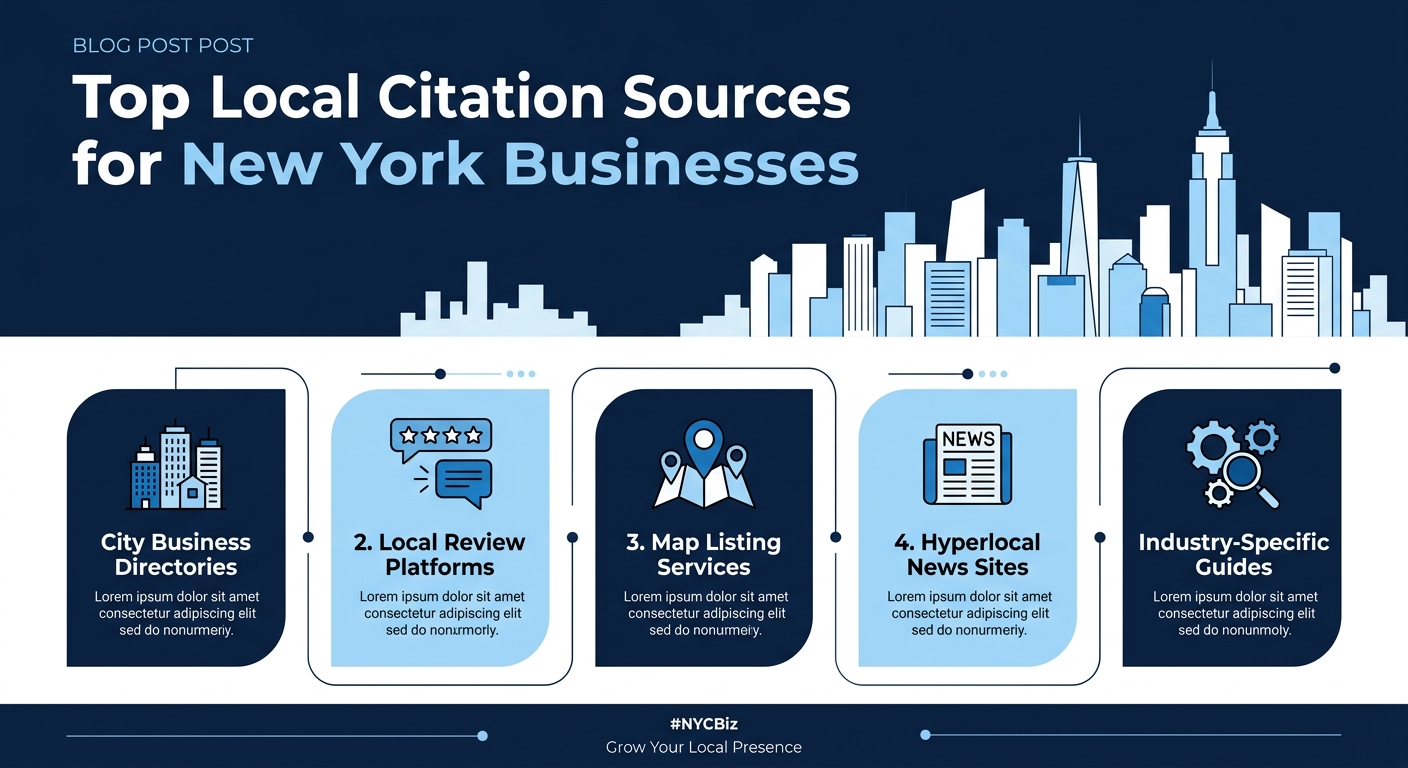
Introduction to Local Citations for New York Businesses
New York is home to millions of residents, hundreds of thousands of small businesses, and some of the most demanding customers anywhere in the world. Whether you run a bakery in Brooklyn, a law firm in Manhattan, or a plumbing company in Queens, your future customers are searching on their phones right now. They want a nearby option they can trust within a few seconds.
Local citations are one of the quiet foundations that help those customers find you. A citation is any online mention of your business name, address, and phone number, and search engines use these mentions to confirm that your company is real, active, and located where you say it is. The more accurate and consistent mentions you have, the more confident search engines become in showing your business.
In a market as crowded as New York, that confidence can be the difference between appearing in the top three map results and being buried several pages down. This guide explores the most valuable citation sources for New York businesses, explains how they work, and shows you how to build a clean and lasting presence. The first step is understanding the fundamentals you need before you submit your details anywhere.
Here is what you will learn throughout this guide:
- What local citations are and why they carry real weight in local search
- How citations support your visibility across all five boroughs
- Why consistent business details matter so much for rankings and trust
- Which directories and platforms deserve your time and budget first
What Local Citations Are and Why They Matter
A local citation is any place on the web where your business details appear, whether or not it includes a link to your website. Common examples include business directories, social profiles, review sites, chamber of commerce listings, and local news mentions. Each one acts like a small signal that tells search engines your business exists at a certain place.
Citations come in two main forms that work together. Structured citations appear in organized listings, such as a directory entry with fields for your name, address, phone number, hours, and categories. Unstructured citations appear in free text, such as a blog post about a neighborhood street fair that mentions your shop, or a news article that quotes your owner.
| Citation Type | Where It Appears | Typical Example | Main Benefit |
|---|---|---|---|
| Structured | Directories and listing platforms | A business profile with address, phone, and hours | Easy verification of your core details |
| Unstructured | Articles, blogs, and event pages | A local news story that mentions your company | Adds natural credibility and community relevance |
| Partial | Social posts and short mentions | A tagged post that includes your name and area | Supports brand awareness and local association |
Citations matter because they build trust on two levels. First, they help search engines verify your details by comparing them across many independent sources. Second, they help real people find you, because many customers still discover businesses through directories, maps, and review platforms before they ever visit a website.
It also helps to understand how citations differ from backlinks. A backlink is a link from another website to yours, while a citation is a mention of your business details that may or may not include a link. Many citations do carry links, so they often deliver both benefits at the same time.
For New York businesses, citations matter even more because of density. A single block in Manhattan can hold dozens of competitors in the same category, and search engines look for stronger proof of legitimacy when many businesses offer similar services. A well maintained citation profile is one of the most reliable ways to supply that proof.
The main advantages of building a strong citation profile include the following:
- Better visibility in map results and local searches
- Greater customer trust through accurate and complete listings
- Extra referral traffic from busy, well known directories
- Protection against wrong details that send customers to the wrong place
How Citations Influence Local Search in the Five Boroughs
Local search results are shaped by three broad ideas, which are relevance, distance, and prominence. Relevance is how well your listing matches what someone searched for, distance is how close you are to the searcher or the area they named, and prominence is how well known and trusted your business appears. Citations contribute mostly to prominence and to the verification of your location.
New York adds a layer of complexity because people search by neighborhood as much as by city. Someone may type a phrase that includes Williamsburg, Astoria, Harlem, or Park Slope instead of the borough name. Citations that show your full address and service area help search engines connect your business to those micro locations.
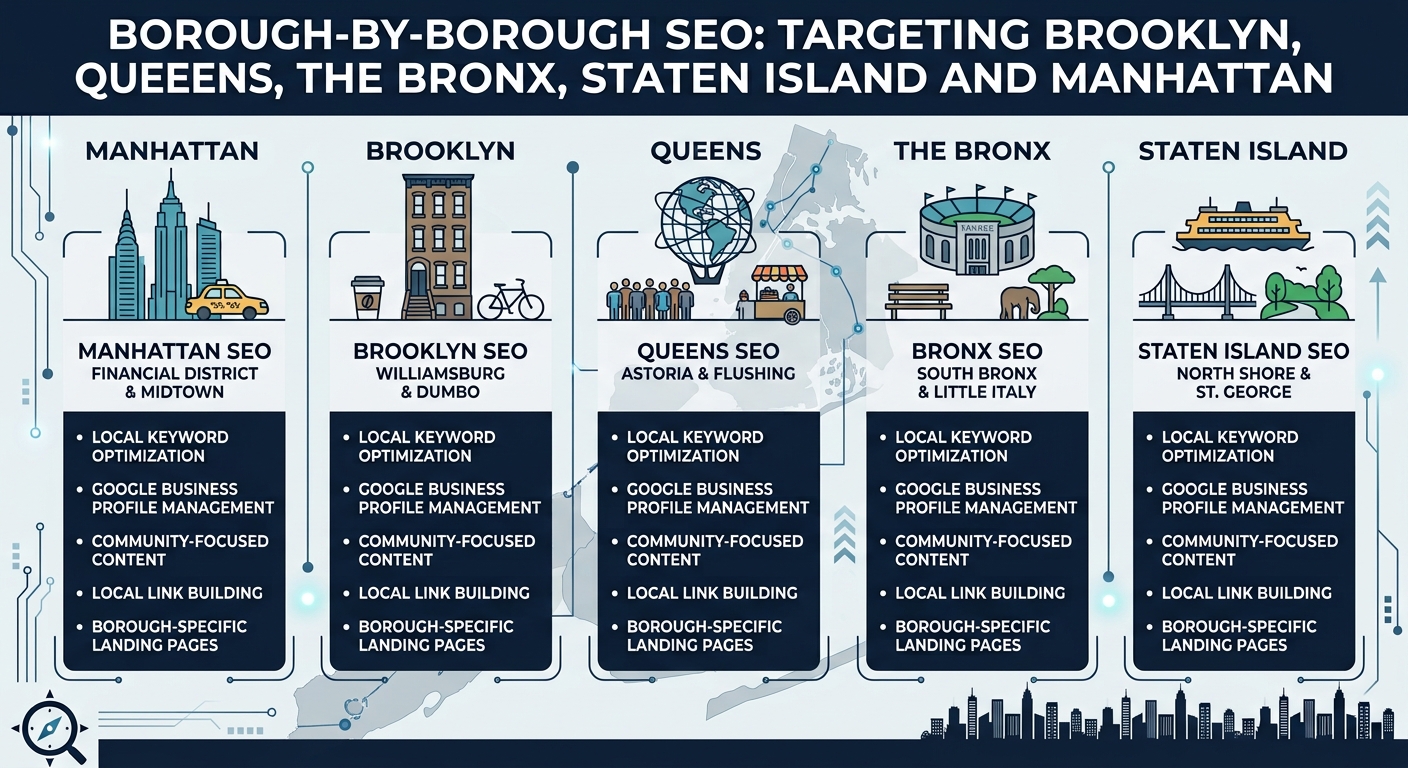
Each borough has its own character, and that affects how you approach citations. Manhattan is dominated by professional services, hospitality, and retail, which makes competition intense. Brooklyn and Queens have strong community driven discovery with many independent shops and restaurants, while the Bronx and Staten Island often have less citation competition, so a well built profile can stand out faster.
Consider these borough specific ideas when planning your citation strategy:
- Manhattan: focus on premium directories, industry platforms, and listings that show exact building and suite details
- Brooklyn: pair standard directories with neighborhood blogs, local guides, and community event pages
- Queens: create profiles that reflect the multilingual communities you serve, since the borough is among the most diverse places on earth
- The Bronx: prioritize community organizations, local business associations, and clear service area information
- Staten Island: use local chambers, island news outlets, and map platforms to capture nearby searches
Mobile behavior is another important factor in this city. Many New Yorkers search while walking, commuting on the subway, or moving between meetings, and they often use phrases such as open now or near me. Accurate hours and consistent details across your citations help your business appear for those urgent, high intent searches.
NAP Consistency Explained
NAP stands for name, address, and phone number, and it is the core data set behind every citation. Consistency means that these three details appear in exactly the same way everywhere your business is listed. Even small differences, such as Street versus St or a missing suite number, can create confusion for search engines.
New York addresses create special challenges that businesses in smaller cities rarely face. Many buildings contain dozens of tenants, so suite and floor numbers are essential, and some street names exist in more than one borough. Writing your address in one standard format and reusing it everywhere avoids these problems and protects your rankings.
Use this checklist to keep your details clean:
- Choose one official version of your business name and never add extra keywords or descriptions to it
- Write your address in a single format that includes the suite or floor number, and use it on every listing
- Use one primary local phone number, ideally with a New York area code such as 212, 718, 917, 646, or 347
- Link to the same website address on every listing and keep your hours identical across platforms
Businesses with multiple locations should create a separate listing for each branch with its own address and local phone number. Pointing every branch to one generic number weakens the link between each location and its neighborhood. If you use call tracking numbers, keep your main number as the primary one on all listings and add the tracking number only as a secondary option where the platform allows it.
Consistency also applies to categories and descriptions. Choose primary categories that accurately describe what you do, and keep your business description similar in meaning across directories while varying the wording slightly. This keeps your information accurate without producing identical text on every site, which can look repetitive and reduce the value of each listing.
Before you submit to any new source, it is wise to audit what already exists online about your business. Older listings, previous addresses, and former phone numbers often linger on directories for years and quietly work against you. Cleaning these up first gives you a solid base, and it makes every new citation you build far more effective.
With the foundation in place, you now understand what citations are, how they shape local visibility across the boroughs, and why accurate business details are so important. The next step is choosing the specific platforms, directories, and industry sources that deserve a place in your strategy.

Top Data Aggregators and Major Platforms
Data aggregators are companies that collect, verify, and distribute business information to hundreds of smaller directories, apps, and navigation tools. When your details are correct at the source, they flow outward to many other places automatically. This makes aggregators one of the most efficient starting points for any New York business that wants wide and accurate coverage.
The best known aggregators include Data Axle, Foursquare, and Localeze. Each one feeds information to GPS systems, mobile apps, voice assistants, and online directories that customers use every day. A single correction at this level can fix errors on dozens of sites that you would otherwise need to chase one by one.
Alongside the aggregators sit the major platform profiles that directly power map and search results. These are the profiles that most customers see first, so they deserve the most careful setup and the most regular attention.
- Google Business Profile: the most important listing for local visibility, since it controls how your business appears in map results and the local pack
- Apple Business Connect: supplies the details shown in Apple Maps and Siri, which matters in a city with a very high share of iPhone users
- Bing Places: feeds Bing search and several voice assistants, and it can be imported quickly from an existing Google profile
- Facebook Business Page: acts as both a social profile and a citation, and many customers check it for hours, photos, and recent updates
Setting up these profiles fully is far better than creating thin, half finished listings. Add accurate categories, service areas, hours, attributes, high quality photos, and a clear description written in natural language. Complete profiles earn more engagement, and engagement sends positive signals about your business.
| Platform | Primary Role | Priority Level | Best For |
|---|---|---|---|
| Google Business Profile | Map and local pack visibility | Essential | All business types |
| Apple Business Connect | Apple Maps and Siri results | Essential | Retail, dining, services |
| Bing Places | Bing and voice assistant results | High | All business types |
| Data Axle | Data distribution to many directories | High | All business types |
| Foursquare | Data for apps and navigation tools | High | Dining, retail, venues |
| Localeze | Distribution to search and mapping partners | High | All business types |
Many owners wonder whether it is worth the effort to submit to aggregators when they have already built the major profiles. The answer is usually yes, because aggregator data supports the long tail of smaller directories that you will never have time to manage manually. It also reduces the chance that an outdated record will appear and conflict with the details you worked hard to standardize.
Best General Business Directories for New York
General directories list businesses from every industry, and they remain a core part of a healthy citation profile. They offer broad reach, steady traffic, and strong trust signals when the information is accurate. For New York businesses, the goal is to choose well established directories rather than submit to every site available.
Quality matters far more than quantity here. A small group of respected directories will do more for your visibility than hundreds of low quality sites that offer no real audience. Spammy directories can even attract unwanted attention, so it pays to be selective.
The following general directories are widely recognized and worth considering for most New York businesses:
- Yelp: a major discovery platform in New York, where diners, shoppers, and service seekers often begin their search
- Yellow Pages: a long standing directory that still earns steady traffic and feeds data to other sites
- Better Business Bureau: adds a layer of trust, especially for service providers and professional firms
- Manta: a directory focused on small businesses, with detailed profiles and category listings
- Superpages: a familiar name with national reach and local filtering by city and neighborhood
- MapQuest: supports navigation searches and draws data from several major aggregators
- Nextdoor: connects your business directly with neighbors who trust recommendations from people nearby
Each directory serves a slightly different purpose, and the table below summarizes how to think about them when planning your time and effort.
| Directory | Main Strength | Effort Level | Value for New York Businesses |
|---|---|---|---|
| Yelp | Customer reviews and discovery | Medium | Very high in dense urban searches |
| Yellow Pages | Broad reach and data sharing | Low | Solid baseline citation |
| Better Business Bureau | Trust and accreditation | Medium | High for service and professional firms |
| Manta | Small business visibility | Low | Good supporting citation |
| Superpages | Local search filtering | Low | Useful supporting citation |
| MapQuest | Navigation and map traffic | Low | Helpful for in person visits |
| Nextdoor | Neighborhood recommendations | Medium | Strong for local service providers |
When you claim a listing, always check whether the directory already has an entry for your business before creating a new one. Duplicate listings split your authority and confuse customers, so it is better to claim and correct an existing record whenever possible. Take a few minutes to verify the details and add photos, since complete profiles perform better than bare ones.
It also helps to keep a simple tracking sheet of every directory you submit to. Record the date, the login details, the listing address, and the verification status for each one. This record becomes extremely valuable when you need to update your information after a move, a rebrand, or a change in phone number.
Social and Review Platforms
Social and review platforms play a dual role because they work as citations and as direct customer touchpoints. New Yorkers rely heavily on reviews when choosing where to eat, which professional to hire, or which contractor to trust. A strong presence on these platforms supports both your search visibility and your reputation.
Your social profiles should carry the same name, address, and phone number as every other listing. Instagram, LinkedIn, X, Pinterest, and YouTube all allow you to add business details, and a consistent presentation across them strengthens your overall identity. Even when a platform does not pass direct ranking value, it reinforces the accuracy of your data in the eyes of customers.
Review platforms deserve special attention because they influence decisions at the exact moment a customer is choosing. Google reviews, Yelp reviews, and industry specific review sites all shape how your business is perceived and ranked. Businesses that collect fresh reviews on a steady basis tend to look more active and trustworthy than those with a few old comments.
Follow these habits to manage reviews well:
- Ask satisfied customers for reviews soon after a positive experience, while the details are still fresh in their minds
- Respond to every review in a polite and professional tone, including negative ones, and offer a clear way to resolve concerns
- Never offer payment or gifts in exchange for reviews, since most platforms forbid it and may remove the reviews
- Share your direct review link in emails, receipts, and follow up messages to make the process easy
Responding to reviews also gives you a natural chance to mention your services and neighborhood in a helpful way. A thoughtful reply shows prospective customers that you value feedback, and it adds fresh content to your profile. This ongoing activity signals that your business is open and engaged with the community.
Industry Specific Directories
Industry specific directories attract highly targeted visitors who already know what kind of service they need. Because they focus on one field, they often carry strong relevance signals that general directories cannot match. For many New York businesses, a handful of the right industry listings will outperform dozens of generic ones.
Legal professionals benefit from platforms such as Avvo, Justia, and FindLaw, which allow attorneys to showcase practice areas and client feedback. Medical providers can use Healthgrades, Zocdoc, and Vitals, where patients search by specialty, insurance, and neighborhood. Restaurants and hospitality businesses gain visibility through TripAdvisor and OpenTable, which are especially popular with both residents and visitors.
Home service companies, contractors, and real estate professionals also have strong options. Angi, Houzz, and Thumbtack connect homeowners with trusted professionals, while Zillow, Realtor.com, and StreetEasy are heavily used by people searching for apartments and homes across the city. Technology and agency businesses often find value in Clutch, which highlights verified client reviews.
| Business Type | Recommended Directories | Why They Matter |
|---|---|---|
| Law firms | Avvo, Justia, FindLaw | Clients compare attorneys by practice area and rating |
| Medical and dental | Healthgrades, Zocdoc, Vitals | Patients search by specialty, location, and availability |
| Restaurants and cafes | TripAdvisor, OpenTable, Yelp | Diners and visitors choose based on reviews and booking ease |
| Home services | Angi, Houzz, Thumbtack | Homeowners look for vetted local professionals |
| Real estate | Zillow, Realtor.com, StreetEasy | Renters and buyers begin searches on these platforms |
| Agencies and tech firms | Clutch, LinkedIn | Buyers compare verified reviews and company profiles |
When choosing from these lists, pay attention to how active each platform is in the New York market. A directory with strong traffic in your category and borough is worth far more than a large site with little local use. Check whether competitors in your area are listed there, since their presence is a helpful sign that the audience is real.
Keep in mind that industry directories often require extra verification, such as license numbers or proof of certification. This extra step is a good thing, because it keeps low quality businesses out and raises the value of your listing. Treat these profiles as professional showcases by adding credentials, service details, and genuine client feedback.
With your major platforms, general directories, review sites, and industry sources in place, you have built the core of a strong citation profile. The next step is to add the uniquely local sources that only New York businesses can access and to follow a clear process for keeping everything accurate over time.

New York Local and Regional Sources
Beyond national directories, New York offers a rich set of local sources that carry strong geographic relevance. Search engines value these mentions because they come from organizations that are genuinely tied to the community. A listing on a respected local site tells search engines that your business belongs to the neighborhood it claims to serve.
Chambers of commerce are among the most valuable local sources. The Brooklyn Chamber of Commerce, the Queens Chamber of Commerce, the Bronx Chamber of Commerce, the Staten Island Chamber of Commerce, and the Manhattan Chamber of Commerce all publish member directories with trusted business details. Membership often includes event opportunities and networking, which can create additional unstructured mentions over time.
Business improvement districts and neighborhood associations are another strong option. Many areas such as Times Square, the Flatiron district, and Downtown Brooklyn maintain websites that promote nearby shops, restaurants, and services. These pages are highly relevant to searches that include a neighborhood name, and they often attract steady visitor traffic.
Government and civic resources also deserve attention. The city’s small business support portals, local library business resources, and community board pages often highlight local companies, especially those that take part in programs or events. Local news outlets, neighborhood blogs, and community newsletters can add unstructured citations when they feature your business in stories, event roundups, or best of lists.
Here are practical ways to earn these local mentions:
- Join the chamber of commerce that covers your borough and complete your member profile in full
- Sponsor or take part in neighborhood events, street fairs, and charity drives that are covered by local media
- Share newsworthy updates such as openings, anniversaries, awards, and community projects with local reporters and bloggers
- Contact your business improvement district and ask how member businesses can be featured on its website
Citation Priority Table
With so many options available, it helps to sort sources by impact and effort so that you spend your time wisely. The table below groups the main source types into tiers that you can follow in order. Start at the top, finish each tier, and then move down as your resources allow.
| Priority Tier | Source Type | Examples | Expected Impact | Effort Level |
|---|---|---|---|---|
| Tier One | Major platforms | Google Business Profile, Apple Business Connect, Bing Places | Very high | Medium |
| Tier Two | Data aggregators | Data Axle, Foursquare, Localeze | High | Low |
| Tier Three | General directories | Yelp, Yellow Pages, Better Business Bureau, Manta | High | Medium |
| Tier Four | Industry directories | Avvo, Healthgrades, TripAdvisor, Angi | High for relevant fields | Medium |
| Tier Five | Local and regional sources | Chambers, business improvement districts, local news | High for local relevance | Higher |
This structure keeps your strategy balanced. The top tiers give you broad coverage quickly, while the lower tiers deliver the deep local relevance that sets New York businesses apart from national competitors. Revisit the table every few months to confirm that your most important tiers are still complete and accurate.
How to Build and Audit Your Citations
A reliable process saves time and prevents mistakes. Follow these steps in order to build a clean and lasting citation profile.
- Create a master document that holds your official business name, address, phone number, website, hours, categories, and description
- Search for your business name and phone number to find existing listings, including old or duplicate ones
- Claim and correct existing listings before creating any new ones, and request removal of duplicates
- Submit to your tier one and tier two sources first, then work down through the remaining tiers
- Record every listing in a tracking sheet with the date, login details, link, and verification status
- Review your listings every three to six months and update them after any change in hours, location, or contact details
Auditing is just as important as building. Over time, directories merge records, scrape data from other sites, and sometimes overwrite correct details with outdated ones. A regular review catches these problems early, before they affect your rankings or confuse customers.
When you find a duplicate listing, handle it carefully. Use the platform’s official process to merge or remove it instead of simply abandoning it. Leaving duplicates untouched can split reviews, dilute authority, and send customers to old phone numbers or closed locations.
Common Citation Mistakes to Avoid
Even experienced owners make mistakes that quietly hurt local performance. Knowing the most common ones helps you avoid them from the start.
- Using different business names, addresses, or phone numbers across listings
- Leaving listings unclaimed, which allows others to edit your details or add incorrect information
- Submitting to low quality or spammy directories that offer no real audience
- Stuffing keywords into your business name, which can lead to suspensions on major platforms
- Forgetting to update listings after a move, rebrand, or change in hours
- Ignoring reviews and questions, which makes a profile look inactive
Each of these issues is easy to prevent with a clear process and regular attention. Treat your citation profile as a living asset rather than a one time task, and it will keep working for your business year after year.
Why Choose DealMate
Building and maintaining citations across dozens of platforms takes time that most New York business owners simply do not have. DealMate offers a dependable and organized way to handle this work so that you can focus on serving customers. Our approach is built on accuracy, consistency, and clear communication from the first audit to the final report.
Our team begins by reviewing your existing online presence and identifying errors, duplicates, and missed opportunities. We then submit your business details to carefully selected platforms, including major profiles, trusted directories, industry sources, and local New York sites. Every submission follows your approved information, which keeps your name, address, and phone number consistent everywhere.
Here is what you can expect when you work with DealMate:
- A thorough audit of your current listings with clear findings and recommendations
- Careful submissions to high quality directories chosen for your industry and borough
- Cleanup and correction of duplicate, outdated, or inaccurate listings
- Transparent reporting that shows exactly where your business is listed
- Ongoing support to keep your information accurate as your business grows and changes
We believe that strong local visibility should be built on honest, quality work rather than shortcuts. With DealMate, you gain a partner who understands the demands of the New York market and takes responsibility for the details that matter. Reach out to start building a citation profile that supports lasting growth.
Frequently Asked Questions
What is a local citation?
A local citation is any online mention of your business name, address, and phone number. It can appear in a directory, a social profile, a review site, or a news article. Search engines use these mentions to confirm that your business is real and located where you say it is. The more accurate mentions you have, the more trust your business can earn.
Why do local citations matter for New York businesses?
New York has intense competition in nearly every category, so search engines look for strong proof of legitimacy. Citations provide that proof by showing consistent details across many trusted sources. They also help customers find you through directories and maps they already use daily. A strong citation profile can improve your visibility in neighborhood level searches across all five boroughs.
How many citations does a business need?
There is no single magic number, because quality matters more than quantity. Most businesses do well with a core set of major platforms, trusted general directories, relevant industry sites, and a few local sources. Competitive categories may require a larger footprint than quieter ones. It is wise to compare your profile with top ranking competitors in your area to set a realistic goal.
What is NAP consistency?
NAP stands for name, address, and phone number, and consistency means they appear identically on every listing. Small differences such as abbreviations or missing suite numbers can confuse search engines. Consistent details make it easier for platforms to verify your business and connect your listings together. This protects your rankings and prevents customers from reaching wrong or outdated information.
Are citations still important for search rankings?
Yes, citations remain a useful part of local search because they support verification and prominence. They work best alongside a complete Google Business Profile, fresh reviews, and a helpful website. While they are not the only factor, missing or inaccurate citations can hold back an otherwise strong profile. Treat them as a foundation that supports your other marketing efforts.
How long does it take to see results from citation building?
Some listings go live within days, while others take several weeks to be reviewed and published. Data aggregators may need a few weeks to pass updates to the sites they supply. Improvements in visibility usually appear gradually over one to three months. Results depend on your competition, your industry, and the quality of your overall online presence.
Should I remove duplicate listings?
Yes, duplicate listings should be merged or removed through each platform’s official process. Duplicates can split reviews and authority between several records. They may also show old phone numbers or addresses that confuse customers. Cleaning them up improves accuracy and strengthens the listing you want people to see.
Do I need citations if I have a Google Business Profile?
A Google Business Profile is essential, but it works best when supported by citations on other platforms. Other sources help confirm that your details are correct and widely recognized. They also reach customers who use different apps, directories, and voice assistants. Relying on a single profile leaves your business exposed if that profile faces a suspension or an error.
How often should I update my citations?
You should update your listings whenever your hours, address, phone number, or services change. Even without changes, a review every three to six months helps catch errors introduced by directories. Seasonal hours and holiday schedules should also be updated in advance. Regular maintenance keeps your information trustworthy and prevents small mistakes from growing into larger problems.
Can I manage citations myself or should I hire a professional?
You can manage citations yourself if you have time, patience, and a careful process. The work involves auditing existing listings, submitting to many platforms, and checking them regularly. Many owners choose a professional service because it saves time and reduces the risk of costly errors. A trusted partner such as DealMate can handle the details while you focus on running your business.
Conclusion
Local citations remain one of the most dependable ways to strengthen your presence in a crowded and fast moving market like New York. By starting with major platforms and data aggregators, adding respected general and industry directories, and finishing with uniquely local sources, you create a profile that search engines and customers can trust. Consistency in your name, address, and phone number ties everything together and protects the value of every listing.
The most successful businesses treat citation building as an ongoing habit rather than a one time project. Regular audits, prompt updates, and thoughtful review management keep your information accurate and your reputation strong. Begin with the highest priority sources today, follow the process step by step, and watch your visibility grow across every borough you serve.