
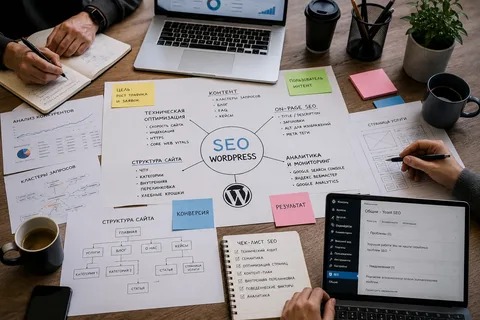
WordPress SEO can look simple from the outside. Install an SEO plugin, add keywords, publish articles, and wait for rankings.
In reality, effective SEO requires a more structured approach.
Experienced WordPress SEO professionals do not normally optimize a website based on a single checklist. They first understand the website, its audience, competitors, technical setup, and business goals. Then they build an SEO strategy around those factors.
They Start With an Audit

Before changing anything, an SEO professional usually wants to know what already exists.
A WordPress SEO audit can examine:
- Website structure
- Indexing status
- Existing rankings
- Page titles
- Meta descriptions
- Headings
- Internal links
- Broken links
- Site speed
- Mobile usability
- XML sitemap
- Robots.txt
- Duplicate content
This prevents unnecessary changes and helps identify the highest-priority issues.
They Understand Search Intent
Experts do not choose keywords simply because they have high search volume.
They ask what the searcher actually wants.
For example, these searches have different intentions:
- “What is WordPress SEO?” → informational
- “WordPress SEO services” → commercial
- “WordPress SEO agency” → service-related
- “How to optimize WordPress” → informational
The page should match the intent behind the search.
Creating a service page for a question that requires an educational answer may not provide the best experience.
They Build a Logical Site Structure
A strong WordPress website should make relationships between pages clear.
For example:
Home
↓
SEO Services
↓
WordPress SEO
↓
Technical SEO / On-Page SEO / Local SEO
Supporting blog content can then link naturally to relevant service pages.
This structure helps visitors navigate the website while giving search engines useful context.
They Optimize Existing Content
SEO experts do not always recommend publishing more content.
Sometimes the better opportunity is improving pages that already exist.
They may review:
- Outdated information
- Weak headings
- Missing search intent
- Poor internal linking
- Thin sections
- Duplicate topics
- Unclear page titles
- Missing supporting information
For example, an old article receiving impressions but few clicks may benefit from a clearer title and stronger content rather than being replaced entirely.
They Pay Attention to Technical SEO
Technical SEO is an important part of WordPress optimization.
Professionals may investigate issues involving:
| Area | What They Check |
|---|---|
| Indexing | Which pages search engines can access |
| Crawling | Whether important pages are reachable |
| Speed | Loading and performance problems |
| Mobile | Usability on smaller screens |
| Redirects | Incorrect or unnecessary redirects |
| Canonicals | Preferred versions of URLs |
| Sitemap | Whether important URLs are included |
| Links | Broken or problematic internal links |
The exact work depends on the website.
They Avoid Blind Plugin Changes
WordPress offers many SEO plugins and optimization tools.
However, installing multiple plugins that perform the same function can create conflicts.
An experienced professional first checks the current configuration before adding another tool.
The same principle applies to themes, caching plugins, redirects, schema, and performance settings.
They Use Data to Guide Decisions
SEO experts monitor performance instead of relying entirely on assumptions.
They may compare:
- Organic clicks before and after optimization
- Search impressions
- Ranking changes
- Conversion activity
- Pages gaining or losing traffic
- Search queries generating impressions
This makes SEO more measurable and helps determine which areas need additional attention.
They Prioritize High-Impact Work

Not every SEO issue deserves the same amount of time.
For example, fixing a major indexing problem can be more important than spending hours adjusting minor metadata across low-value pages.
A practical priority system might look like:
High priority: indexing, major technical errors, important service pages
Medium priority: internal linking, content improvements, page speed
Ongoing: content expansion, authority building, performance monitoring
This helps keep SEO focused on meaningful improvements.
They Think Beyond Rankings
Search rankings are important, but they are not the only objective.
A website can receive organic traffic without generating meaningful business results.
Professionals also consider whether visitors:
- Find the information they need
- Reach important service pages
- Contact the business
- Request a quote
- Purchase a product
- Complete another desired action
This connects SEO activity with actual website goals.
Working With a WordPress SEO Agency
For businesses that do not have the time or technical knowledge to manage SEO themselves, a WordPress SEO agency can provide ongoing support.
Depending on the project, that support may include technical audits, keyword research, content optimization, internal linking, performance improvements, local SEO, and regular reporting.
The strongest approach is usually not about making the largest number of changes. It is about understanding the website, identifying meaningful opportunities, implementing changes carefully, and measuring what happens afterward.

















