Introduction to SEO Audit Services in Florida
🔍 Search engine optimization plays an important role in helping businesses improve their online visibility, attract relevant visitors, and generate more customer inquiries. However, even a well-designed website can experience ranking problems, declining traffic, technical errors, or weak conversion rates. SEO audit services in Florida help businesses identify these issues, understand their causes, and develop a practical plan for improving search performance.
Florida has a competitive business environment, with companies across Miami, Orlando, Tampa, Jacksonville, Fort Lauderdale, and other communities competing for attention online. Whether a company provides home improvement services, healthcare, legal assistance, real estate, or digital marketing, its website must meet customer expectations and remain accessible to search engines. A professional SEO audit examines the factors that influence website performance and identifies opportunities to strengthen organic visibility.
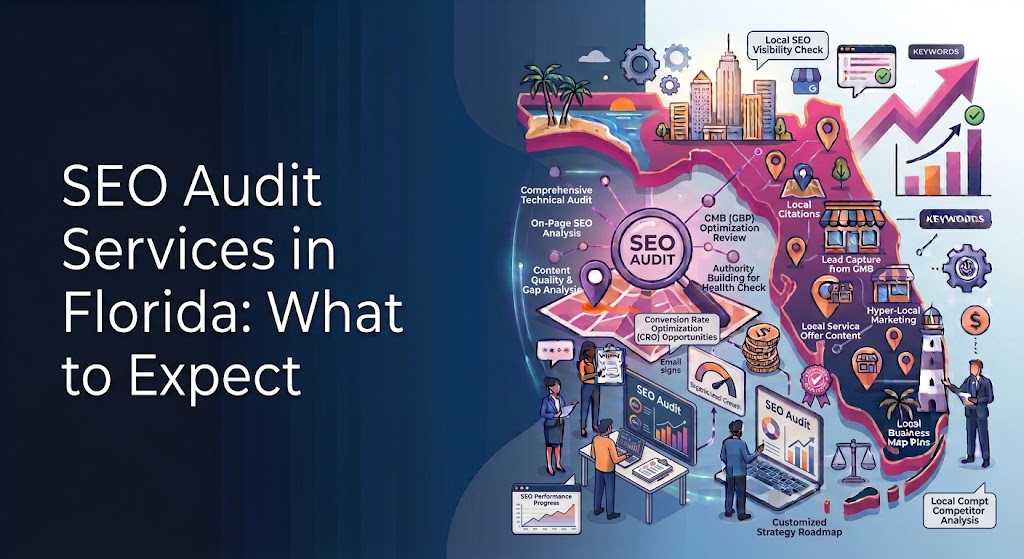
An SEO audit is more than a quick review of keywords or website rankings. It typically involves analyzing technical SEO, on-page optimization, content quality, internal links, backlinks, mobile usability, local search presence, and conversion opportunities. The scope depends on the website’s size, business objectives, current problems, and competitive environment.
📈 For Florida businesses, the main purpose of an SEO audit is to understand what is working, what needs improvement, and which changes should receive priority. A detailed audit provides a clearer picture of website health and helps businesses avoid spending resources on activities that do not address their most important problems. By using the findings to guide ongoing optimization, companies can build a stronger foundation for sustainable search visibility and business growth.
Understanding What an SEO Audit Includes
An SEO audit is a structured evaluation of a website’s ability to be discovered, understood, and ranked by search engines. It also considers whether the website provides a useful experience for visitors who arrive through organic search. Rather than assuming that every website has the same weaknesses, an audit examines the site’s current condition and identifies issues relevant to its goals.
A typical audit begins with an initial assessment of the website, its existing search performance, and its business priorities. SEO professionals may review search impressions, organic traffic trends, indexed pages, keyword visibility, technical errors, and important landing pages. This information helps establish a baseline against which future improvements can be evaluated.
The technical portion of an audit examines whether search engines can access and process important pages effectively. The on-page review considers headings, title tags, meta descriptions, content relevance, image optimization, and internal links. Other areas may include backlink quality, local SEO signals, mobile performance, site security, and conversion tracking.
A professional audit should produce actionable findings rather than a long list of technical warnings without explanations. Each important issue should be described in clear language, including why it matters, which pages are affected, and what corrective action is recommended. Businesses should also receive a sensible order of priorities so they can address the most important problems first.
Key Areas Covered in an SEO Audit
The exact scope varies, but many SEO audit services examine the following areas:
- Technical SEO to identify crawling, indexing, redirect, and website accessibility problems.
- On-page SEO to evaluate titles, headings, content relevance, image attributes, and page optimization.
- Content quality to identify thin, outdated, repetitive, or poorly targeted pages.
- Website structure to review navigation, URL organization, and internal linking.
- Backlink analysis to assess referring domains, link relevance, and potential risks.
- Local SEO to evaluate location pages, business listings, and local search visibility.
- User experience to identify usability problems that may discourage visitors from engaging.
- Performance measurement to review analytics, conversion tracking, and existing search results.
These areas work together, so an audit should consider how individual problems affect the website as a whole. For example, improving content may have limited value if search engines cannot index the page properly. Similarly, strong rankings may not produce enough inquiries if visitors encounter confusing service information or broken contact forms.
Why Florida Businesses Need Regular SEO Audits
Search engine optimization is an ongoing process, and website conditions can change over time. New pages, website redesigns, software updates, changes in search behavior, and competitor improvements can all affect organic performance. Regular SEO audits help businesses detect emerging problems and maintain a website that supports their marketing objectives.
Florida companies often serve competitive local markets where visibility can influence how many potential customers discover their services. A roofing contractor in Tampa, for example, may depend on search traffic for inspections, repairs, and roof replacements. If important service pages develop indexing issues or competitors improve their content, the contractor may lose opportunities to attract relevant inquiries.
An audit can also reveal problems that are difficult to notice during routine website management. Broken links, redirect chains, duplicate page versions, missing metadata, and inconsistent location information may remain unnoticed until they affect search performance or the visitor experience. A structured review helps uncover these issues before they become more difficult to resolve.
Identifying the Reasons Behind Traffic Declines
A decline in organic traffic can occur for several reasons, and the cause is not always obvious. A website may lose rankings because of technical errors, changes in search demand, stronger competitors, outdated content, or shifts in the types of results shown for relevant searches. An SEO audit helps narrow down possible explanations by examining performance data and website conditions together.
Businesses should also distinguish between a genuine search visibility decline and normal fluctuations in visitor behavior. Seasonal industries, including tourism and some home services, may experience changing demand throughout the year. Comparing appropriate time periods and reviewing search impressions, clicks, and landing page performance can help identify meaningful trends.
Supporting Website Redesigns and Business Expansion
An SEO audit is especially valuable before and after a website redesign. Changes to URL structures, navigation, page templates, redirects, or indexing settings can affect how search engines discover existing content. Reviewing these elements before launch can help reduce avoidable visibility problems, while a post-launch audit can identify issues that appear after the new website becomes available.
Businesses expanding into additional Florida cities or introducing new services may also benefit from an audit. The review can assess whether the website structure supports the expansion and whether existing content clearly represents the company’s services and coverage areas. This creates a more organized foundation for future optimization efforts.
How SEO Experts Evaluate Website Performance
Website performance evaluation helps SEO professionals understand how a website currently appears in search results and how visitors interact with it. Instead of relying on a single ranking report, a thorough assessment combines several types of evidence. This makes it easier to identify patterns and distinguish technical problems from content or competition-related challenges.
SEO experts may examine organic traffic, search impressions, click-through rates, landing page engagement, indexed URLs, and conversion activity. They can also compare current performance with earlier periods to identify important changes. The most useful metrics depend on the business model, because a local service provider may value qualified calls more than general page visits.
Reviewing Organic Search Traffic
Organic search traffic refers to visits that come from unpaid search engine results. An audit examines whether this traffic is increasing, declining, or concentrated on a small number of pages. It may also identify whether visitors are reaching pages that support the company’s commercial objectives.
For example, a Florida accounting firm might receive traffic from general tax information articles but very few visits to its business accounting service pages. This pattern could suggest an opportunity to improve internal links, expand service page content, or target more relevant commercial searches. The correct response depends on the search queries, user behavior, and existing content quality.
Evaluating Search Visibility and Click-Through Rates
Search visibility includes how frequently a website appears for relevant queries and how often users click its listings. Search impressions can show that a page is being displayed, while clicks indicate that users have selected it from the results. Reviewing these metrics together helps identify pages that may benefit from clearer titles, more relevant content, or improved search targeting.
A page receiving many impressions but relatively few clicks may have a title that does not clearly communicate its value, or it may appear for queries that do not match its content closely. However, click-through rates also vary by ranking position, search intent, device, and search result layout. SEO professionals should examine these factors before recommending changes.
Connecting SEO Performance With Business Goals
An effective audit should connect website performance with the outcomes that matter to the business. Depending on the company, these outcomes may include phone calls, contact form submissions, appointment bookings, quote requests, or online purchases. Tracking these actions helps determine whether search visibility is contributing to real business opportunities.
A website can attract substantial traffic while producing few qualified leads, which may indicate a mismatch between visitor intent and the services offered. Conversely, a smaller number of highly relevant visitors may generate valuable inquiries. A performance review should therefore consider traffic quality and conversion activity alongside rankings and impressions.
Technical SEO Audit and Website Health
⚙️ Technical SEO focuses on the website infrastructure and settings that help search engines access, crawl, interpret, and index pages. Technical problems can limit search visibility even when the website contains useful information. An SEO audit examines these issues to identify barriers that may prevent important pages from appearing appropriately in search results.
Common technical review areas include crawling, indexing, redirects, canonical tags, XML sitemaps, robots directives, HTTPS security, structured data, and broken links. The audit may also review website architecture and page templates to identify patterns affecting multiple URLs. The scope should reflect the website’s size and complexity rather than treating every technical warning as equally important.
Checking Website Accessibility for Search Engines
Search engines use automated crawlers to discover and process web pages. If important pages are blocked unintentionally, buried too deeply within the site structure, or inaccessible because of server errors, search engines may struggle to find or index them. A technical audit examines these conditions and recommends corrections where necessary.
The review may include robots.txt directives, meta robots tags, HTTP status codes, XML sitemaps, and internal links. These elements need to work together so search engines can access the pages that should be discoverable while avoiding unnecessary or restricted URLs. An SEO professional should verify the actual cause of any accessibility issue before recommending a change.
Identifying Redirects and Broken Links
Redirects help send visitors and search engines from an old URL to a relevant destination. They are useful during website migrations, page replacements, and URL changes, but poorly managed redirects can create unnecessary chains or send visitors to irrelevant pages. An audit identifies these problems and recommends a suitable redirect structure.
Broken links can lead visitors to pages that no longer exist or return errors. These issues can create frustration and interfere with navigation, particularly when they affect important service pages or contact pathways. Correcting broken links and updating outdated references helps maintain a more reliable website experience.
Reviewing Canonical Tags and Duplicate URLs
Websites sometimes contain multiple URLs that display similar or identical content. This can occur because of tracking parameters, alternative URL versions, ecommerce filters, or inconsistent technical settings. Canonical tags can help indicate the preferred version of a page, although search engines may consider other signals when selecting the URL they index.
An SEO audit checks whether canonical tags point to appropriate destinations and whether important pages have conflicting indexing signals. It may also examine HTTP and HTTPS versions, trailing slash variations, and other URL inconsistencies. The objective is to reduce unnecessary duplication and help search engines identify the preferred pages.
Website Crawling and Indexing Analysis
Website crawling and indexing are related but distinct processes. Crawling occurs when search engines access pages to discover or revisit their content, while indexing involves processing information and deciding whether a page should be included in the search index. A page can be accessible to a crawler without necessarily being indexed or appearing prominently in search results.
SEO audit services often use crawling tools and search engine reporting to identify pages with missing metadata, broken links, duplicate titles, redirect issues, or inconsistent status codes. These tools can provide a broad view of website structure and highlight patterns that may be difficult to discover manually. Findings should then be reviewed to distinguish genuine problems from harmless technical variations.
Examining Important Indexed Pages
Businesses should verify whether their most valuable pages are eligible for indexing and appear in search results when appropriate. These pages may include core service pages, important location pages, product categories, and high-value educational resources. If a critical page is missing from the index, the audit should investigate whether technical settings, content quality, duplication, or other factors may explain the situation.
Not every page needs to be indexed. Internal search results, some filtered URLs, administrative pages, and duplicate versions may not provide sufficient value to justify indexing. A good audit focuses on ensuring that the right pages are discoverable rather than maximizing the number of indexed URLs without considering quality.
Reviewing XML Sitemaps and Crawl Efficiency
An XML sitemap lists URLs that a website owner wants search engines to discover. It can support URL discovery, especially on larger websites, but it does not force search engines to crawl or index every listed page. An audit checks whether the sitemap includes relevant, canonical URLs and excludes URLs that should not be presented as preferred pages.
For large websites, crawl efficiency may become important because numerous low-value or duplicate URLs can complicate the discovery of important content. SEO professionals can review internal linking, URL parameters, redirects, and unnecessary page variations to identify potential improvements. The recommended actions should be based on the site’s actual structure and crawl behavior.
Website Speed and Core Web Vitals Assessment
⚡ Website speed influences how quickly visitors can access information and interact with a page. Slow-loading websites can frustrate users, especially when they are searching for an urgent service or browsing on a mobile connection. An SEO audit evaluates performance issues and identifies practical ways to make important pages load and respond more efficiently.
The review may include image file sizes, JavaScript execution, CSS resources, server response times, caching, and third-party scripts. Large images and unnecessary scripts can delay content display or interfere with interaction. Optimizing these elements can improve usability, although the appropriate fixes depend on the website’s technology and current performance.
Understanding Core Web Vitals
Core Web Vitals are a set of user experience metrics used to evaluate aspects of loading performance, interactivity, and visual stability. They include Largest Contentful Paint, Interaction to Next Paint, and Cumulative Layout Shift. These measurements help website owners understand whether important page experiences are loading smoothly and responding reliably.
An audit may use available field data, laboratory tests, and performance tools to evaluate these metrics. Field data reflects real user experiences where sufficient data is available, while laboratory tests provide controlled conditions for diagnosing potential issues. The two approaches offer different insights and should be interpreted together when possible.
Prioritizing Performance Improvements
Not every speed issue has the same business impact. A slow homepage, a frequently visited service page, and a rarely used informational page may deserve different levels of attention. SEO professionals should prioritize problems that affect important pages, common user journeys, and measurable performance outcomes.
Common improvements include compressing images, using appropriate modern image formats, reducing unnecessary scripts, improving caching, and optimizing server performance. Changes should be tested after implementation to verify that they produce the intended result. Businesses should also ensure that speed improvements do not break essential functions such as forms, booking systems, or payment processes.

Mobile-Friendliness and Responsive Design Review
📱 Mobile usability is an important part of an SEO audit because many customers use smartphones to search for local businesses and compare services. A website that displays incorrectly on smaller screens can make it difficult for visitors to read content, navigate menus, or contact a company. Florida SEO experts examine how well the website adapts to different screen sizes and whether important actions remain accessible.
A responsive website adjusts its layout according to the visitor’s device and screen dimensions. During an audit, professionals may review text readability, image scaling, menu behavior, button placement, form usability, and horizontal scrolling. They also test important pages to identify layout problems that might not be visible when viewing the website on a desktop computer.
Evaluating Mobile Navigation and Readability
Mobile navigation should allow visitors to locate important information without unnecessary steps. Service categories, location details, contact information, and appointment options should be easy to find. If a menu covers important content or requires excessive scrolling, users may leave before discovering the information they need.
Text should be readable without requiring users to zoom in, and interactive elements should be easy to tap. Forms should use clear labels and appropriate input fields to simplify the process of submitting information. These improvements can make the website more convenient for customers searching for services while traveling or working away from their computers.
Testing Important Conversion Paths
A mobile SEO audit should test the actions that matter most to the business. These may include calling a phone number, submitting a contact form, requesting a quote, scheduling an appointment, or completing an online purchase. A page may appear visually correct but still have a broken button or malfunctioning form that prevents visitors from becoming leads.
Florida SEO professionals can identify these issues by testing real user journeys across different devices and browsers. They may also review analytics data to determine whether mobile visitors abandon important pages more frequently than desktop visitors. Addressing these problems can improve usability and help the website support its lead generation goals.
On-Page SEO Audit and Content Optimization
On-page SEO involves optimizing individual website pages so search engines and visitors can understand their purpose and relevance. An on-page audit examines titles, headings, descriptions, content quality, image attributes, internal links, and the relationship between each page and its target search queries. The goal is to identify opportunities to make important pages more relevant, informative, and useful.
Florida businesses often provide several services that appeal to different customer groups. A company offering air conditioning repair, system installation, and maintenance should make these services easy to distinguish on its website. When page content is vague or multiple pages target the same topic without a clear purpose, search engines and users may struggle to identify the most relevant page.
Reviewing Title Tags and Meta Descriptions
Title tags help communicate the main topic of a page and may influence how the page title appears in search results. An audit checks whether important pages have descriptive, unique titles that accurately reflect their content. Titles that are duplicated, missing, misleading, or unnecessarily repetitive may need improvement.
Meta descriptions provide a summary that search engines may use when displaying a result, although they can generate a different snippet from the page content. Clear descriptions can help explain the page’s value and encourage relevant users to visit. Businesses should avoid making unsupported claims or stuffing descriptions with repeated keywords.
Evaluating Headings and Page Structure
Headings organize content into understandable sections and help visitors locate information quickly. An SEO audit reviews whether the main heading accurately describes the page and whether supporting headings create a logical structure. Headings should guide readers through the content instead of being used simply to repeat keywords.
A service page might explain the service, describe its benefits, outline the process, answer common questions, and provide contact options. This structure can make the information easier to understand while supporting the visitor’s decision-making process. Clear organization is especially useful for people comparing several providers.
Optimizing Images and Other Page Elements
Images can support the content by showing products, completed projects, team members, or service examples. An audit may identify oversized image files, missing descriptive alternative text, unclear filenames, or images that fail to load properly. Appropriate image optimization helps improve accessibility and page performance without sacrificing useful visual information.
Alternative text should describe the meaningful content or purpose of an image rather than repeat keywords unnecessarily. Decorative images may be handled differently according to accessibility best practices. The objective is to make images useful to visitors and understandable to assistive technologies while maintaining a reliable browsing experience.
Keyword Research and Search Intent Analysis
Keyword research helps SEO professionals understand which searches are relevant to a business and how potential customers describe their needs. An SEO audit examines whether existing pages target appropriate keywords and whether the content matches the intent behind those searches. This review can reveal missed opportunities, irrelevant keyword targeting, and overlap between pages.
Florida businesses may need to target service-related phrases, local searches, informational questions, and comparison terms. For example, a person searching for emergency plumbing services in Orlando has different expectations from someone researching how to prevent pipe leaks. A strong website should provide the right type of page for each relevant search intent.
Identifying Missing Keyword Opportunities
An audit may reveal valuable keywords for which a business has limited or no relevant content. Search performance reports and keyword research tools can help identify queries related to existing services and potential customer needs. Professionals should assess the relevance and commercial value of these opportunities before recommending new pages.
A business should not create a separate page for every minor keyword variation. Closely related searches may be addressed effectively by one comprehensive page when they share the same intent. This approach helps avoid unnecessary duplication and keeps the website organized.
Finding Keyword Cannibalization
Keyword cannibalization is a term commonly used when multiple pages compete for similar search intent in a way that may weaken the site’s overall targeting. For example, a Florida landscaping company might have several nearly identical pages about lawn maintenance that offer no clear distinction between them. An audit can identify overlapping content and determine whether the pages should be improved, consolidated, or given more distinct purposes.
Having several pages rank for related terms is not automatically a problem. The important question is whether each page provides a useful, distinct purpose and whether the search results show a meaningful conflict between them. SEO professionals should examine actual performance and content before recommending consolidation.
Matching Keywords With Business Goals
The best keywords are not always those with the highest search volume. A local service provider may receive greater business value from a specific service query that attracts ready-to-hire customers than from a broad informational term. An audit should evaluate keyword relevance, competition, location, and likely customer intent together.
Keyword priorities should also reflect the company’s actual capabilities and target service areas. A business should not optimize for services it does not provide or locations it cannot realistically serve. This keeps the SEO strategy aligned with genuine customer needs and business objectives.
Website Structure and Internal Linking Audit
Website structure determines how information is organized and how easily visitors and search engines can discover important pages. A well-structured website groups related content logically and creates clear paths between service pages, supporting articles, and contact information. An SEO audit examines whether the current structure supports these goals or creates unnecessary navigation barriers.
Internal links connect pages within the same website. They help visitors explore related information and can assist search engines in discovering pages and understanding relationships between content. A review identifies missing internal links, broken destinations, excessive navigation depth, and opportunities to connect important pages more effectively.
Reviewing Navigation and URL Organization
Navigation should reflect the way customers think about a business’s services. Visitors should be able to find important categories, individual services, location information, and contact options without searching through unrelated sections. A confusing navigation structure can make the website feel difficult to use and may hide valuable content.
URLs should also be understandable and consistent. Descriptive URL structures can help users interpret page destinations, while unnecessary parameters or inconsistent variations may complicate website management. An audit should recommend URL changes only when there is a clear benefit and should account for appropriate redirects whenever existing URLs change.
Identifying Orphan Pages and Deep Content
An orphan page is a page with no internal links pointing to it from other pages on the website. Such pages may be difficult for visitors and search engines to discover through normal navigation, even if they appear in a sitemap or are accessible through direct links. An audit can identify valuable orphan pages and recommend appropriate links from relevant sections of the website.
Important pages should generally be reachable through a sensible navigation path. If visitors need to click through many unrelated pages to reach a key service, the structure may deserve improvement. The appropriate depth depends on the site’s size and purpose, but priority pages should not be unnecessarily difficult to find.
Strengthening Internal Link Relevance
Internal links should connect pages that offer genuinely related information. A blog post about roof damage might link to a relevant roof inspection service, while an article about maintaining an air conditioning system could link to the company’s maintenance services. These links create a helpful path for visitors who want to move from research to a practical solution.
Link text should describe the destination accurately and naturally. Repeating identical keyword-rich anchor text excessively can make links feel unnatural and reduce their usefulness to readers. An audit should prioritize clear navigation and meaningful connections rather than adding links solely to influence rankings.
Duplicate Content and Content Quality Assessment
Content quality is a major consideration in an SEO audit because website pages should provide useful information that matches user intent. Duplicate, outdated, thin, or repetitive content can make a website less helpful and create challenges when search engines select which pages to display. A content audit examines existing pages to identify where updates, consolidation, expansion, or removal may be appropriate.
Duplicate content does not automatically result in a penalty, and some duplication is normal across websites. However, large numbers of near-identical pages can create unnecessary complexity and weaken the distinct purpose of individual URLs. Florida SEO experts evaluate the cause and impact of duplication before recommending changes.
Identifying Thin or Outdated Content
Thin content provides little value beyond basic or repetitive information. A service page with only a short generic paragraph may fail to answer important customer questions or explain why the service is relevant. An audit can identify pages that need more detail, clearer explanations, useful examples, or better alignment with customer needs.
Outdated content can also reduce trust when it includes incorrect service details, expired offers, old contact information, or references that no longer apply. Updating these pages can improve accuracy and usefulness. However, content should not be expanded merely to increase word count; every section should serve a clear purpose.
Consolidating Overlapping Content
Some websites accumulate multiple articles or service pages that cover nearly identical topics. An audit may recommend combining these pages when one stronger resource would serve users more effectively. Consolidation should be planned carefully, particularly when the existing pages receive organic traffic or have valuable backlinks.
When URLs are merged or replaced, the business should review redirects, internal links, canonical settings, and indexing requirements. The destination page should provide relevant information for users arriving from the old URLs. The goal is to preserve useful value while making the content structure clearer.
Maintaining Useful and Original Information
Businesses should publish information that reflects their services, expertise, and customer needs rather than simply rewriting competitors’ content. Original project examples, detailed service explanations, accurate local information, and genuine answers to customer questions can make pages more valuable. Content should be factually reliable and reviewed when accuracy is especially important.
Florida SEO experts can prioritize content improvements by examining relevance, search performance, customer engagement, and business importance. Pages that support important services may deserve attention before articles with little relevance to the company’s objectives. This ensures that content work is connected to practical outcomes rather than performed without a clear strategy.
Local SEO Audit for Florida Businesses
📍 Local SEO is essential for many businesses that serve customers within specific cities, counties, or service areas. A local SEO audit examines how accurately the business is represented online and whether its website supports relevant geographic searches. This is particularly useful for contractors, healthcare practices, restaurants, legal firms, and other companies that depend on local customers.
Florida’s markets differ in population, competition, customer demand, and service coverage. A business serving central Orlando may need a different local strategy from a company operating across several counties in South Florida. An audit helps determine whether the website and local business information reflect the company’s actual operating area.
Reviewing Local Keywords and Location Pages
Local keywords combine a service or business category with a geographic reference, or indicate that a nearby provider is desired. An audit evaluates whether relevant location terms appear naturally in page titles, headings, service descriptions, and other useful content. The focus should remain on accurately representing the business rather than inserting city names repeatedly.
Location pages can help when a company genuinely serves multiple communities and has useful information to provide about each area. Each page should offer a clear purpose and accurate details about service availability. Creating many near-identical pages with only location names changed may provide little value and should be avoided.
Checking Local Business Information
Local business information should be accurate and consistent wherever the business is represented. An audit may review the company name, address where applicable, phone number, website, opening hours, categories, and service areas. Conflicting details can confuse customers and make it harder for them to verify the business.
Service-area businesses should follow platform rules for displaying addresses and defining their coverage. A company should not claim a physical office where it does not operate or misrepresent the locations it serves. Accuracy and transparency help maintain customer confidence and support a dependable local presence.
Evaluating Local Search Opportunities
Local SEO analysis may include reviewing search visibility across relevant service categories and geographic areas. Businesses can identify whether important services are represented clearly and whether local competitors provide information that customers may be looking for. These findings can inform improvements to service pages, local listings, reviews, and customer communication.
Local search rankings can vary depending on the searcher’s location, the query, and other factors. A business should therefore avoid relying on a single ranking check as proof of overall local performance. An audit should combine search data with the quality of the website, local business information, and lead outcomes to develop a more useful assessment.
Google Business Profile and Local Listings Review
Google Business Profile can help eligible businesses display essential information to people searching for local services. The profile may include the business category, contact information, operating hours, photographs, reviews, and other relevant details. An audit examines whether the profile is complete, accurate, and aligned with the company’s website.
SEO professionals may review primary and secondary categories, business descriptions, service details, photographs, and available contact options. They may also check whether the profile follows platform requirements and accurately reflects the business’s location or service-area status. Incorrect or misleading information should be corrected rather than used to create an artificial local presence.
Reviewing Business Categories and Services
Business categories help describe the company’s main activity and can influence its relevance to local searches. An audit checks whether the selected categories accurately represent the business rather than listing unrelated categories in an attempt to attract more traffic. Service details should also reflect the work the company genuinely provides.
Businesses should keep profile information current when services, contact details, or operating hours change. Seasonal hours and temporary closures may need updates where supported by the platform. Accurate details help customers decide whether to contact the company and reduce the risk of missed opportunities.
Checking Reviews and Reputation Signals
Customer reviews can influence trust and purchasing decisions. An audit may assess review activity, response practices, recurring customer concerns, and whether the business has a consistent process for managing feedback. Businesses should encourage honest reviews through appropriate methods and avoid fabricated feedback or prohibited incentives.
Professional responses can demonstrate that the company takes customer concerns seriously. Negative reviews may also reveal operational issues that require attention beyond SEO, such as delayed communication or unclear service expectations. Addressing genuine problems can improve customer satisfaction and support a more credible online reputation.
Reviewing Other Local Listings
Businesses may appear in relevant industry directories, professional associations, mapping platforms, and local business listings. An audit can identify important listings that contain incorrect details or outdated website links. Correcting these records can reduce customer confusion and help maintain a consistent online presence.
Not every directory is equally valuable, and businesses do not need to submit their information to every available listing site. The priority should be relevant, reputable platforms that customers may actually use. Local listing management should support genuine discoverability rather than becoming a numbers-based exercise.
Backlink Profile Analysis and Link Quality Assessment
🔗 Backlinks are links from other websites that point to a business’s website. Relevant, editorially earned links can help search engines understand how a website fits into its broader online environment and can introduce the business to new audiences. A backlink audit reviews the site’s existing link profile to identify useful links, suspicious patterns, and opportunities for improvement.
SEO professionals may examine referring domains, link relevance, anchor text, link placement, and changes in backlink acquisition over time. They may also compare the website’s link profile with relevant competitors to understand differences in visibility and content promotion. The findings should be interpreted in context because the presence of a low-quality link does not automatically mean that the website will be penalized.
Identifying Valuable and Relevant Links
A relevant backlink generally comes from a website or page with a genuine connection to the subject, industry, or audience of the business. For example, a Florida contractor might earn a link from a relevant industry association, a local community resource, or a publication discussing home improvement. Such links can provide referral traffic as well as potential SEO value.
The quality of a link depends on multiple factors, including its context, editorial nature, and the credibility of the source. Metrics supplied by SEO tools can help with initial analysis, but they should not be treated as direct measurements of Google’s ranking calculations. An audit should focus on relevance and legitimacy rather than chasing a particular third-party score.
Detecting Potentially Risky Link Patterns
An audit may identify links that appear to be part of manipulative schemes, such as large-scale paid links intended to influence rankings, automated link creation, or networks of unrelated sites. However, unusual links can occur naturally, and their presence alone does not establish a violation. SEO professionals should review the context and available evidence before recommending corrective action.
Businesses should be cautious about services that promise hundreds of powerful backlinks in a short period or guarantee rankings through link building. Sustainable strategies focus on earning relevant links through useful content, legitimate partnerships, and genuine editorial interest. Any action involving link removal or disavowal should be based on a careful assessment rather than automatic reactions to every unfamiliar link.
Finding Opportunities for Future Link Building
A backlink audit can also reveal opportunities to improve the website’s authority and discoverability. Businesses may develop useful resources, publish original project studies, contribute expert insights, or build legitimate relationships with relevant organizations. These approaches can provide a reason for other websites to reference the business naturally.
Florida SEO experts should explain which opportunities are realistic and how they relate to the company’s goals. Link building should complement technical improvements, content quality, and local SEO rather than replace them. A balanced strategy reduces dependence on any single ranking factor and supports long-term website development.

Competitor SEO Analysis in Florida Markets
🔎 Competitor analysis helps businesses understand how other companies attract organic traffic and compete for visibility in search results. During an SEO audit, professionals examine relevant competitors’ websites, content strategies, keyword targeting, local search presence, and backlink profiles. The purpose is not to copy competing businesses but to identify realistic opportunities for improving the website’s own performance.
Florida markets can be highly competitive, particularly in industries such as real estate, home improvement, legal services, healthcare, and tourism. A business competing in Miami may face different search competitors from a company targeting Jacksonville or Tampa. An audit should therefore identify competitors based on the actual services and geographic areas the business wants to reach.
Identifying the Right SEO Competitors
SEO competitors are websites that compete for the same search queries, not necessarily only companies that compete directly for sales. A business may have local competitors offering similar services as well as national websites that publish information on the same topics. Understanding both groups helps SEO professionals determine which search results the business needs to compete against.
An audit may compare the pages ranking for important service keywords and examine how those pages address customer needs. This review can reveal whether competitors offer more detailed service information, stronger internal linking, better location coverage, or more useful resources. Businesses can use these findings to improve their own websites without duplicating another company’s content.
Finding Content and Keyword Gaps
A content gap exists when competitors address relevant topics or customer questions that the business has not covered adequately. For example, a Florida remodeling company might discover that competing websites explain project timelines, material options, permits, and cost considerations more clearly. These findings can help identify useful content opportunities that support customer decision-making.
However, businesses should not create a page for every keyword used by a competitor. Each new page should serve a genuine audience need and fit the company’s services. A focused content plan is generally more useful than publishing numerous pages without considering quality or commercial relevance.
Evaluating Competitor Backlinks and Local Visibility
Competitor backlink analysis can identify relevant organizations, industry publications, and local resources that reference other businesses. These discoveries may suggest legitimate opportunities for partnerships, useful content promotion, or professional participation. A competitor’s backlink profile should be treated as a source of research ideas, not a list of links to reproduce automatically.
Local competitor analysis can also compare service pages, customer reviews, business listings, and location information. The findings may reveal where the business communicates its value less effectively or fails to answer important customer questions. An SEO audit should translate these observations into specific actions that support the company’s own strategy.
Website Security and Technical Error Detection
🔐 Website security and reliability are important components of a comprehensive SEO audit. Visitors need to trust that the website is safe to browse and that contact forms or other important features work correctly. Technical failures can interfere with search engine access, damage customer confidence, and prevent potential leads from reaching the business.
An audit may review HTTPS implementation, server errors, broken resources, outdated redirects, mixed-content warnings, and technical problems affecting page access. Security concerns should be evaluated carefully because not every technical warning has the same level of risk. Where a serious vulnerability is identified, the business should involve an appropriately qualified developer or security professional.
Checking HTTPS and Secure Connections
HTTPS helps protect information exchanged between a visitor’s browser and a website. An audit checks whether the website uses HTTPS consistently and whether internal links, canonical tags, redirects, and important resources point to the appropriate secure URLs. Inconsistent configurations can create access problems or cause users to encounter browser warnings.
Businesses should also ensure that forms and other interactive elements work correctly after security-related changes. A secure connection does not guarantee that a website is free from every security risk, so appropriate software maintenance and access controls remain important. SEO professionals should work with technical specialists when deeper security remediation is required.
Identifying Server Errors and Broken Resources
Server errors can prevent search engines and visitors from accessing pages. An audit may identify repeated server failures, timeouts, unavailable images, broken scripts, or other resources that affect important parts of the website. These problems should be prioritized according to how frequently they occur and which pages they affect.
A broken resource on a high-value service page may deserve immediate attention if it prevents customers from submitting a form or understanding the service. A minor issue on an unused page may be less urgent. Prioritizing errors according to their business impact helps teams use their time and budget more effectively.
Reviewing Website Maintenance Practices
Regular maintenance can reduce the likelihood of technical issues appearing unexpectedly. Businesses should keep supported software updated, maintain appropriate backups, monitor website availability, and restrict administrative access where necessary. These practices support a stable website that visitors can use with confidence.
An SEO audit may recommend a maintenance schedule that includes periodic technical checks and testing after major updates. Changes to plugins, themes, tracking scripts, or website templates can affect functionality even when the visual design appears unchanged. Testing important customer journeys after updates helps ensure that the website continues to support lead generation.
Conversion Rate and User Experience Evaluation
A website can receive organic traffic and still fail to produce meaningful business results. Visitors may leave because the service information is unclear, the design is difficult to navigate, or the contact process requires too much effort. A conversion-focused SEO audit examines whether the website gives visitors a straightforward path from search discovery to taking action.
Florida SEO experts may review contact forms, phone number placement, booking tools, service descriptions, trust signals, and calls to action. They can also evaluate analytics data to identify pages where visitors frequently leave or fail to complete important tasks. These findings help determine whether usability improvements should be included in the SEO action plan.
Evaluating Calls to Action
Calls to action tell visitors what they can do next. Examples include requesting a quote, booking a consultation, scheduling a service, or contacting the business for additional information. An audit checks whether these options are relevant, visible, and consistent with the expectations created by the page.
The best call to action depends on the business and the customer’s stage in the decision-making process. A visitor comparing service providers may need more information before booking, while someone searching for emergency assistance may prefer a direct phone call. Clear and appropriate options make it easier for different visitors to take the next step.
Reviewing Contact Forms and Lead Capture
Contact forms should request enough information to help the business respond but avoid unnecessary complexity. Long forms can discourage some visitors, especially when people are browsing on mobile devices. An audit should examine field requirements, error messages, submission behavior, confirmation messages, and whether inquiries reach the correct team.
The business should also test forms periodically to ensure that they continue working after website updates. A successful submission should be recorded accurately when conversion tracking is configured. Businesses need to protect submitted information and handle it according to applicable privacy requirements.
Identifying User Experience Barriers
User experience problems can include confusing navigation, intrusive pop-ups, poor readability, inconsistent page layouts, and distracting visual elements. These issues can make it harder for visitors to find information and evaluate the company’s services. An audit identifies barriers that interfere with important user journeys and recommends changes that improve clarity.
Analytics can help highlight pages that may deserve closer investigation, but user behavior metrics should not be interpreted in isolation. A high exit rate is not automatically a sign of failure because visitors may find the information they need on a single page. Recommendations should be based on the page’s purpose, actual user needs, and available conversion evidence.
SEO Audit Tools and Reporting Methods
SEO professionals use a combination of tools, manual reviews, and business information to assess website performance. Different tools provide different types of evidence, so a thorough audit rarely depends on a single report. The purpose is to combine technical findings, search data, content analysis, and user experience observations into a practical improvement plan.
Commonly used resources may include website crawling software, search performance reporting, analytics platforms, page speed testing tools, keyword research systems, and backlink analysis tools. These resources can identify patterns and potential problems, but their findings still require interpretation. Automated tools may produce warnings that are irrelevant to a particular website or fail to explain the underlying cause of a problem.
Common SEO Audit Tools and Their Uses
| Audit Area | Example Tool Type | What It Helps Evaluate |
|---|---|---|
| Search performance | Search Console reporting | Impressions, clicks, indexing information, and search queries |
| Website analytics | Analytics platform | Traffic sources, landing pages, and tracked conversions |
| Technical crawling | Website crawler | Broken links, redirects, missing metadata, and page structure |
| Page performance | Speed testing tools | Loading performance, interactivity, and visual stability |
| Keyword research | Keyword analysis tools | Search demand, keyword opportunities, and competitor visibility |
| Backlink analysis | Link analysis tools | Referring domains, link patterns, and backlink opportunities |
| Mobile usability | Device and responsive testing | Layout issues, readability, and interaction problems |
Businesses should understand that third-party tools often use their own estimates and scoring systems. A tool’s technical health score is not the same as a search engine ranking or a direct measurement of lead generation performance. SEO professionals should explain which findings have real business implications and which are lower-priority observations.
What a Professional SEO Audit Report Should Include
A useful report should explain the website’s current condition, major findings, supporting evidence, and recommended actions. It should identify affected pages or templates wherever possible and describe the expected purpose of each improvement. This makes it easier for business owners, developers, and marketing teams to understand what needs to happen next.
Reports should also distinguish urgent technical problems from longer-term opportunities. For example, a broken contact form may require immediate correction, while expanding a content cluster may be part of a longer optimization plan. Clear prioritization helps businesses allocate resources according to risk, effort, and potential value.
Common SEO Problems Discovered During an Audit
SEO audits frequently uncover a combination of technical, content, and strategic issues. Some problems affect the entire website, while others are limited to particular pages or services. Identifying these issues provides a starting point for correcting weaknesses and improving the site’s ability to attract relevant visitors.
One common issue is missing or duplicate page metadata. Important service pages may have vague titles, identical descriptions, or headings that do not accurately explain the service. Improving these elements can make pages clearer and help them communicate their relevance more effectively.
Another common problem is poor internal linking. Important pages may receive few internal links, while unrelated pages may link to one another without providing a useful path for visitors. A structured linking plan can improve navigation and help search engines discover relevant content.
Websites may also contain outdated information, repetitive location pages, thin articles, broken redirects, and unoptimized images. These issues can reduce content usefulness, complicate site maintenance, or create a frustrating user experience. An audit should determine which issues deserve attention first instead of treating every observation as equally urgent.
Common SEO Audit Findings and Recommended Actions
| Common Problem | Possible Impact | Recommended Action |
|---|---|---|
| Important pages are not indexed | Reduced search visibility | Investigate indexing directives, content quality, and accessibility |
| Slow page performance | Frustrating visitor experience | Optimize images, scripts, caching, and server performance |
| Duplicate service pages | Unclear page purpose | Differentiate, consolidate, or restructure pages where appropriate |
| Broken contact forms | Lost inquiries | Repair the form and test submission tracking |
| Weak local information | Confusing local presence | Correct business details and improve relevant local pages |
| Poor internal linking | Important pages are difficult to discover | Add relevant links and improve website navigation |
| Low-value backlinks | Limited SEO value or potential policy concerns | Review link patterns and take proportionate action |
| Outdated content | Reduced accuracy and usefulness | Update, improve, consolidate, or remove content when justified |
These recommendations should be adapted to the specific website and its business priorities. For example, a technical issue affecting a major service page may deserve more immediate attention than a minor metadata issue on an old article. A professional audit should provide enough context for the business to understand why each action matters.
How SEO Experts Prioritize Audit Recommendations
An SEO audit can identify dozens or even hundreds of potential improvements, especially on a large website. Attempting to fix everything at once may overwhelm the business and delay important changes. Florida SEO experts should organize recommendations according to their impact, urgency, implementation effort, and relevance to business goals.
Critical problems usually include issues that prevent important pages from being accessed or interfere with customer actions. Examples may include an accidental indexing block on key service pages, widespread server errors, or broken forms that stop leads from being submitted. These issues should generally be investigated before lower-impact enhancements.
Medium-priority work may include improving important service page content, strengthening internal links, correcting recurring metadata problems, or refining local listings. Lower-priority tasks might include minor improvements on pages with limited traffic or small usability refinements that do not currently interfere with important actions. The exact ranking of tasks depends on the website’s situation and available evidence.
Balancing Impact, Effort, and Risk
A useful prioritization framework considers how many pages are affected, how important those pages are, how severe the issue is, and how difficult it may be to fix. A single template correction might improve hundreds of pages, making it more efficient than editing each page individually. Conversely, a problem affecting one high-value landing page may still deserve immediate attention if it prevents customers from contacting the business.
Businesses should also consider implementation risks. Changing URL structures, consolidating pages, or modifying indexing directives can affect search visibility if handled incorrectly. Important changes should be planned, tested, and monitored rather than implemented hastily.
Creating a Practical SEO Action Plan
The audit should conclude with a clear plan that identifies recommended tasks, responsible team members, dependencies, and suggested timing. The plan may separate immediate fixes, short-term improvements, and longer-term strategic work. This helps the business turn technical findings into an organized workflow.
Progress should be reviewed after implementation to confirm that changes were completed correctly. Search performance and conversion results should be monitored over an appropriate period because improvements do not always appear immediately. A clear action plan makes the audit more useful than a report that simply lists problems.
What Happens After an SEO Audit
Completing an SEO audit is the beginning of the improvement process rather than the final step. The business must decide which recommendations to implement, assign responsibility, and establish a way to measure progress. Some changes can be completed quickly, while others may require development work, content creation, or coordination between different teams.
The first stage usually involves resolving high-priority issues that interfere with crawling, indexing, security, or customer actions. The next stage may focus on improving important service pages, correcting internal links, updating business information, and addressing content gaps. More advanced work can include expanding relevant content, developing legitimate backlink opportunities, and refining conversion paths.
Implementing Technical Corrections
Technical fixes may require collaboration between SEO professionals and web developers. Changes involving redirects, canonical tags, robots directives, structured data, or website templates should be implemented carefully. After each significant change, the team should verify that important pages remain accessible and that the intended correction has worked.
Businesses should keep a record of major changes and their implementation dates. This makes it easier to investigate later performance fluctuations and understand which updates may have influenced the results. Monitoring helps catch unintended consequences before they affect a larger portion of the website.
Improving Content and Page Optimization
Content recommendations may involve updating existing service pages, improving titles and headings, consolidating overlapping articles, or creating new resources for valuable customer questions. The priority should be to make information more useful and relevant rather than increasing word count without a clear purpose. Businesses should also ensure that all service descriptions, prices, qualifications, and location details remain accurate.
After updates, performance can be monitored through search impressions, clicks, landing page traffic, and conversion activity. Results should be evaluated over a reasonable period because search performance can fluctuate. The business can then decide whether further content refinement or technical investigation is necessary.
Monitoring Results and Repeating the Audit
SEO audits should be repeated periodically and after major website changes. The appropriate frequency depends on website complexity, publishing activity, technical risk, and market competition. A large ecommerce website may require more frequent technical monitoring than a small business website with relatively few pages.
Follow-up reviews help confirm that completed work remains effective and identify new issues as the website evolves. They can also reveal opportunities created by new services, changing search demand, or improvements in competitors’ websites. This ongoing process helps businesses maintain website health and adapt their SEO strategy over time.
How Long Does an SEO Audit Take?
The time required to complete an SEO audit depends on the size of the website, the number of services and locations, the complexity of the technical setup, and the depth of the review. A small business website with a limited number of pages may be assessed more quickly than a large ecommerce store or a multi-location company. The timeline also depends on whether the business needs a focused review or a comprehensive assessment covering technical SEO, content, local search, backlinks, and conversion tracking.
An initial audit may take several business days for a relatively simple website, while larger or more complex projects can require several weeks. These are general planning estimates rather than guarantees because each website has different requirements. A provider should explain what is included in the scope and what factors could extend the timeline.
The audit itself should be distinguished from implementing its recommendations. A report may be completed within an agreed timeframe, but technical fixes, content revisions, and performance evaluation can take considerably longer. Businesses should establish separate expectations for audit delivery, implementation, and follow-up measurement.
How Much Do SEO Audit Services Cost in Florida?
The cost of SEO audit services in Florida varies according to the website’s size, technical complexity, business goals, and scope of work. A basic review may focus on key technical and on-page issues, while a comprehensive audit can include detailed crawling, keyword analysis, backlink evaluation, local SEO, competitor research, and conversion tracking. Websites with thousands of URLs or complex ecommerce functionality generally require more analysis than small informational websites.
Businesses should compare providers based on deliverables rather than price alone. A useful proposal should explain which areas will be reviewed, what tools or data sources will be used, what the final report will contain, and whether consultation or implementation support is included. Extremely low-cost offers may provide only automated reports without the manual analysis needed to identify the most important problems.
A business should also clarify whether technical fixes and content updates are included in the quoted fee. Some providers deliver the audit and recommendations only, while others offer implementation as a separate service. Understanding these differences helps companies budget appropriately and avoid unexpected expenses.
Choosing the Right SEO Audit Service Provider
Choosing an SEO audit provider requires evaluating its process, communication, technical understanding, and ability to connect recommendations with business goals. A useful audit should explain why issues matter and how they can be addressed. Businesses should be cautious of providers that rely entirely on automated scores or promise guaranteed rankings as the outcome of an audit.
Reviewing Experience and Methodology
A provider should be able to explain how it evaluates technical SEO, on-page content, local search, backlinks, and conversion opportunities. Its approach should be appropriate for the business’s industry, website structure, and service area. Relevant experience can be helpful, but the provider should still demonstrate how its process applies to the company’s specific needs.
Businesses can ask for a sample report or an explanation of how findings are prioritized. The report should contain clear observations and actionable recommendations rather than a collection of unexplained technical metrics. A transparent methodology makes it easier to understand the value of the work.
Evaluating Reporting and Communication
An SEO audit may contain technical concepts that are unfamiliar to business owners. A good provider should explain these findings in understandable language while retaining enough detail for developers and marketing teams to implement the recommendations. Communication should also clarify which tasks are urgent, which can wait, and which require additional investigation.
Businesses should confirm the expected delivery date, scope, pricing, and any follow-up support before agreeing to a project. They should also understand who will implement recommendations and whether additional development or content costs may apply. Clear expectations help the business use the audit effectively.
Avoiding Unrealistic Promises
No provider can guarantee a specific search ranking or a fixed number of leads simply by completing an audit. Search performance depends on multiple factors, including competition, website quality, customer demand, implementation, and changes in search systems. A trustworthy provider will explain these uncertainties and focus on actions that can be evaluated.
Businesses should avoid providers that recommend risky shortcuts or refuse to explain their methods. Sustainable SEO depends on useful content, technically sound implementation, accurate business information, and ongoing evaluation. The right provider should help the company make informed decisions rather than pressure it with unrealistic promises.
Why Choose DealMate for SEO Audit Services
Choosing an SEO service provider should involve understanding the company’s needs and confirming that the provider can deliver a useful, actionable audit. DealMate can be evaluated by Florida businesses seeking a structured review of website health, search visibility, and optimization opportunities. Before making a decision, businesses should review the actual services offered, the scope of work, and the provider’s approach to reporting and implementation.
A Structured Approach to Website Analysis
A useful SEO audit should examine technical performance, on-page optimization, content quality, internal linking, local search, and other relevant areas. Businesses should assess whether DealMate’s proposed audit covers the issues that matter to their website and industry. A clearly defined scope helps ensure that the review addresses business priorities rather than relying only on generic automated findings.
Actionable Recommendations for Improvement
An audit is most valuable when it explains what needs attention and why. Businesses should look for recommendations that identify affected pages, describe potential consequences, and provide practical next steps. DealMate should be evaluated on its ability to turn audit findings into a prioritized action plan that the business or its development team can follow.
Clear Communication and Reporting
Clear reporting helps business owners understand technical findings and make informed decisions about their SEO investment. A provider should explain important issues, separate urgent corrections from longer-term opportunities, and communicate any limitations in the available data. Before choosing DealMate, businesses should confirm what the final report includes and whether consultation or follow-up support is available.
A Focus on Sustainable SEO Practices
Long-term search visibility depends on useful content, reliable technical implementation, relevant local information, and ethical optimization methods. Businesses should confirm that any proposed recommendations align with search engine guidelines and their actual services. The right audit provider should focus on realistic improvements and measurable objectives rather than guaranteed rankings or instant results.
Ultimately, businesses should choose DealMate only after confirming that its services, expertise, communication practices, and pricing match their requirements. A comprehensive audit can help identify weaknesses and create a clear path toward improvement, but results depend on how recommendations are implemented and maintained. With a realistic plan and consistent monitoring, Florida businesses can use SEO audits to support stronger website performance and long-term growth.
Frequently Asked Questions About SEO Audit Services in Florida
What are SEO audit services in Florida?
SEO audit services in Florida evaluate a website’s technical health, content quality, search visibility, and optimization opportunities. The review can include crawling and indexing, page performance, keyword targeting, internal links, backlinks, and local SEO. The findings help businesses understand which issues may be limiting their organic search performance. A professional audit should provide actionable recommendations that reflect the website’s needs and business objectives.
Why does my Florida business need an SEO audit?
An SEO audit can help identify problems that prevent potential customers from finding or using your website effectively. It may uncover technical errors, weak service pages, outdated content, inaccurate local information, or broken contact forms. Addressing these issues can improve the website’s ability to support search visibility and customer inquiries. Businesses can also use audit findings to prioritize marketing work and avoid spending resources on low-impact activities.
How often should a website receive an SEO audit?
The ideal audit frequency depends on website size, technical complexity, publishing activity, and the amount of change occurring on the site. A small business website may benefit from periodic comprehensive reviews and additional checks after major updates. Large ecommerce or multi-location websites may need more frequent technical monitoring because they manage many pages and ongoing changes. Businesses should also consider an audit when organic traffic declines unexpectedly or when planning a website redesign.
How long does a professional SEO audit take?
A focused audit for a small website may take several business days, while a comprehensive review of a large or technically complex website may take several weeks. The timeline depends on the number of pages, the areas included, and the availability of relevant performance data. The provider should explain the scope, expected delivery date, and any factors that could affect completion. Implementing the recommendations is a separate process and can require additional time.
What does an SEO audit report include?
A professional SEO audit report typically includes findings about technical SEO, page optimization, content quality, website structure, and relevant search performance data. Depending on the scope, it may also cover local SEO, backlinks, competitor analysis, mobile usability, and conversion tracking. The report should explain important issues and recommend practical actions in order of priority. A useful report gives business owners and developers enough information to understand and implement the proposed improvements.
How much do SEO audit services cost in Florida?
SEO audit pricing varies according to website size, technical complexity, industry competition, and the depth of the requested analysis. A basic review generally covers fewer areas than a comprehensive audit that includes detailed technical, content, backlink, and local search analysis. Businesses should compare the deliverables, reporting quality, and support included in each proposal rather than choosing solely by price. They should also confirm whether implementation and follow-up work are billed separately.
Can an SEO audit improve my Google rankings?
An SEO audit can identify problems and opportunities that may help improve search visibility when the recommended changes are implemented correctly. However, completing an audit alone does not directly guarantee better rankings. Results depend on the quality of the website, competition, content relevance, technical implementation, and other factors. Businesses should monitor search performance after making improvements to evaluate whether the changes are producing the intended outcomes.
Does an SEO audit include local SEO?
A comprehensive SEO audit can include local SEO checks, although the exact scope depends on the provider’s service package. These checks may review Google Business Profile information, local landing pages, service-area details, customer reviews, and relevant business listings. Local SEO is particularly important for Florida businesses that depend on customers in specific cities or service areas. Businesses should confirm that local optimization is included if it is a priority for their marketing strategy.
Can I perform an SEO audit myself?
Business owners can use available SEO tools to identify basic issues such as broken links, missing page titles, indexing concerns, and slow-loading pages. However, interpreting technical findings and deciding which issues matter most can require additional knowledge and experience. A professional audit may provide deeper analysis, competitive context, and a prioritized action plan. Businesses can choose between a self-managed review and professional support based on their website’s complexity, available time, and objectives.
What should I do after receiving an SEO audit report?
After receiving an audit report, review the recommendations and prioritize issues according to urgency, business impact, and implementation effort. Correct critical problems first, especially those affecting indexing, website security, important service pages, or customer contact methods. Then work through content improvements, local SEO updates, and longer-term optimization opportunities. Monitor search performance and conversion activity after implementation to assess progress and identify any additional work that may be needed.
Conclusion
SEO audit services in Florida help businesses understand how effectively their websites support search visibility, user experience, and customer acquisition. A comprehensive audit can uncover technical errors, content weaknesses, indexing problems, local SEO gaps, backlink concerns, and barriers that prevent visitors from becoming leads. These findings give businesses a clearer basis for deciding which improvements deserve priority.
The real value of an SEO audit comes from turning findings into practical actions and measuring the results over time. Businesses should work with an appropriate provider, maintain accurate website information, improve important pages, and review performance after significant changes. With a structured approach to website analysis and ongoing optimization, Florida businesses can build a stronger foundation for organic visibility and sustainable online growth.