

Introduction
Search engine optimization has become an essential part of digital marketing for businesses that want to attract customers, increase online visibility, and compete effectively in California’s busy digital marketplace. Whether you operate a local service company in Los Angeles, an e-commerce store in San Diego, a technology startup in San Francisco, or a professional business in Sacramento, hiring the right SEO consultant can influence your long-term growth and marketing success.
However, finding a reliable SEO consultant is not always easy because the industry includes professionals with different levels of experience, technical knowledge, and ethical standards. Some consultants deliver valuable improvements through carefully planned strategies, while others make unrealistic promises, use risky shortcuts, or charge expensive fees without providing meaningful results.
🚩 Recognizing the warning signs before signing a contract can help you protect your marketing budget, maintain your website’s reputation, and avoid unnecessary business risks. Instead of choosing a consultant simply because they promise fast rankings or offer an attractive package, you should evaluate their experience, communication, methods, and ability to connect SEO activities with your business objectives.
California businesses operate in competitive markets where customers frequently use search engines to compare products, find nearby services, and research companies before making purchasing decisions. A well-planned SEO strategy can help your business reach these customers, but an unsuitable consultant may waste valuable time and resources on activities that do not support your goals.
This guide explains the major red flags to watch for when hiring an SEO consultant in California, how to recognize questionable practices, and what to look for when evaluating potential service providers. By understanding these warning signs, you can make a more informed decision and choose an SEO professional who prioritizes transparency, sustainable growth, and measurable business outcomes.
Why Hiring the Right SEO Consultant Matters
SEO involves much more than adding keywords to website pages or building backlinks to improve search visibility. A successful strategy combines technical optimization, useful content, keyword research, website structure, user experience, and authority development to help search engines understand a website and connect it with relevant searches.
A knowledgeable SEO consultant evaluates your existing website, identifies opportunities, researches competitors, and develops a strategy based on your industry and target audience. Rather than applying the same techniques to every client, a reliable professional considers your business model, available resources, location, competition, and commercial objectives before recommending specific improvements.
The Impact of SEO on Business Growth
For many California businesses, organic search can become an important source of qualified website traffic and potential customers. When your website appears for searches related to your services, you have an opportunity to reach people who are already looking for the solutions your business provides.
For example, a plumbing company in San Jose might want to attract homeowners searching for emergency plumbing services, while a marketing agency in Los Angeles might target companies looking for specialized digital marketing support. An effective consultant researches the relevant search terms, improves appropriate landing pages, and helps each business create a more useful experience for potential customers.
The value of SEO should not be measured exclusively by rankings or website visits because these metrics do not always translate into revenue. A consultant should also help you understand whether organic traffic attracts the right audience, generates inquiries, encourages purchases, or contributes to other meaningful business outcomes.
Understanding California’s Competitive Market
California contains businesses across numerous industries, including technology, healthcare, hospitality, retail, real estate, professional services, and home improvement. Competition can be particularly strong in major metropolitan areas, where multiple businesses target similar customers and compete for visibility in traditional search results and local search features.
A strategy that works for a small business in a less competitive location may not be sufficient for a company targeting customers throughout Los Angeles or the San Francisco Bay Area. A reliable consultant considers local competition, search intent, service areas, and the resources required to establish a meaningful presence in the market.
Businesses should also recognize that SEO is not identical across every industry. An e-commerce website may require detailed product optimization and structured data, while a local service provider may benefit more from location-specific landing pages, a well-maintained Google Business Profile, and a stronger review strategy.
The Importance of Ethical SEO Practices
Ethical SEO focuses on improving a website’s usefulness, accessibility, relevance, and credibility while following search engine guidelines. These methods generally support sustainable growth because they aim to satisfy users rather than manipulate ranking systems through deceptive techniques.
Some consultants may recommend shortcuts such as purchasing large quantities of artificial backlinks, publishing hundreds of low-quality pages, or repeating keywords unnaturally throughout website content. Although these activities might produce temporary changes in certain circumstances, they can also create long-term problems, waste resources, and expose websites to search engine spam actions.
Choosing a consultant who understands ethical optimization helps you establish a stronger foundation for future growth. It also makes it easier to evaluate recommendations, understand the purpose of each activity, and maintain control over important business assets.
🚩 Red Flags to Watch for When Hiring an SEO Consultant
Before hiring an SEO consultant, it is important to understand that impressive sales presentations do not necessarily demonstrate technical ability or professional reliability. A consultant may speak confidently about search engine algorithms while providing little evidence that their methods can improve your website’s performance.
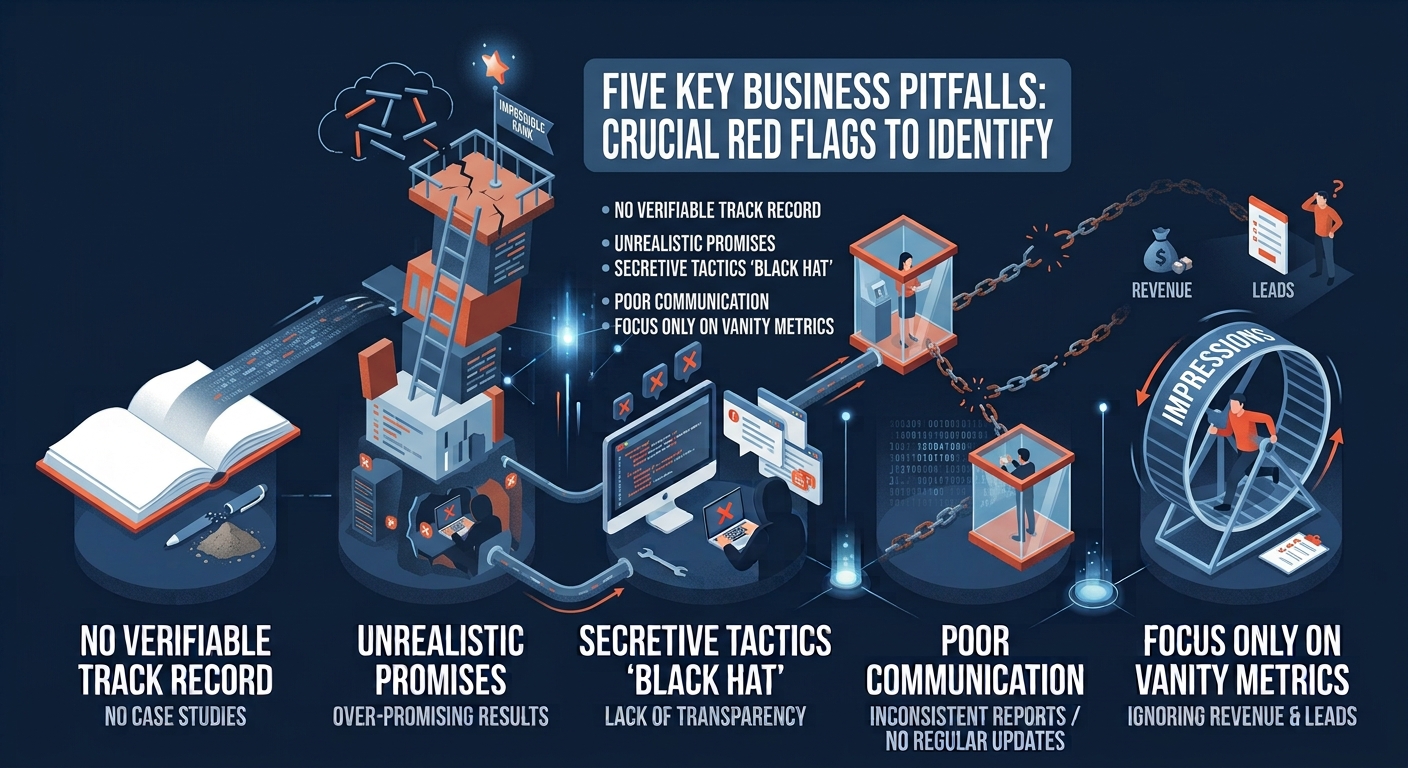
The following warning signs can help you identify questionable service providers before you commit to a long-term agreement. One warning sign alone does not automatically prove that a consultant is unsuitable, but repeated patterns of unrealistic claims, secrecy, poor communication, and unsupported promises deserve careful attention.
Guaranteed Google Rankings
One of the clearest warning signs is a consultant who guarantees that your website will reach the first position on Google or achieve a specific ranking within a fixed period. Search rankings depend on numerous factors, including competition, search intent, website quality, technical accessibility, content relevance, and changes in search systems that no independent consultant completely controls.
A professional SEO consultant can establish targets, explain opportunities, and develop a plan to improve your website’s search performance. However, they cannot honestly guarantee a particular organic ranking for every keyword because search engines determine which results appear and how those results change over time.
Why Ranking Guarantees Are Misleading
A consultant might promise to rank your business first for a particular keyword without explaining whether that keyword attracts potential customers or has meaningful search demand. In some cases, the promised keyword may be so specific or uncommon that ranking for it provides little commercial value.
For example, ranking first for a highly specific phrase that almost nobody searches may contribute less to business growth than improving visibility for several relevant commercial keywords. A trustworthy consultant explains the relationship between keyword opportunities, search intent, competition, and your broader marketing objectives rather than focusing exclusively on a single ranking position.
Another concern is that some providers may attempt to achieve promised results through risky tactics. Artificial backlinks, manipulative redirects, doorway pages, or other spam techniques can create problems if they violate search engine policies, making a short-term ranking improvement a poor substitute for sustainable performance.
What a Reliable Consultant Should Promise
Instead of guaranteeing rankings, a qualified professional should describe the work they intend to complete and the outcomes they aim to improve. These outcomes may include resolving technical SEO problems, improving relevant landing pages, increasing qualified organic traffic, expanding keyword visibility, or generating more valuable inquiries.
A consultant should also explain how progress will be monitored and what factors could affect the results. Look for realistic expectations, clear reporting, and a willingness to discuss uncertainty because these qualities indicate a more responsible approach to SEO.
Before accepting a proposal, ask the consultant how they define success beyond ranking positions. Their answer should demonstrate an understanding of your business goals and include measurable indicators that can be reviewed throughout the engagement.
Unrealistic Promises of Instant Results
Another major red flag is a consultant who promises dramatic organic traffic growth within a few days or claims that your website will dominate competitive search results almost immediately. SEO often requires technical improvements, content development, competitive analysis, and time for search engines to discover and evaluate changes.
The time required depends on your website’s current condition, industry competition, domain history, publishing frequency, and the quality of the strategy. Some improvements may produce relatively quick benefits, particularly when fixing significant technical issues, but substantial growth for competitive keywords generally requires a more sustained effort.
Why Sustainable SEO Takes Time
Search engines need to discover pages, crawl accessible content, understand its relevance, and determine how it compares with other available results. Even after a consultant makes improvements, ranking changes may take time to appear, and the results can fluctuate as competitors update their websites and search systems evolve.
A newly launched website may require more foundational work than an established business website with useful content and existing authority. Similarly, a local business targeting a narrow service area may have different opportunities from an online retailer competing nationally across thousands of product categories.
An honest consultant considers these differences when estimating timelines. They should explain which improvements can be completed during the initial phase, which outcomes may take longer, and how the strategy will adapt according to observed performance.
How to Recognize False Urgency
Be cautious when a consultant insists that you must sign a contract immediately to secure a guaranteed ranking opportunity or avoid an invented search engine penalty. High-pressure sales tactics can prevent business owners from comparing proposals, checking references, or understanding what they are purchasing.
Some providers may also present unusually short timelines without examining the website or understanding the competitive landscape. If someone promises major results before conducting even a basic assessment, ask them to explain the assumptions behind their estimate and what evidence supports their claims.
A better approach is to request a preliminary assessment, a list of priorities, and a realistic explanation of the expected work. You should be able to understand what the consultant intends to accomplish without feeling pressured into making a rushed financial decision.
Lack of Transparency About SEO Strategies
Transparency is an important part of a successful relationship between a business owner and an SEO consultant. If a consultant refuses to explain their methods, provides vague descriptions of monthly activities, or insists that their entire strategy must remain secret, you should investigate further before hiring them.
Professional SEO work can involve specialized technical knowledge, but the overall approach should still be understandable to the client. You do not need to know every technical detail to make a hiring decision, yet you should understand what the consultant will do, why those activities matter, and how their impact will be evaluated.
Warning Signs of Secretive SEO Work
A questionable consultant might repeatedly use phrases such as advanced ranking techniques or proprietary optimization methods without explaining the practical work involved. They may also refuse to provide meaningful updates about content production, backlink acquisition, technical changes, or the progress of agreed tasks.
Another concern arises when a consultant makes substantial website changes without explaining their purpose or requesting appropriate approval. Unnecessary modifications to important pages, navigation, redirects, or metadata can affect the user experience and create avoidable technical problems.
Businesses should also be cautious when consultants cannot explain where backlinks originate or how content is developed. Although some commercial information may be confidential, clients should still receive enough information to assess whether the work is relevant, ethical, and consistent with the agreed strategy.
What Transparency Should Look Like
A reliable consultant should be able to explain their recommendations in clear language and provide an organized plan of action. Their proposal should identify the major work areas, expected deliverables, reporting arrangements, and responsibilities of both parties.
For example, if a consultant recommends creating new service pages, they should explain which customer needs those pages address, what search intent they target, and how the pages fit into the website structure. If they recommend link building, they should describe the quality standards they use to evaluate relevant websites and avoid manipulative practices.
You should also receive regular updates about completed tasks, ongoing work, challenges, and planned improvements. Transparent communication helps you understand how your investment is being used and makes it easier to identify problems before they affect your business.
Extremely Cheap SEO Packages
An unusually cheap SEO package can seem attractive, particularly for small businesses with limited marketing budgets. However, a low price becomes a warning sign when the provider promises extensive work, rapid results, large quantities of backlinks, and comprehensive reporting without explaining how those services can be delivered at the advertised cost.
SEO requires research, analysis, content planning, technical evaluation, implementation, and ongoing monitoring. When a provider charges a very small amount for an extensive list of services, it is worth examining whether the promised work will actually be completed to an acceptable standard.
The Risks of Underpriced SEO Services
Some inexpensive providers rely on automated reports, duplicated content, irrelevant backlinks, or generic optimization tasks that are not tailored to individual businesses. These activities may produce regular deliverables on paper while failing to address the website’s actual problems or opportunities.
For instance, receiving a monthly spreadsheet containing hundreds of backlinks does not necessarily mean your website is gaining useful authority. If the links come from unrelated, low-quality, or manipulative sources, they may offer little value and could create risks depending on the methods used.
Low-cost services can also exclude essential work such as technical SEO audits, conversion analysis, content improvements, and meaningful strategy development. A business may eventually need to pay another professional to correct poor implementation or rebuild a strategy that never addressed its original objectives.
How to Evaluate SEO Pricing
Rather than judging a consultant solely by their price, compare the scope of work, level of expertise, expected deliverables, communication arrangements, and reporting standards. A smaller engagement with a qualified consultant may be more useful than an inexpensive package that promises everything but delivers little meaningful improvement.
Ask providers to explain what is included in their fees and which services require additional payment. You should understand whether the price covers strategy, technical recommendations, content writing, website implementation, link acquisition, local SEO, and ongoing performance analysis.
A professional consultant should be comfortable explaining how their proposed work fits your budget and priorities. If the price appears unusually low, request a detailed breakdown before making a commitment rather than assuming that the cheapest offer provides the best value.
No Proven Experience or Relevant Case Studies
An SEO consultant does not necessarily need to have worked with hundreds of companies to provide a valuable service. However, they should be able to demonstrate relevant knowledge, explain previous projects, or show credible examples of how they approach SEO challenges.
Be cautious when a provider claims extensive experience but cannot describe the types of websites they have worked on, the problems they addressed, or the methods they used to evaluate progress. A lack of evidence becomes particularly concerning when the consultant makes impressive claims about revenue growth, search rankings, or traffic improvements without offering any meaningful explanation.
Why Relevant Experience Matters
Different websites face different SEO challenges, and experience with a similar business model can help a consultant identify practical opportunities. An e-commerce website may need product-page optimization, category architecture, crawl management, and structured data, while a local contractor may need location-specific service pages, local search visibility, and a stronger reputation strategy.
A consultant who understands your industry may also recognize how customers research services, compare providers, and make purchasing decisions. This knowledge can improve keyword selection, content planning, and the way organic search activity is connected with lead generation.
However, industry experience should not be the only hiring criterion. A capable consultant should also demonstrate analytical thinking, ethical judgment, adaptability, and the ability to explain why a particular strategy suits your website.
How to Verify Previous Results
Ask the consultant to share case studies, sample audits, or anonymized examples of completed projects when client confidentiality prevents public disclosure. Useful evidence should explain the starting situation, the work performed, the timeframe, and the metrics used to evaluate the outcome.
For example, a case study might describe how technical improvements helped search engines access important pages or how content optimization increased qualified organic visits over several months. The consultant should distinguish their own contribution from other marketing activities and acknowledge factors that may have influenced the results.
You can also ask for professional references or a walkthrough of an actual SEO analysis. A consultant who can explain their decisions, limitations, and lessons learned may provide more convincing evidence of competence than someone who simply displays impressive ranking screenshots.
Remember that past performance does not guarantee future results. Use previous work to evaluate the consultant’s reasoning and experience, then determine whether their proposed approach is appropriate for your own business.
Black Hat SEO Techniques
Black hat SEO refers to tactics designed to manipulate search engine rankings in ways that violate or attempt to evade search engine spam policies. These practices can expose websites to ranking losses, removal from search results, or other negative consequences, depending on the techniques used and the search engine’s response.
A consultant who recommends shortcuts without discussing their risks may be prioritizing temporary improvements over your business’s long-term interests. Before hiring anyone, understand the common practices that should raise concerns and ask how the consultant ensures that their work follows applicable search engine guidelines.
Common Black Hat SEO Warning Signs
Keyword stuffing is one example of a questionable technique that involves repeating target phrases unnaturally to influence rankings. It can make website content difficult to read and reduce its usefulness for customers who need clear information before contacting a business.
Another concern is manipulative link building, including buying links intended to pass ranking credit or participating in link schemes that violate search engine policies. While not every paid placement is prohibited, links that are arranged primarily to manipulate rankings can create risks when they fail to meet applicable guidelines.
Other warning signs include cloaking, deceptive redirects, automatically generated doorway pages, and publishing large volumes of low-value content solely to attract search traffic. These techniques can undermine user trust and make it harder to establish a sustainable organic presence.
Why Ethical Optimization Is a Better Choice
Ethical SEO focuses on making your website more useful, accessible, relevant, and trustworthy for the people you want to reach. It includes improving page quality, fixing technical issues, creating original and helpful content, strengthening internal links, and earning relevant editorial attention through legitimate methods.
These activities do not guarantee rankings, but they provide a more defensible foundation for long-term growth. They also support other business goals by helping visitors find accurate information, understand your services, and navigate your website more easily.
Before agreeing to an SEO strategy, ask the consultant to explain how they approach content creation, link building, technical changes, and compliance with search engine spam policies. If their answers rely on secrecy, manipulation, or guaranteed results through artificial methods, consider it a serious warning sign.
Poor Communication and Reporting
SEO requires collaboration between the consultant and the business owner, particularly when recommendations involve website development, content approval, marketing campaigns, or changes to important landing pages. A consultant who communicates poorly can delay implementation, create confusion, and leave you uncertain about how your investment is being used.
Communication problems may appear before the contract is signed, making the initial consultation an important opportunity to assess professional reliability. If a provider frequently misses meetings, avoids direct questions, or takes an unreasonable amount of time to respond without explanation, consider how these habits could affect a longer engagement.
Signs of Weak Client Communication
A questionable provider may send vague updates that repeat phrases such as SEO improvements are underway without identifying completed tasks or explaining what happens next. They may also avoid discussing disappointing results, ignore questions about spending, or blame every problem on search engine changes without providing supporting analysis.
Another warning sign is a consultant who reports only selected successes while refusing to discuss areas that require improvement. Effective SEO involves experimentation, monitoring, and adjustment, so a professional should be able to explain both positive developments and setbacks.
You should also be concerned if a consultant changes the agreed scope of work without communicating the reasons or obtaining appropriate approval. Clear expectations help prevent misunderstandings and make it easier to evaluate whether the services being delivered match the original proposal.
What Professional Reporting Should Include
Useful SEO reports should explain the work completed, the performance trends observed, the problems identified, and the actions planned for the next reporting period. Depending on your business goals, relevant metrics may include organic clicks, impressions, qualified traffic, keyword visibility, conversion rates, leads, and revenue attributed to organic search.
A report should not simply display numbers without explaining their significance. For example, an increase in website visits may appear positive, but the consultant should help you determine whether the additional traffic is relevant to your target audience and whether it contributes to meaningful business outcomes.
Ask how often reports will be delivered, which tools will be used, and whether the consultant will explain the findings during regular review meetings. Consistent communication and useful reporting allow you to make better decisions and identify whether the strategy needs adjustment.
No Customized SEO Strategy
A generic SEO package that looks identical for every client may indicate that the consultant is relying on routine tasks instead of analyzing your business’s actual needs. Although certain SEO fundamentals apply to most websites, the priorities, competition, audience, and available opportunities vary significantly between businesses.
A professional consultant should understand your objectives before recommending a detailed strategy. They should consider your target customers, geographic coverage, existing search performance, website condition, competitors, and the resources available to implement improvements.
Why Copy-and-Paste Strategies Often Fail
A small business targeting customers in Fresno may need a different approach from a company offering specialized services throughout Los Angeles and Orange County. Similarly, a business that receives traffic but few inquiries may need improvements to its landing pages and conversion process, while a newer website may require more foundational work involving indexing, site architecture, and content development.
Applying the same keyword list, publishing schedule, backlink targets, and technical recommendations to every website can lead to wasted effort. A consultant may spend time optimizing pages that already perform well while overlooking more important issues that prevent the business from attracting suitable customers.
Generic strategies can also ignore differences in customer behavior and search intent. Someone searching for general information may not be ready to purchase, while someone searching for a specific service and location may be much closer to making a decision.
How to Identify a Tailored Approach
A reliable consultant should begin by asking questions about your services, ideal customers, competitive advantages, marketing objectives, and existing challenges. They should also review your website and available performance data before deciding which activities deserve priority.
Their proposal should explain why specific keywords, pages, technical improvements, or content topics matter for your business. It should also identify the expected deliverables, the order of implementation, and how the consultant intends to measure progress.
Before hiring a provider, ask them to describe the first few priorities they would investigate on your website and explain the reasoning behind those recommendations. A thoughtful response demonstrates that the consultant is considering your business as an individual project rather than treating it as another standard package.
Overreliance on AI-Generated Content
Artificial intelligence tools can support SEO research, content planning, outlining, editing, and other marketing tasks when they are used carefully. However, a consultant who relies heavily on automated content production without meaningful review may publish material that is repetitive, inaccurate, generic, or insufficiently useful for your audience.
The central concern is not simply whether AI has been used to create content. The more important questions are whether the content is accurate, original in its presentation, helpful to readers, and aligned with the website’s purpose and search engine guidance.
Why Low-Quality Content Can Be a Problem
Publishing large numbers of pages without adding meaningful value can make a website less useful and consume resources that could be spent improving existing content. If pages repeat the same information, provide shallow answers, or target nearly identical search terms, they may struggle to serve distinct user needs.
For example, a consultant might create dozens of location pages for a California service business by changing only the city name while leaving the rest of the text almost identical. If those pages offer no meaningful local information or unique value, they may provide a poor experience and could fall under doorway abuse or other spam concerns depending on how they are created and used.
Automatically generated material can also contain incorrect statements, unsupported claims, or details that do not accurately reflect your services. These errors can damage credibility, especially when customers rely on your website to make purchasing decisions.
What Responsible Content Creation Looks Like
A responsible consultant uses automation as a supporting tool rather than a replacement for editorial judgment and subject knowledge. They should verify factual claims, review content for originality and usefulness, incorporate relevant expertise, and ensure that each page serves a clear purpose.
For California businesses, effective content may include detailed service explanations, answers to customer questions, practical comparisons, genuine project examples, and location-specific information where appropriate. These elements help differentiate a business from competitors and provide visitors with reasons to trust the information presented.
Ask the consultant how content is researched, reviewed, and approved before publication. If they propose publishing hundreds of pages in a short period without explaining quality control or the purpose of each page, request a more detailed content plan before proceeding.
Suspicious Backlink Building Practices
Backlinks are links from other websites that point to your website, and they can help search engines discover pages and understand relationships between online resources. However, not every backlink is valuable, and a large quantity of links does not automatically indicate authority, relevance, or improved search performance.
A consultant who focuses exclusively on backlink volume may be overlooking the quality and context that make link acquisition meaningful. You should understand where links come from, why they are being pursued, and whether the methods used align with search engine spam policies.
Warning Signs in Link Building
Be cautious when a provider promises thousands of backlinks for a very low fee or claims that every link will directly improve rankings. Such offers may involve automated submissions, irrelevant websites, link farms, or paid arrangements designed primarily to manipulate search results.
Another warning sign is a refusal to explain the sources of newly acquired links. Although consultants may not be able to control every editorial decision made by another website, they should be able to describe their outreach process, quality standards, and approach to evaluating potential link opportunities.
You should also question strategies that depend on unrelated websites with no meaningful connection to your business or audience. For example, a California accounting firm may gain little practical value from links placed on unrelated websites that exist mainly to sell backlinks.
How to Evaluate a Consultant’s Link Building Strategy
A responsible consultant should prioritize relevance, editorial quality, and legitimate opportunities to earn attention from appropriate websites. Depending on your business, this could involve useful original resources, industry partnerships, digital public relations, professional contributions, or genuinely valuable information that others choose to reference.
Ask how the consultant evaluates potential linking websites and whether they avoid schemes intended to manipulate rankings. They should be able to explain their methods without promising a particular ranking improvement for every link acquired.
It is also important to understand that not every low-quality link requires immediate removal or a disavowal request. Search engines often ignore many irrelevant links, and unnecessary disavowal work can waste time; decisions should be based on a careful assessment of the situation rather than fear-based sales claims.
A thoughtful backlink strategy supports your broader SEO objectives instead of treating link quantity as the only measure of success. Choose a consultant who can explain how link acquisition fits into content quality, brand credibility, and sustainable search visibility.
No Technical SEO Knowledge
Technical SEO helps search engines discover, crawl, understand, and index the important pages on your website. A consultant who focuses only on keywords and content while ignoring technical problems may overlook issues that prevent your website from performing well in organic search.
California businesses operating e-commerce stores, service websites, and large content platforms may face different technical challenges. These can include slow-loading pages, broken internal links, incorrect redirects, duplicate URLs, indexing problems, mobile usability issues, and poorly organized website structures.
Why Technical SEO Matters
Even excellent content may struggle to attract organic traffic if search engines cannot access or index the relevant pages properly. For example, an important service page might be blocked from crawling, accidentally marked with a noindex directive, or excluded from the XML sitemap when it should be available in search results.
Website performance also influences the experience visitors have when browsing your business online. Slow pages, confusing navigation, and unstable layouts can frustrate users and make it harder for them to find information, submit inquiries, or complete purchases.
A competent consultant should understand how to investigate these issues and determine which ones deserve attention first. They should also recognize when a problem requires support from a web developer, particularly when the solution involves code, server configuration, complex redirects, or a content management system.
Warning Signs of Limited Technical Expertise
Be cautious if a consultant cannot explain basic technical SEO concepts or claims that every website problem can be solved simply by adding keywords. Another concern is receiving automated audit reports without any explanation of which findings are important or how they affect your website.
Technical audit tools can identify possible problems, but not every warning requires immediate action. A qualified consultant should interpret the findings, prioritize meaningful issues, and explain the potential consequences of leaving them unresolved.
Before hiring someone, ask how they investigate crawling and indexing, website speed, canonical tags, redirects, mobile usability, and structured data where relevant. Their answers should demonstrate practical understanding rather than an ability to repeat technical terminology.
Ignoring Local SEO Opportunities
Local SEO is particularly important for California businesses that serve customers within specific cities, neighborhoods, or geographic service areas. A consultant who ignores local search visibility may miss opportunities to connect your business with people looking for nearby services and businesses.
For example, a dental clinic in San Diego, a restaurant in Sacramento, or a home improvement company in Oakland may benefit from appearing for relevant local searches. Their strategies may involve improving location-specific website pages, maintaining accurate business information, managing customer reviews, and optimizing their Google Business Profile when eligible.
Why Local Search Visibility Matters
People frequently search for services using location-based phrases or expect search engines to show businesses near them. Your website should therefore communicate where you operate, which services you provide, and why your business is relevant to the customers you want to attract.
Local SEO involves more than adding a city name to every page. Search engines may consider relevance, distance, and prominence when presenting local results, and businesses cannot control every factor influencing those results.
A useful strategy combines accurate business information, relevant service pages, consistent contact details, genuine customer reviews, and a positive website experience. The exact priorities depend on your business model, service area, and the competition in your target market.
Red Flags in Local SEO Services
One warning sign is a consultant who promises guaranteed placement in the Google Maps results or claims they can make your business appear at the top for every city in California. Local search results vary according to the searcher’s location, query, competition, and other factors, so these promises should be treated cautiously.
Another concern is creating numerous nearly identical location pages that provide no useful information about the places they target. A consultant may also recommend fake business listings, fabricated reviews, or misleading business addresses, all of which can create serious problems for your business.
Ask the consultant how they plan to improve local visibility and which activities are appropriate for your business. A reliable professional should explain the role of your Google Business Profile, local landing pages, customer reviews, business information consistency, and relevant local content without promising outcomes beyond their control.
Refusing to Share Account Access or Ownership
Your website, domain name, analytics properties, and business listings are important digital assets. If an SEO consultant controls these accounts without providing appropriate access or refuses to explain who owns them, you could experience serious difficulties when changing providers or managing your business independently.
A professional relationship should make it easier to manage your online presence, not create unnecessary dependence on one individual or company. You should understand which accounts are used, who administers them, and how access will be maintained if the engagement ends.
Why Account Ownership Matters
Google Search Console provides information about your website’s presence in Google Search, while Google Analytics can help you understand how visitors interact with your website. Your domain registrar, website hosting account, content management system, and Google Business Profile may also be essential to maintaining your online operations.
If these assets are registered under a consultant’s personal account without suitable arrangements, you may struggle to retrieve information or regain control later. The risk becomes more serious if the consultant stops responding, closes their business, or disputes the terms of your agreement.
Business owners should generally retain ownership of their core digital assets while granting consultants the permissions necessary to perform their work. This arrangement supports accountability and reduces the risk of losing access when a working relationship changes.
How to Protect Your Business
Before hiring a consultant, confirm that you or your organization can access the essential accounts associated with your website and marketing activities. Use appropriate permission levels rather than sharing passwords unnecessarily, and maintain secure recovery options for important accounts.
Ask whether the consultant will work within your existing tools or create new accounts on your behalf. If new accounts are required, make sure ownership, administrator access, data handling, and the transfer process are clearly documented.
A trustworthy consultant should have no reasonable objection to an arrangement that protects your ownership of business assets. If they insist that your website data, domain, or business listing must remain exclusively under their control, consider this a significant warning sign and resolve the issue before proceeding.
No Clear Contract or Defined Deliverables
An SEO agreement should explain what the consultant will provide, how the work will be delivered, how fees will be calculated, and how either party can end the relationship. When these details are missing, businesses may face misunderstandings about responsibilities, deadlines, payments, and the actual scope of work.
Verbal promises can be difficult to evaluate when expectations differ later. A written agreement provides a practical reference point for determining whether the consultant has completed the agreed work and whether additional services require separate approval.
What a Professional SEO Agreement Should Include
A clear contract should describe the services being provided, such as technical audits, keyword research, content optimization, local SEO, reporting, or strategic consulting. It should also explain whether implementation is included or whether the consultant will only provide recommendations for your internal team or web developer.
Payment arrangements should be equally clear, including setup fees, monthly retainers, hourly charges, payment dates, and any additional expenses. If the consultant uses third-party writers, development services, or outreach providers, the agreement should clarify how those costs are handled and who approves them.
The contract should also identify reporting frequency, communication expectations, access requirements, confidentiality provisions, and termination procedures. Depending on the engagement, it may be helpful to define how website changes, content drafts, analytics data, and completed work will be handed over when the contract ends.
Contractual Warning Signs
Be cautious if the consultant refuses to provide written terms, changes the scope without agreement, or pressures you into a lengthy commitment before explaining the deliverables. Vague phrases such as comprehensive SEO optimization are insufficient when there is no explanation of what the service actually includes.
Another concern is a contract that makes it difficult to cancel services or retrieve business assets after termination. Some SEO engagements legitimately require several months of consistent work, but that does not remove the need for clear expectations and reasonable contractual terms.
Before signing, review the proposal carefully and ask for clarification about any unfamiliar terms. If the agreement involves significant spending, unusual restrictions, or complicated ownership provisions, consider obtaining appropriate professional advice before making a commitment.
Misleading Reports and Vanity Metrics
SEO reporting should help business owners understand whether their marketing investment is producing meaningful progress. A consultant who focuses entirely on impressive-looking numbers may make a campaign appear successful even when it generates little qualified traffic or contributes almost nothing to business objectives.
Vanity metrics are measurements that may look positive but have limited value when considered without context. Examples can include raw traffic increases without audience quality, large backlink counts without relevance, or rankings for keywords that rarely attract potential customers.
Understanding Meaningful SEO Metrics
Organic clicks and impressions can help you understand how your website performs in Google Search. However, these measurements should be interpreted alongside relevant landing pages, search intent, conversion activity, and changes in the overall business environment.
For a service business, meaningful outcomes may include qualified inquiries, phone calls, appointment requests, or completed lead forms. For an online store, useful measurements may include organic revenue, product purchases, conversion rates, and the performance of important product and category pages.
A consultant should also explain when results are uncertain or when additional time is required to evaluate an improvement. For example, a recent website redesign or seasonal demand change may influence traffic, making it important to compare suitable periods and investigate the reasons behind significant changes.
How to Recognize Misleading Reports
A warning sign is receiving reports that contain numerous charts but no clear explanation of what happened during the reporting period. If the consultant cannot connect completed tasks with observed performance or explain why certain metrics changed, the report may offer limited value.
You should also be cautious when a provider highlights only positive data and refuses to discuss declining traffic, unsuccessful experiments, or missed targets. Honest reporting acknowledges challenges and identifies the next steps required to address them.
Before hiring, ask for a sample report with confidential information removed. Check whether it explains completed work, important performance trends, business outcomes, outstanding problems, and the priorities planned for the following period.
Using Fear-Based Sales Tactics
Some consultants attempt to win clients by creating unnecessary fear about website performance, competitors, or search engine penalties. They may claim that your business will disappear from Google unless you purchase an expensive service immediately, even when they have not performed a meaningful audit.
Urgency can sometimes be justified when a website has a genuine security issue, a major indexing problem, or a serious technical error. However, a credible consultant should explain the evidence, the possible consequences, and the recommended solution instead of relying on frightening statements to pressure you into purchasing services.
Common Fear-Based Tactics
One warning sign is receiving a message claiming that your website has thousands of critical errors without any explanation of which issues matter. Automated tools can identify numerous potential problems, but the number of warnings alone does not establish the severity of the situation.
Another tactic involves claiming that a competitor is using secret SEO methods and that your business must immediately purchase a premium package to remain competitive. Competitive analysis can identify useful opportunities, but it should be based on observable evidence and realistic recommendations.
Some providers may also exaggerate the consequences of minor technical issues or insist that a website requires a complete rebuild before any SEO improvements can begin. Major redesigns may occasionally be appropriate, but the recommendation should follow a proper assessment of the website and its business needs.
How to Respond to Pressure
Ask the consultant to provide evidence supporting their claims and explain which problems require immediate attention. Request a written breakdown of the recommended work, the likely risks of delaying it, and any reasonable alternatives that may be available.
You can also seek an independent second opinion before approving expensive or urgent work. Comparing assessments from qualified professionals can help you distinguish genuine technical concerns from exaggerated sales claims.
A reliable SEO consultant should help you make informed decisions rather than use fear to control them. If the provider refuses to explain their recommendations or repeatedly pressures you to pay immediately, consider working with someone who communicates more professionally.
Warning Signs at a Glance
When comparing SEO consultants in California, it helps to organize your observations into a practical evaluation framework. The following table summarizes common warning signs, the risks they may indicate, and the actions you can take before deciding whether to hire a provider.
| Red flag | Potential risk | Recommended action |
|---|---|---|
| Guaranteed first-page rankings | Unrealistic expectations or risky methods | Ask for realistic goals and measurable targets |
| Promises of instant results | Misleading timelines and possible shortcuts | Request a strategy with phased milestones |
| Secretive SEO methods | Limited accountability and unclear work | Ask for clear explanations and deliverables |
| Extremely cheap packages | Inadequate work or low-quality services | Compare scope, expertise, and actual value |
| No credible case studies | Unverified experience or exaggerated claims | Request examples, references, or sample audits |
| Black hat techniques | Search engine spam actions or ranking losses | Confirm that methods follow applicable guidelines |
| Poor communication | Delays and unresolved problems | Establish reporting and communication expectations |
| Generic SEO strategies | Missed opportunities and wasted resources | Request a website-specific action plan |
| Low-quality AI content | Unhelpful pages and potential spam concerns | Review editorial standards and content quality |
| Suspicious backlinks | Artificial link patterns and wasted spending | Ask about link sources and acquisition methods |
| Weak technical knowledge | Important crawling or indexing issues overlooked | Request a technical assessment |
| Ignoring local SEO | Missed opportunities in relevant local searches | Review the proposed local search strategy |
| Restricted account access | Loss of control over digital assets | Retain ownership and suitable administrator access |
| Unclear contracts | Disputes over fees and deliverables | Obtain written terms before starting |
| Misleading reports | Poor decisions based on incomplete information | Focus on qualified traffic and business outcomes |
| Fear-based sales pressure | Unnecessary spending and rushed decisions | Request evidence and compare independent opinions |
The table should be used as a decision-making aid rather than an automatic rejection checklist. A consultant may have a reasonable explanation for an individual concern, but several warning signs occurring together should encourage you to investigate more carefully before committing your budget.
Questions to Ask Before Hiring an SEO Consultant
A consultation is an opportunity to evaluate how a provider thinks, communicates, and approaches business challenges. Asking focused questions can reveal whether the consultant understands your needs and has a practical process for improving your website’s organic performance.
You do not need to be an SEO specialist to assess the answers. Look for explanations that are clear, supported by evidence, and connected to your business goals rather than responses that depend entirely on technical jargon or exaggerated promises.
Questions About Strategy and Experience
Start by asking how the consultant would assess your website and determine which SEO opportunities deserve priority. A thoughtful answer should include research, technical evaluation, competitor analysis, search intent, and an understanding of the customers you want to attract.
Ask for examples of similar projects and how the consultant measured their outcomes. Their explanation should distinguish completed tasks from results, acknowledge the limitations of the available evidence, and demonstrate how lessons from previous work could inform your campaign.
You should also ask which activities they would prioritize during the initial phase of the engagement. This question can reveal whether they understand how to identify important problems instead of simply applying a standard checklist to every client.
Questions About Methods and Reporting
Ask how the consultant approaches link building, content creation, technical optimization, and local SEO when those services are relevant to your business. Their answers should demonstrate an understanding of ethical practices, quality control, and the importance of tailoring work to specific objectives.
Find out which metrics they track and how they distinguish qualified traffic from visits that are unlikely to produce business value. You should also ask how frequently they report results, what the reports contain, and how they respond when performance does not meet expectations.
Finally, ask what access they need, who will implement website changes, and how you can retrieve your data and completed work if the relationship ends. Clear answers to these questions help establish a professional arrangement with appropriate accountability.
Evaluating the Answers You Receive
A strong consultant should be comfortable explaining their approach without promising outcomes they cannot control. They should be willing to discuss challenges, identify limitations, and explain why certain activities are more important than others.
Be cautious if a provider avoids direct questions, repeatedly changes the subject, or makes claims that cannot be supported with evidence. An unwillingness to explain basic deliverables or account arrangements may indicate problems that become more difficult to resolve after a contract is signed.
After each consultation, compare the answers against the proposal and your business objectives. A structured evaluation makes it easier to choose a provider based on professional capability, communication, and value rather than sales confidence alone.

How to Verify an SEO Consultant’s Credibility
Before hiring an SEO consultant in California, take time to verify their professional background, evaluate their previous work, and understand how they approach client relationships. A polished website and confident sales presentation can create a positive first impression, but reliable evidence, transparent communication, and a clear strategy provide a stronger basis for making your decision.
Review Case Studies and Previous Work
Ask potential consultants to share case studies, sample SEO audits, or examples of projects that demonstrate their approach to improving website performance. Strong examples should explain the original challenges, the actions taken, the timeframe involved, and the outcomes measured rather than simply displaying screenshots of high rankings.
Pay attention to whether the examples relate to your business model, target audience, and competitive environment. A consultant who has experience with similar websites may understand your challenges more quickly, although professionals with different industry backgrounds can also demonstrate valuable analytical and technical skills.
Check References and Professional Communication
Where possible, ask for references from previous or existing clients who can discuss their experience working with the consultant. Focus on practical questions about communication, reliability, reporting quality, strategic thinking, and whether the consultant completed the work agreed upon.
You can also assess credibility through the initial consultation. A reliable professional should listen to your business needs, ask relevant questions, explain recommendations clearly, and acknowledge that SEO results depend on several factors beyond their direct control.
Evaluate the Quality of Their Audit
An SEO audit can reveal how a consultant approaches problem-solving and prioritizes improvements. A useful audit should identify relevant technical issues, content opportunities, search visibility gaps, and potential improvements based on your website’s condition and business objectives.
Be cautious if the consultant provides an automated report filled with warnings but offers no explanation of which issues matter most. The ability to interpret data, distinguish urgent problems from minor observations, and recommend practical solutions is more valuable than simply generating a long list of technical findings.
How Much Should California Businesses Expect to Pay?
The cost of hiring an SEO consultant in California varies according to experience, project complexity, industry competition, service scope, and the amount of work required. A consultant providing occasional strategic advice will generally have different pricing from a professional responsible for technical audits, content optimization, local SEO, ongoing analysis, and coordination with a development team.
Businesses should compare proposals based on the value and relevance of the services offered rather than selecting the lowest price automatically. A reasonably priced engagement with clearly defined priorities may provide better value than a cheap package filled with generic tasks that do not address the website’s most important challenges.
Understanding Common SEO Pricing Models
SEO consultants may charge hourly fees, fixed project fees, or monthly retainers depending on the nature of the engagement. Hourly consulting can be useful when you need expert guidance or targeted problem-solving, while project-based pricing may suit a technical audit, website migration assessment, or defined optimization project.
Monthly retainers are often used when a business needs ongoing strategic support, regular performance reviews, content planning, and continuous optimization. However, a monthly fee does not automatically indicate the quality of the service, so you should understand the exact work included before comparing offers.
The following table provides illustrative budgeting ranges in US dollars for planning purposes. These figures are not verified current market averages, and actual California consulting fees can fall outside these ranges depending on the provider, location, and project requirements.
| SEO service type | Illustrative pricing range | Potential use |
|---|---|---|
| Hourly SEO consulting | $75 to $250 per hour | Strategic advice and targeted problem-solving |
| Basic SEO audit | $500 to $2,000 per project | Identifying website issues and improvement priorities |
| Comprehensive SEO audit | $2,000 to $7,500 or more per project | Detailed technical, content, and competitive analysis |
| Small business SEO retainer | $750 to $2,000 per month | Focused ongoing optimization and reporting |
| Competitive SEO campaign | $2,000 to $5,000 or more per month | More extensive strategy, content, and optimization work |
| Specialized enterprise consulting | $5,000 or more per month | Complex websites and demanding technical requirements |
How to Compare Pricing and Value
When comparing proposals, check whether the fees include research, recommendations, implementation, content writing, developer coordination, and reporting. Some consultants provide strategic guidance only, meaning your internal team must carry out the recommendations separately.
Ask each provider to identify the deliverables, estimated timeframes, additional expenses, and responsibilities that fall outside the quoted price. This makes it easier to compare services fairly and reduces the possibility of unexpected costs after the engagement begins.
You should also avoid assuming that a higher price guarantees better results. A qualified consultant should be able to explain why their services cost what they do and how the proposed work supports your business goals, while respecting the limits of your available budget.
Choosing an SEO Consultant for Your California Business
After identifying the warning signs and comparing potential providers, the next step is to select a consultant whose experience, methods, communication style, and services match your requirements. The right professional should understand your business priorities and provide a realistic plan for improving organic search performance without relying on misleading promises.
Define Your SEO Goals Before Hiring
Start by identifying what you want SEO to achieve for your business. Your priorities may include increasing qualified organic traffic, generating more leads, improving local search visibility, increasing online sales, or resolving technical problems that affect website performance.
Clear objectives help you evaluate whether a consultant’s proposal is relevant to your needs. For example, a local service provider that wants more customer inquiries may benefit from location-specific landing pages and conversion improvements, while an e-commerce business may require product optimization and a better-organized category structure.
Compare Proposals Carefully
Request proposals from more than one suitable consultant when possible, and evaluate them using consistent criteria. Compare the proposed strategy, scope of work, experience, reporting process, pricing, communication arrangements, and contract conditions instead of focusing exclusively on the monthly fee.
Look for evidence that each consultant has investigated your website and understands your market. A detailed proposal should identify the major opportunities, explain the reasoning behind the recommendations, and establish how progress will be assessed over time.
Start With Clear Expectations
Before work begins, agree on the responsibilities of both parties, access requirements, approval processes, reporting frequency, and the deliverables expected during the initial phase. It is also useful to establish a baseline using available website performance data so that future changes can be evaluated more accurately.
SEO is an ongoing process, and the strategy may need adjustments as new information becomes available. A professional relationship should therefore include regular reviews, open communication, and a willingness to refine priorities when the evidence suggests that a different approach would better support your business.
Why Choose Dealmate for Your SEO Needs?
Choosing an SEO partner should involve more than comparing service prices or listening to promises about search rankings. Businesses need a partner who understands their objectives, communicates clearly, and approaches organic growth with a focus on useful work, responsible methods, and measurable progress.
Dealmate can be considered as an option when evaluating SEO support for your business, provided its actual services, experience, and working arrangements match your requirements. Before making a commitment, review the services it offers, request a clear proposal, and confirm that the team can explain how its approach will address your website’s specific challenges.
A Business-Focused Approach to SEO
An effective SEO strategy begins with an understanding of the business rather than a predetermined list of routine tasks. Your goals, audience, competitive environment, website condition, and available resources should influence which opportunities receive attention first.
When discussing your requirements with Dealmate, explain the outcomes that matter most to your business and ask how the proposed services would support them. A useful plan should connect keyword research, technical optimization, content development, and other relevant activities with your commercial objectives instead of treating rankings as the only measure of success.
Transparency and Practical Recommendations
Clear communication helps businesses understand what they are paying for and how the work contributes to their online presence. Before starting an engagement, ask Dealmate to outline the scope of work, reporting arrangements, account access requirements, fees, and any services that may involve additional costs.
You should also expect explanations of the recommendations being made, including the evidence supporting them and the limitations involved. These details make it easier to evaluate performance, discuss concerns, and decide whether the relationship continues to provide appropriate value.
Supporting Sustainable Search Visibility
Long-term SEO improvement generally requires ongoing attention to website quality, technical health, search intent, and the needs of potential customers. Rather than relying on guaranteed rankings or artificial shortcuts, businesses should prioritize a strategy that aims to improve the usefulness and discoverability of their online resources.
If Dealmate can demonstrate relevant expertise, transparent processes, realistic expectations, and a suitable strategy for your website, it may be worth including in your shortlist of potential providers. Make your final decision after reviewing the proposal, checking available evidence, and confirming that the services align with your budget and business goals.
Frequently Asked Questions
Can an SEO Consultant Guarantee First-Page Google Rankings?
No independent SEO consultant can honestly guarantee a specific organic ranking on Google because search results depend on competition, relevance, website quality, and other changing factors. A consultant can identify opportunities, establish measurable goals, and implement strategies intended to improve search visibility. Be cautious of providers who promise first place for competitive keywords within a fixed period. Choose a professional who explains realistic expectations and measures progress using meaningful business outcomes.
How Long Does SEO Take to Show Results?
SEO timelines vary according to your website’s condition, industry competition, existing authority, and the type of improvements required. Some technical corrections may produce noticeable changes relatively quickly, while building visibility for competitive keywords can take several months or longer. A reliable consultant should explain the expected stages of the campaign and identify which early indicators will be monitored. Avoid providers who promise dramatic organic growth within a few days without conducting a proper assessment.
What Are the Biggest Red Flags When Hiring an SEO Consultant?
Common warning signs include guaranteed rankings, unrealistic timelines, unclear strategies, suspicious backlinks, and a refusal to provide meaningful reports. You should also investigate consultants who cannot demonstrate relevant experience or who insist on controlling your business accounts exclusively. These behaviors can indicate poor accountability, inadequate expertise, or methods that expose your website to unnecessary risks. Evaluate the complete proposal and look for repeated warning signs before making a decision.
How Can I Tell Whether an SEO Consultant Uses Ethical Techniques?
Ask the consultant to explain their approach to keyword research, content creation, technical optimization, and backlink acquisition. A trustworthy professional should be able to describe their methods clearly and explain how they avoid manipulative practices that violate search engine spam policies. Request examples of previous work or a sample audit to evaluate their reasoning and quality standards. Be particularly cautious if the consultant relies on secrecy, artificial link schemes, or promises that sound too good to be true.
How Much Does an SEO Consultant Cost in California?
SEO consulting fees vary depending on experience, project complexity, competition, and the services included in the agreement. Some consultants charge hourly fees, while others offer fixed-price audits or ongoing monthly retainers. You should compare the actual deliverables, reporting arrangements, implementation support, and expertise provided rather than selecting a consultant solely because of the price. Request a written proposal and confirm whether additional expenses apply before signing a contract.
Should I Hire a Freelancer or an SEO Agency?
A freelancer may be suitable when your business needs direct access to one specialist, focused advice, or a smaller and more flexible engagement. An agency may be more appropriate when your project requires several disciplines, such as technical SEO, content production, web development, and digital public relations. However, the quality of the work depends on the individual professionals, their processes, and their understanding of your business. Compare experience, communication, costs, and service scope before deciding which arrangement suits your needs.
What Should an SEO Consultant Include in Monthly Reports?
A useful monthly report should explain completed tasks, organic search performance, important changes, outstanding issues, and the next priorities. Depending on your goals, it may include search clicks, impressions, qualified organic traffic, conversions, leads, and revenue measurements. The consultant should interpret the figures instead of simply presenting charts without context. Regular reporting should help you understand what is working, where improvement is needed, and how the strategy will be adjusted.
Can a Bad SEO Consultant Damage My Website?
Yes, inappropriate SEO practices can contribute to ranking losses, indexing problems, poor user experiences, and unnecessary website costs. Examples include manipulative link schemes, careless technical changes, duplicated low-value content, and incorrect redirects. Not every unsuccessful SEO campaign causes lasting damage, and some problems can be corrected when identified promptly. Protect your website by retaining ownership of important accounts, reviewing significant changes, and choosing a consultant who follows responsible practices.
How Do I Check an SEO Consultant’s Previous Results?
Ask for case studies, relevant work samples, anonymized audit examples, or client references that demonstrate the consultant’s approach. Review the original challenge, the actions taken, the timeframe, and the metrics used to evaluate performance. Where possible, ask how the consultant contributed to the outcome and whether other marketing activities influenced the results. Remember that previous success can provide useful evidence of experience, but it cannot guarantee the same outcome for your business.
When Should I Stop Working With an SEO Consultant?
Consider ending the engagement when the consultant repeatedly fails to deliver agreed work, refuses to communicate, uses questionable methods, or cannot provide meaningful explanations of their activities. Before making a final decision, review the contract, document your concerns, and give the provider an appropriate opportunity to address legitimate misunderstandings when practical. Ensure that you retain access to your website, analytics, Search Console, domain, and other business assets throughout the transition. If you change providers, request the necessary documentation and a clear handover so that ongoing SEO work can continue without avoidable disruption.
Conclusion
Hiring an SEO consultant in California is an important decision that can influence your website’s visibility, marketing efficiency, and long-term business growth. The right professional should understand your objectives, explain their methods, establish realistic expectations, and provide a clear plan for improving your online presence.
Watch for warning signs such as guaranteed rankings, unrealistic timelines, secretive techniques, suspicious backlinks, poor communication, misleading reports, and unclear contracts. These concerns do not all carry the same level of risk, but they should encourage you to ask questions, verify claims, and compare potential providers carefully before investing your budget.
A reliable consultant should prioritize ethical practices, relevant research, technical quality, helpful content, and measurable business outcomes. They should also respect your ownership of digital assets and provide regular explanations of the work being completed.
Before choosing a provider, define your goals, review available evidence, compare proposals, and make sure you understand the terms of the engagement. If you are considering Dealmate or another SEO service provider, verify its actual capabilities and confirm that its approach aligns with your needs.
Ultimately, successful SEO is not about finding someone who promises the fastest rankings or the lowest price. It is about building a professional partnership that supports sustainable search visibility, earns customer trust, and contributes to your business’s long-term success.